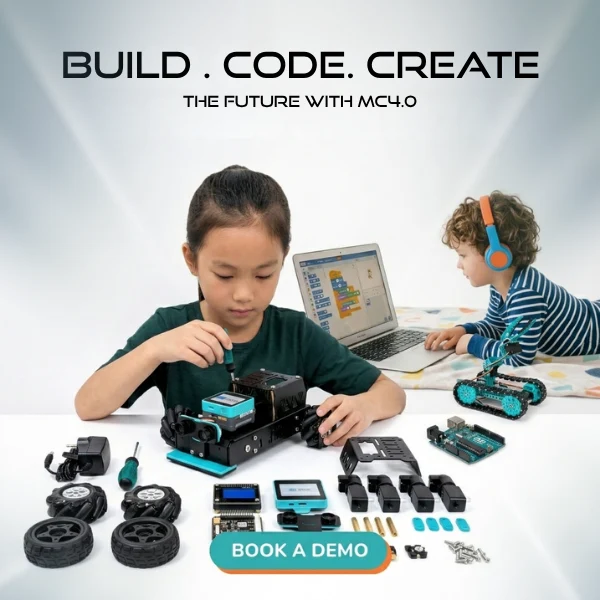
Most “educational” toys end up gathering dust in a closet because they offer five minutes of entertainment without a single hour of real learning. You’ve likely felt the frustration of seeing students master a closed-loop gadget only to hit a brick wall when it’s time to transition to real-world engineering. Choosing the right coding kit for kids shouldn’t feel like a gamble on a flashy toy. It should be a strategic investment in their future-readiness. We view technology as an accessible tool for creative expression, acting as a bridge between classroom curiosity and professional capability.
Professional-grade hardware must do more than just blink; it needs to integrate with a structured K-12 curriculum that empowers both the learner and the educator. You deserve a clear roadmap that scales from basic block-based logic to sophisticated Python and AIoT applications. Discover how to evaluate kits based on professional standards, curriculum alignment, and long-term educational impact. This guide provides the clarity you need to select tools that mirror industry standards, ensuring your students develop transferable skills that thrive in an AI-driven world.
Key Takeaways
- Distinguish between simple technical toys and professional education platforms that prioritize physical engineering alongside digital literacy.
- Learn how to select a coding kit for kids that features high-performance controllers capable of managing complex logic and sensor inputs.
- Evaluate educational value by focusing on curriculum-aligned pathways that ensure sequential growth rather than isolated, one-off projects.
- Discover how professional teacher training programs remove the technical barriers to implementing complex hardware in any learning environment.
- Prepare for the future of AIoT and STEAM by choosing modular hardware designed to scale from block-based logic to industry-standard coding.
Table of Contents
- Beyond the Toy Box: Why Your Choice of Coding Kit for Kids Matters in 2026
- The Essential Components of a Professional-Grade Coding Kit
- Evaluating Long-Term Educational Value: Curriculum vs. Projects
- Implementation: From Classroom to Home Environment
- Empowering Future Innovators with the Maker & Coder Ecosystem
Beyond the Toy Box: Why Your Choice of Coding Kit for Kids Matters in 2026
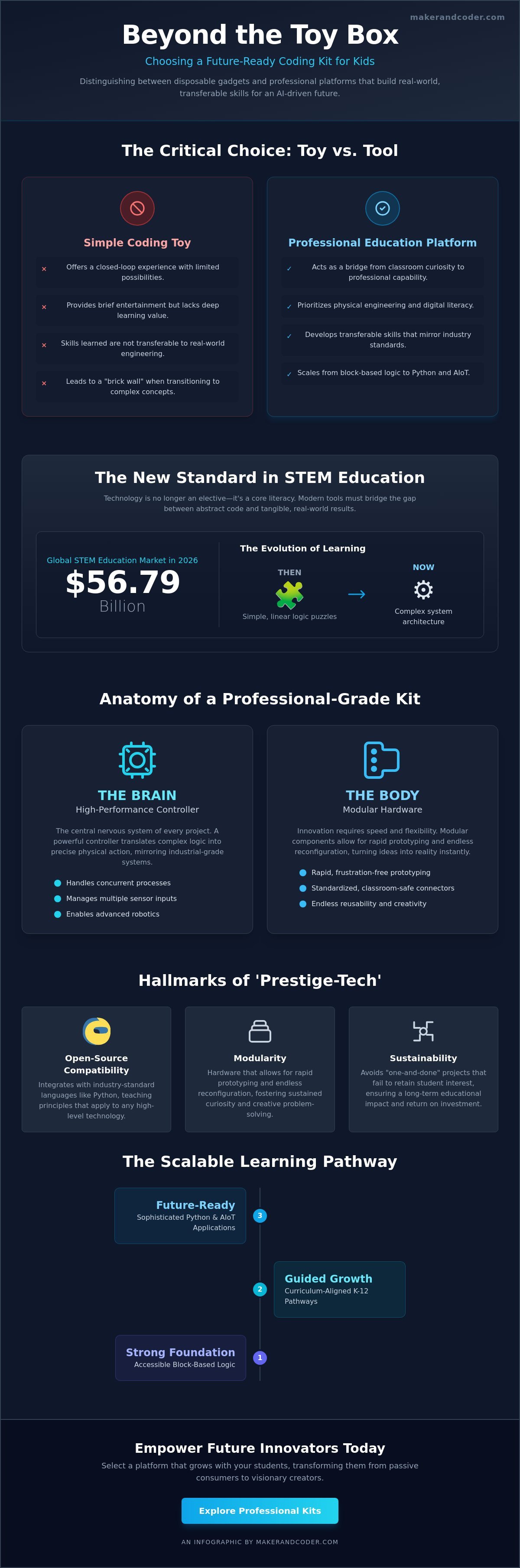
Selecting a coding kit for kids in 2026 requires a fundamental shift in perspective. We must look past the flashing lights of consumer toys and demand technical education platforms that offer genuine industrial relevance. A coding toy often provides a closed-loop experience; it entertains for a moment but lacks the depth to foster true innovation. In contrast, a technical education platform serves as a springboard, moving learners from passive consumers to visionary creators who understand the mechanics of the world around them. This is the “Expert-as-Enabler” philosophy in action: providing the tools and knowledge that transform a student’s curiosity into a tangible, functional reality.
The global STEM education market has surged to $56.79 billion in 2026, reflecting a society that no longer views technology as an elective but as a core literacy. Future-readiness is no longer a distant goal; it’s a present necessity. To meet this demand, kits must bridge the gap between abstract screen time and physical engineering. When a child builds a system that interacts with the physical world, they aren’t just learning to code. They’re learning to architect solutions for a complex, interconnected future.
The Evolution of STEM Learning
Traditional STEM tools often focused on simple logic puzzles and linear “if-then” scenarios. Today, the focus has shifted toward complex system architecture. Modern learning environments require modular hardware that can withstand the rigors of classroom use while offering the flexibility of professional prototyping tools. Systems like the MC 4.0 Kit represent this new standard. This transition allows students to receive tangible feedback, which is vital for cognitive development. When a line of code translates into the precise movement of a robotic arm or the activation of a sensor, the abstract becomes concrete, sparking a deeper level of engagement and understanding.
Identifying ‘Prestige-Tech’ vs. Plastic Gadgets
Distinguishing between professional-grade tools and disposable plastic gadgets is essential for long-term educational impact. High-quality kits are defined by their “prestige-tech” feel and industrial compatibility. Consider these hallmarks of a professional platform:
- Open-Source Compatibility: Tools that integrate with industry-standard languages like Python.
- Modularity: Hardware like MC Blocks that allows for rapid prototyping and endless reconfiguration.
- Sustainability: Avoiding “one-and-done” projects that fail to sustain student interest after the first build.
Kits that mirror industry standards respect the learner’s potential. They don’t just teach a specific software; they teach the logic and engineering principles that apply to any high-level technology. By investing in professional-grade components, educators and parents ensure that the learning journey doesn’t end when the box is empty, but rather begins a lifelong path of discovery and creation.
The Essential Components of a Professional-Grade Coding Kit
A high-caliber coding kit for kids must transcend basic circuitry to mirror the tools used in modern research and development labs. It requires a sophisticated architecture where hardware and software communicate with absolute precision. This begins with the “brain” of the operation: the microcontroller. Without a powerful controller, a kit is merely a collection of parts; with one, it becomes a platform for limitless discovery. We believe in providing hardware that respects the learner’s ambition, offering the same level of performance found in industrial systems.
The Power of the MC4.0 Controller
In a professional learning environment, the MC4.0 Controller serves as the central nervous system of every build. Unlike basic chips that manage only one task at a time, a high-performance microcontroller handles concurrent processes, allowing for advanced robotics that move, sense, and react simultaneously. This capability prepares students for the multi-threaded environments they will encounter in professional engineering and software development. The MC4.0 Controller is the robust foundation that translates complex logic into precise physical action across the entire STEM ecosystem.
Modular MC Blocks: Designing for Creativity
Speed is the ally of innovation. Modular MC Blocks utilize standardized connectors to ensure classroom efficiency, allowing students to spend more time on logic and less time troubleshooting loose wires or faulty breadboards. This snap-and-play modularity significantly reduces the barrier to entry for younger learners while providing the scalability needed for high school students. By moving from simple mechanical builds to complex AIoT systems, students experience a frictionless transition that keeps their creative momentum high. It turns the act of building into an intuitive process of discovery.
True literacy in 2026 involves understanding the “Internet of Things” and how data flows through a network. A professional-grade kit must move beyond simple LEDs and buzzers. It should integrate high-precision sensors that capture real-world environmental data such as light intensity, atmospheric temperature, or ultrasonic motion detection. When combined with built-in Wi-Fi and Bluetooth connectivity, these components allow students to build smart-city models or remote-monitoring systems that mirror industrial applications. This is where AIoT becomes a tangible reality rather than a buzzword, empowering students to collect and analyze data just like professional data scientists.
If you’re ready to see how these components integrate into a structured classroom setting, you can reach out to our team for a detailed demonstration of our professional-grade hardware.
Evaluating Long-Term Educational Value: Curriculum vs. Projects
Many kits boast about offering hundreds of individual projects, but a collection of one-off builds doesn’t equal a comprehensive education. There is a profound difference between a student who can copy a diagram and one who understands the underlying architectural logic. When selecting a coding kit for kids, you must look for a pedagogical framework that prioritizes sequential growth over isolated tasks. Project-based learning often results in “copy-paste” coding where the learner mimics a solution without grasping the “why.” Curriculum-aligned learning ensures that every lesson builds upon the last, transforming a spark of interest into a durable professional skill set.
A structured approach also serves a critical role in the classroom: it protects our most valuable resource—the teacher. Implementing complex hardware can be daunting, but a robust K-12 curriculum reduces preparation time and mitigates the risk of teacher burnout. By aligning hardware with recognized academic standards, schools can ensure that STEM time isn’t just an elective break, but a core component of cognitive development. This alignment provides a measurable roadmap for success, allowing educators to track student progress from foundational concepts to advanced systems engineering.
The K-12 MC Curriculum Advantage
The MC Curriculum (K-12) is designed to evolve alongside the learner. In primary stages, the focus remains on tactile exploration and basic logic using the MC4.0 Base Kit. As students progress into secondary school, the complexity increases, introducing variables, functions, and data structures. This pathway ensures that the hardware doesn’t become obsolete as the student grows. Instead, the same professional-grade components scale to meet higher intellectual demands, providing a consistent environment where assessment is based on genuine mastery rather than just completing a build.
From Block-Based Coding to Python Mastery
The journey from visual logic to professional syntax is the most critical transition in a young coder’s development. While block-based coding is excellent for introducing logic without the frustration of syntax errors, it eventually reaches a ceiling. Python has emerged as the preferred language for 2026 AI and robotics education because of its readability and industrial dominance. Students must learn to bridge this gap to remain competitive. The MC ecosystem supports this linguistic transition by allowing users to toggle between visual blocks and real-time Python code, reinforcing the connection between abstract logic and professional execution. This method empowers students to become the architects of the future, capable of writing the code that powers the next generation of AIoT innovation.
Implementation: From Classroom to Home Environment
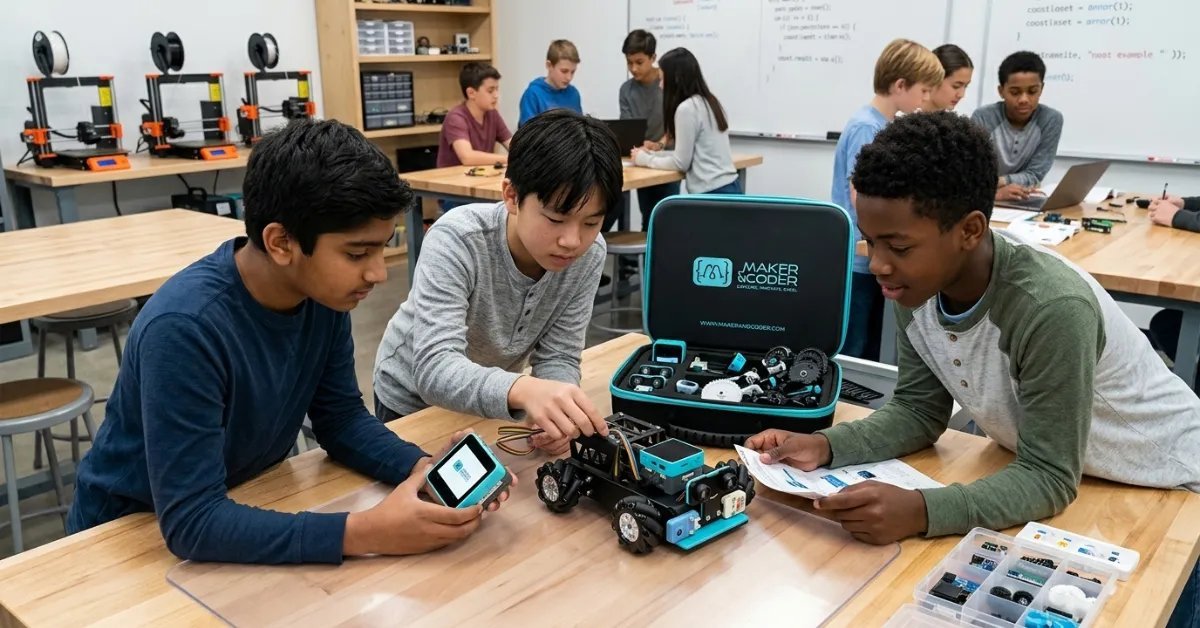
The most common barrier to implementing a coding kit for kids isn’t the cost or the hardware. It’s the human element. Educators often worry they lack the technical expertise to guide a classroom through complex robotics or AIoT systems. We believe this challenge is actually an invitation to innovate. By transforming the classroom into a collaborative Maker Space, teachers become facilitators of discovery rather than just lecturers. This environment encourages students to experiment, fail, and iterate; mirroring the work of real-world engineers. Integrating the MC4.0 AIoT Kit or the MC4.0 STEAM Kit into existing science and math lessons turns abstract theories into tangible, data-driven experiments.
Teacher Training: Empowering the Educators
Our Teacher Training Programs bridge the confidence gap that often stalls STEM rollouts. We provide hands-on workshops that demystify high-performance microcontrollers and modular components. These programs reduce the “fear of technology” by placing the educator in the role of the learner first. When a teacher feels empowered, student engagement skyrockets. This professional development ensures that hardware isn’t just a novelty, but a core component of a sophisticated pedagogical strategy. If you’re ready to empower your staff or bring professional-grade STEM to your community, contact us today to learn more about our training programs.
Adapting for Home Learning
The transition from school to home should be seamless. Parents don’t need to be software engineers to facilitate advanced learning; they simply need the right platform. A structured coding kit for kids provides a focused alternative to unstructured screen time. It turns a quiet evening into a long-term family engineering project. By working together on an MC4.0 Base Kit, families can explore the fundamentals of system architecture. This shared experience fosters curiosity and provides peace of mind, knowing that playtime is actually a high-level investment in future-readiness. It’s about moving from passive consumption to active creation within the home environment.
Successful implementation requires a bridge between complex modern systems and the learner’s immediate surroundings. Whether in a high-tech laboratory or a primary school classroom, the goal remains the same: to provide the tools that spark curiosity. By focusing on professional support and modular hardware, we ensure that every student has the opportunity to become an architect of the future. You can explore our full range of classroom-ready tools in the Maker & Coder shop.
Empowering Future Innovators with the Maker & Coder Ecosystem
Building the architects of the future requires more than just a set of instructions; it demands a complete ecosystem where hardware, curriculum, and support converge. We view the coding kit for kids as the foundation of a sophisticated STEM laboratory, rather than a mere weekend activity. By providing tools that mirror industrial standards, we empower students to transition from being curious observers to capable creators. The Maker & Coder vision is rooted in this transformation, ensuring that every learner has access to the professional-grade technology needed to solve the challenges of tomorrow.
The MC 4.0 Kit serves as the core of this laboratory, offering a versatile platform that adapts to various educational goals. Whether you are outfitting a dedicated school makerspace or establishing a high-level engineering corner at home, our ecosystem provides the scalability required for long-term success. It’s an investment in a system that grows alongside the student, maintaining its relevance as they move from basic logic to complex system architecture.
Specialized Pathways: AIoT and STEAM
Different technical interests require specialized tools. The MC4.0 AIoT Kit is specifically engineered for projects that explore the “Internet of Things,” such as smart-city models and home-automation systems. It allows students to engage with real-world data and network connectivity, preparing them for careers in data science and modern infrastructure. For those who want to blend artistic expression with technical precision, the MC4.0 STEAM Kit integrates art and design into the engineering process. Choosing the right coding kit for kids depends on their specific technical interests and age level, but both pathways ensure that the underlying engineering principles remain grounded in professional standards.
Why Maker & Coder is the Partner of Choice for Schools
Schools choose the Maker & Coder platform because it offers a level of reliability and modularity that consumer toys simply cannot match. Our integration of hardware, the MC Curriculum (K-12), and professional training creates a frictionless experience for both teachers and students. We don’t just provide the tools; we provide the roadmap and the confidence to use them effectively. This holistic approach ensures that your STEM program is sustainable and impactful, fostering a generation of innovators who are ready to lead. We encourage you to explore the Maker & Coder Shop to find the specialized kits that will best serve your school or home environment. Investing in a professional-grade ecosystem today is the first step toward building a brighter, more innovative future.
Architecting the Next Generation of Innovators
Choosing a coding kit for kids is more than a purchase; it’s a strategic investment in a child’s cognitive development. We’ve explored why moving beyond disposable gadgets toward a professional-grade platform is essential for success in 2026. True technical literacy requires a synergy between high-performance hardware and a structured K-12 Aligned Curriculum. By prioritizing sequential growth over isolated projects, you ensure that learners develop the logic and engineering skills needed to thrive in an AI-driven economy.
Success in STEM education isn’t just about the tools; it’s about the support system surrounding them. Our Professional Teacher Training Programs remove implementation barriers, allowing educators to focus on inspiring their students. With the Modular MC4.0 Hardware Platform, you aren’t just buying a kit; you’re building a complete STEM laboratory that scales with the learner’s ambition. It’s time to move from being a consumer to becoming a creator who understands the systems that power our world.
Build your future STEM lab with Maker & Coder kits and join a global community of forward-thinking educators and parents. The journey from curiosity to mastery begins with a single, purposeful step toward innovation.
Frequently Asked Questions
What age is appropriate for a coding kit for kids?
Most educators find that a coding kit for kids is appropriate starting at age 8, though our ecosystem provides a comprehensive roadmap for the entire K-12 spectrum. Younger learners engage with visual block-based logic to build foundational thinking skills. As students progress into middle and high school, they transition to professional-grade hardware and text-based languages. This ensures the technology remains challenging and relevant throughout their educational journey, scaling from basic builds to complex AIoT systems.
Do I need a computer science background to use these kits with my students?
You don’t need a background in computer science to successfully implement these tools in your classroom. We provide a structured curriculum and professional teacher training programs that empower you to act as a mentor and facilitator. These resources demystify complex systems, allowing you to guide students through the discovery process without being a technical expert yourself. Our goal is to enable educators to foster innovation through hands-on, supportive learning environments.
What is the difference between a coding toy and an educational coding kit?
The primary difference lies in the depth of learning and industrial relevance. A coding toy often provides a closed-loop experience designed for short-term entertainment with limited transferable skills. In contrast, a professional-grade coding kit for kids serves as a technical education platform. It utilizes modular hardware and open-source compatibility to teach the same logic and engineering principles used by professional developers, ensuring the skills learned today apply to high-tech careers.
Does the MC 4.0 Kit support Python programming?
Yes, the MC 4.0 Kit is specifically designed to support the transition to Python programming. While younger students may start with visual blocks to master logic, the MC4.0 Controller is fully compatible with Python 3, the industry standard for AI and robotics in 2026. This dual-compatibility allows learners to see their visual logic translated into professional syntax in real-time, providing a clear pathway from introductory concepts to advanced software engineering and data science.
How does the MC Curriculum align with school standards?
The MC Curriculum is meticulously designed to align with global academic standards, providing a structured K-12 pathway for school-wide integration. It moves beyond isolated projects to offer a sequential learning journey that builds on measurable outcomes. This alignment ensures that STEM time contributes directly to cognitive development and future-readiness, allowing schools to track student progress against recognized milestones while reducing the preparation time required for teachers to deliver high-quality technical education.
Can these kits be used for remote or hybrid learning?
These kits are highly effective for remote and hybrid learning environments due to their modularity and portable design. The hardware is robust enough for home use, while the digital curriculum provides clear, step-by-step guidance that students can follow independently or with parental support. This flexibility ensures that the learning process continues uninterrupted, whether students are collaborating in a high-tech laboratory or engaging in a family engineering project in their own living room.
What hardware is included in the MC4.0 Base Kit?
The MC4.0 Base Kit includes the high-performance MC4.0 Controller, which serves as the “brain” of every project, along with a variety of modular MC Blocks. You will find essential sensors and actuators that allow for the collection of real-world data and the execution of precise physical movements. This hardware foundation is designed for rapid prototyping, allowing students to quickly move from an initial concept to a functional, interactive system without the frustration of complex wiring.
Is teacher training available for the Maker & Coder ecosystem?
We provide comprehensive Teacher Training Programs designed to remove technical barriers and spark educator confidence. These programs include hands-on workshops that cover everything from basic hardware setup to the implementation of advanced AIoT projects. By focusing on professional development, we ensure that schools have the internal expertise to sustain a long-term STEM rollout. Our workshops empower teachers to become bold innovators who can effectively transfer high-level knowledge to the next generation.