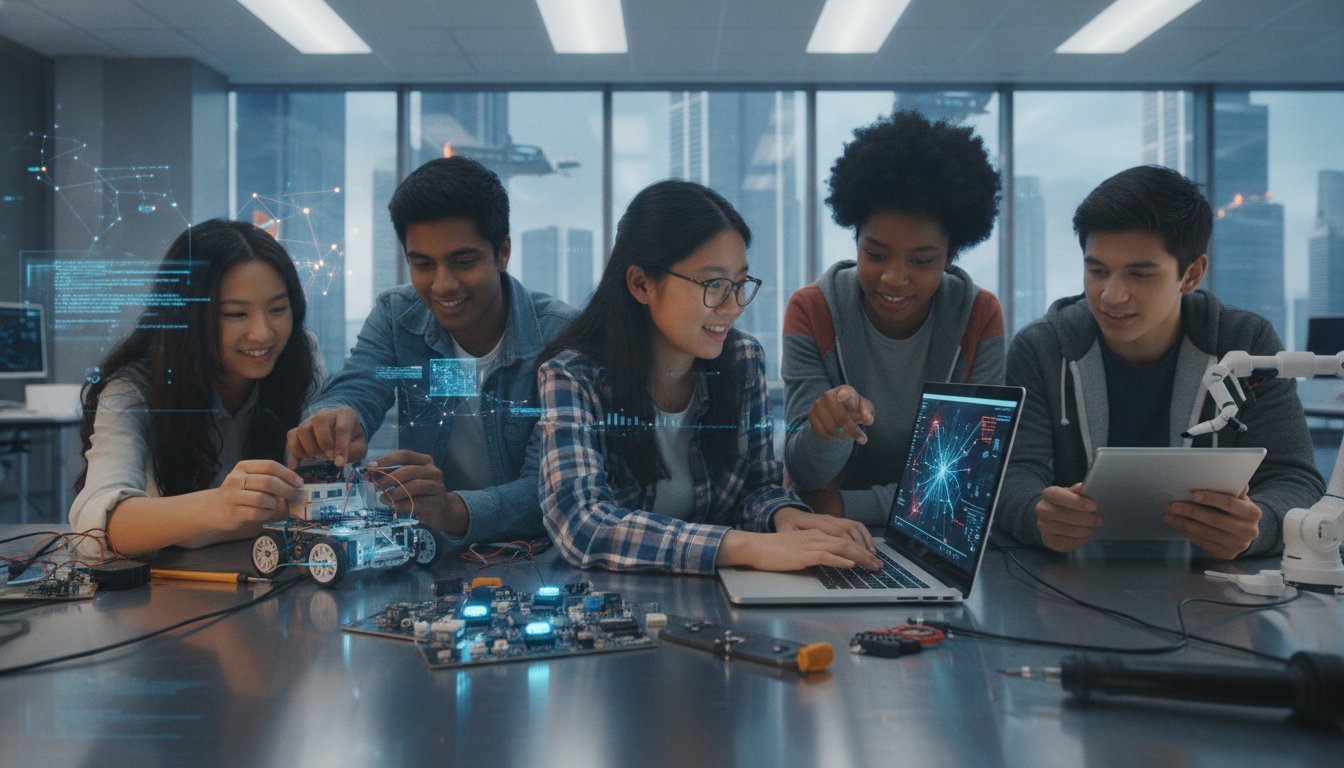
The era of the screen-only coding tutorial is officially over. In 2026, the most competitive AI and machine learning projects for high school have moved out of the browser and into the physical world. You’ve probably spent hours training models that only exist as lines of code, feeling the disconnect between high-level theory and practical application. It’s a common pain point. Without accessible hardware, AI often feels like an abstract puzzle rather than a tool for tangible change.
You deserve to build something that commands attention and demonstrates true technical authority. This article provides a clear blueprint for creating high-impact AIoT innovations that transform your college application from a list of courses into a visionary portfolio. We’ll explore how to use the MC 4.0 AIoT Kit to bridge the gap between software and robotics. From mastering Python-based control systems to deploying your first autonomous prototype, you’re about to see exactly how to lead the next wave of technological advancement.
Key Takeaways
- Shift your focus from abstract code to physical systems that interact with the real world. You’ll learn why hardware integration is the new standard for STEM excellence in 2026.
- Discover how to select and execute AI and machine learning projects for high school that address community needs like sustainability or accessibility.
- Explore the power of the MC 4.0 AIoT Kit to build sophisticated prototypes, including autonomous sorting robots and smart climate controllers.
- Master essential developer frameworks like MicroPython and TensorFlow Lite to run intelligent models on constrained hardware.
- Create a standout college application narrative by transforming theoretical knowledge into working AIoT innovations.
The Evolution of STEM: Why AI and Machine Learning Projects Matter in 2026
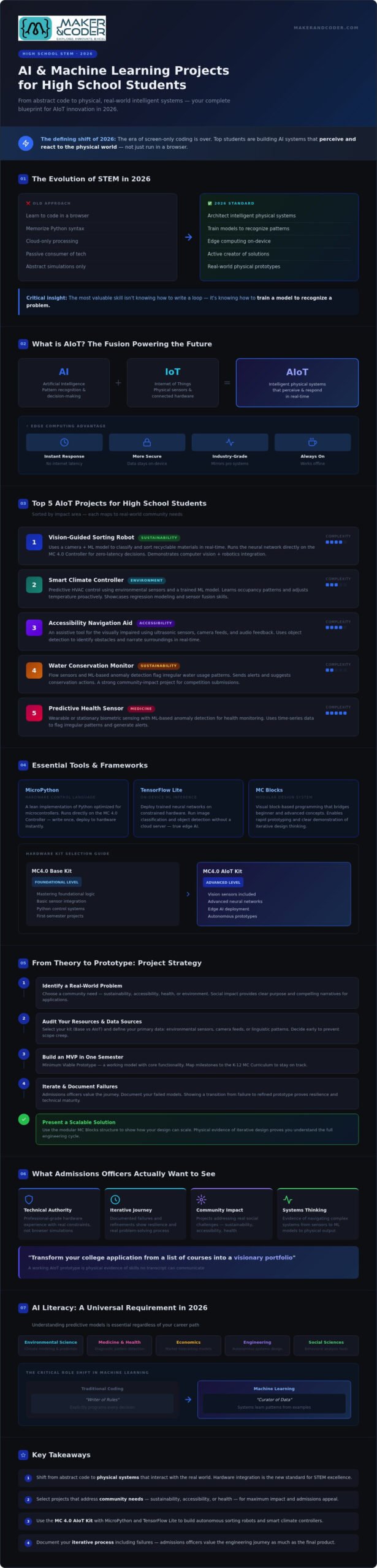
In 2026, the definition of STEM has undergone a fundamental transformation. It’s no longer enough to simply “learn to code.” Today, the most impactful AI and machine learning projects for high school focus on synthesis. Students aren’t just memorizing Python syntax; they’re architecting intelligent systems that perceive and react to their surroundings. This shift represents a move from passive consumption to active, iterative design. By engaging with these technologies now, you develop critical data literacy and systems thinking skills that are indispensable in a world driven by automated decision-making.
Choosing to build with AI allows you to move from being a user of technology to a creator of solutions. You’ll find that the most valuable skill isn’t just knowing how to write a loop, but knowing how to train a model to recognize a problem. This level of sophistication is exactly what top-tier universities look for. They want to see that you can navigate the complexity of modern systems and produce something that works in the real world.
Moving Beyond the Screen: The Rise of AIoT
The most significant advancement in student engineering is the emergence of AIoT, the fusion of Artificial Intelligence and the Internet of Things. While early educational models relied on cloud-based processing, modern high-level projects prioritize edge computing. This means the AI model runs directly on the hardware, such as the MC 4.0 Controller, allowing for instantaneous responses without a constant internet connection. This local processing is faster, more secure, and mimics how professional industrial systems operate.
Colleges are looking for more than just a certificate from an online course. They want to see a narrative of physical innovation. Building a vision-guided sorting system with the MC 4.0 Kit proves you can handle professional-grade hardware. It demonstrates that you can move beyond screen-based simulations to solve tangible challenges. This practical experience separates serious innovators from those who simply follow basic coding tutorials.
AI Literacy as a 21st Century Requirement
AI literacy has become a universal requirement, regardless of your intended career path. Whether you’re interested in environmental science, medicine, or economics, understanding how to leverage predictive models is essential. AI and machine learning projects for high school provide a playground for testing these concepts safely and effectively. You aren’t just building a robot; you’re building a foundation for a career in a tech-driven economy.
Mastering these tools also requires a deep dive into ethics. When you build an autonomous system, you must consider the implications of its decisions. Machine Learning is the process of training systems to recognize patterns without explicit programming. This subtle distinction is vital. It shifts the student’s role from being a “writer of rules” to a “curator of data.” Understanding this responsibility prepares you for the complex ethical landscape of the future workforce.
From Theory to Prototype: How to Choose Your AI Project
Success in AI and machine learning projects for high school begins with a strategy, not just code. The most impressive portfolios aren’t built by accident. They result from a methodical approach that bridges the gap between a concept and a working machine. To start, identify a real-world problem. Whether it’s a sustainability challenge like water conservation or an accessibility tool for the visually impaired, choosing a project with social impact provides a clear purpose that fuels your motivation.
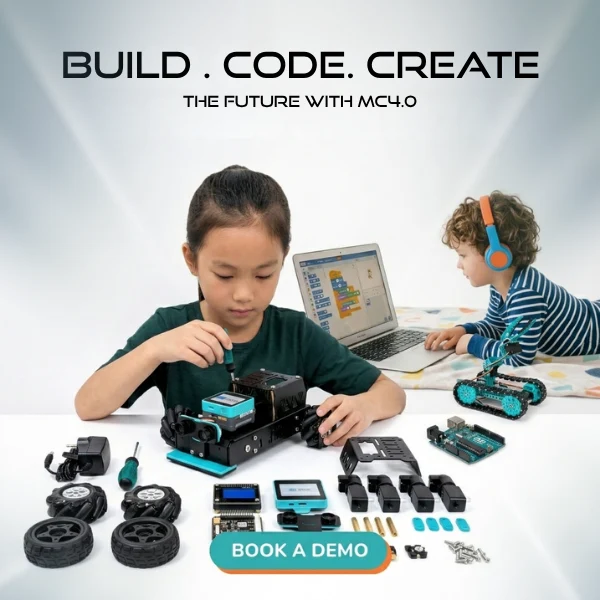
Once you’ve defined your mission, audit your resources. The MC4.0 Base Kit is excellent for mastering foundational logic, while the MC4.0 AIoT Kit provides the vision sensors and processing power required for advanced neural networks. Decide on your primary data source early. Will your model learn from environmental sensors, camera feeds, or linguistic patterns? Defining this early prevents scope creep and ensures you can build a Minimum Viable Prototype (MVP) within a single semester. Mapping these steps to the K-12 MC Curriculum ensures you hit the necessary learning milestones while staying on track for a finished product.
Aligning Projects with College Admissions Goals
Admissions officers value the journey as much as the destination. Don’t hide your mistakes. Documenting the transition from a failed initial model to a refined, successful prototype demonstrates resilience and technical maturity. Use the modular nature of MC Blocks to show how your design can scale. This physical evidence of iterative design proves you understand the engineering cycle. If you need help refining your project scope to better fit your academic goals, you can reach out to our team for guidance on curriculum alignment.
Assessing Technical Feasibility
Before you begin training, evaluate the learning model that fits your data. Supervised learning works best for classification tasks, like identifying recyclables. Unsupervised learning helps find hidden patterns in complex datasets, while reinforcement learning is ideal for robotics that learn through trial and error. Balance this complexity with your hardware’s capacity. While the cloud offers massive power, the MC 4.0 Controller allows you to deploy models at the edge, providing the real-time response times needed for autonomous systems. Create a timeline that leaves at least 30% of your schedule for data collection and model training, as these phases often take longer than the initial coding.
Top 5 AIoT and Robotics Projects for High School Students
The most effective AI and machine learning projects for high school move beyond simulated data to solve tangible problems. By integrating the MC 4.0 Controller with modular MC Blocks, you can create systems that see, hear, and interact with their environment. These five projects represent the cutting edge of student innovation in 2026, offering a perfect blend of technical rigor and real-world utility.
- Smart Climate Controller: Use AI to analyze environmental data and automate greenhouse management for peak efficiency.
- Autonomous Sorting Robot: Deploy computer vision to identify and categorize recyclables in real-time on a conveyor system.
- AI-Powered Sign Language Translator: Develop wearable tech that uses gesture recognition sensors to bridge communication gaps.
- Predictive Maintenance System: Train models to detect specific vibration patterns that signal imminent motor failure before it happens.
- Intelligent Home Security: Build a facial recognition system that triggers physical locking mechanisms on MC Block structures.
Deep Dive: The Autonomous Sorting Robot
Building an autonomous sorter proves you can manage complex hardware-software integration. You’ll need an MC 4.0 Controller, a compatible camera module, and MC Blocks to construct the chassis, conveyor, and sorting arms. The core of this project is a Convolutional Neural Network (CNN). You’ll train this model on thousands of waste images until it can distinguish between plastic, paper, and metal with high accuracy. The controller acts as the central hub, translating the “image recognized” signal into a precise motor command that directs the sorting arm. This project demonstrates mastery of both computer vision and mechanical robotics, creating a powerful narrative for any engineering portfolio.
Deep Dive: Smart Climate Controller
The skills used in these projects are the same foundations found in professional sectors. For example, Cognitron Robotics utilizes advanced automation and AI to power commercial systems, demonstrating how student-led innovation mirrors the technology driving modern industry.
Modern agriculture provides a perfect canvas for predictive modeling. By using the MC4.0 AIoT Kit, you can collect high-fidelity temperature and humidity data over several weeks to understand localized microclimates. Instead of using simple “if-then” threshold logic, you’ll implement a regression model. This allows the system to predict optimal watering times based on historical trends and current atmospheric conditions, which significantly reduces resource waste. Check out the MC4.0 AIoT Kit for sensor integration to see how these modular components work together. This project showcases your ability to handle time-series data and deliver a sustainable solution that has a measurable, positive impact on the environment.
Essential Tools and Frameworks for Building AI Models
Python is the undisputed backbone of the modern AI ecosystem. Its clear syntax and massive library support make it the preferred choice for AI and machine learning projects for high school. While the language is powerful, the real challenge lies in deploying that code to physical devices. This is where TensorFlow Lite and MicroPython become indispensable. These frameworks allow you to condense complex neural networks so they can run efficiently on the MC 4.0 Controller, turning abstract code into real-time physical responses. By mastering these tools, you move from just writing scripts to architecting intelligent, responsive machines.
Hardware vs. Software: Finding the Balance
Choosing the right platform is critical for project success. While Raspberry Pi and Arduino are popular, the specialized MC 4.0 platform is engineered specifically for AIoT integration in a learning environment. Loose wiring is a common failure point in student robotics; modular MC Blocks solve this by providing secure, plug-and-play connections that ensure classroom reliability. Edge AI allows models to run locally on hardware without an internet connection. This local processing is vital for autonomous systems that require immediate feedback, such as a robot navigating a crowded room.
Top Libraries for Student Projects
To build sophisticated systems, you need the right digital toolkit. OpenCV is the gold standard for computer vision, enabling your robot to identify shapes, colors, or faces with precision. If your project involves environmental data or financial forecasting, NumPy and Pandas provide the mathematical muscle to process large datasets with ease. The MC Curriculum simplifies these complex libraries, breaking down professional-grade tools into manageable milestones for K-12 learners. This structured approach ensures you spend less time debugging syntax and more time analyzing your model’s accuracy and loss through integrated visualization tools.
Ready to equip your classroom with these professional tools? Contact us today to discuss teacher training and kit options.
Scaling Your AI Journey with the Maker & Coder Ecosystem
Technology is not a static hurdle to clear; it’s a ladder to climb. The MC 4.0 platform is intentionally designed to evolve alongside the learner, providing a seamless transition from foundational logic to professional-grade engineering. A student might begin their journey with basic automation in middle school and progress to complex AI and machine learning projects for high school by their senior year. This growth is facilitated by our structured pathways. You move from the MC4.0 Base Kit, where you master core control systems, to the MC4.0 AIoT Kit, where you integrate advanced vision sensors and neural networks. This journey builds the technical confidence required to tackle the most pressing challenges of 2026.
Success in this field requires more than just technical skill. It requires a supportive ecosystem that bridges the gap between individual curiosity and classroom-wide implementation. Whether you’re an independent learner or part of a large school district, our platform provides the tools to scale. We transform the abstract into the attainable, ensuring that every milestone reached is a step toward future-readiness.
For Students: Building a Professional Portfolio
Your technical portfolio should be more than a collection of code snippets. In the competitive landscape of modern admissions, you need to demonstrate prestige-tech skills through tangible, working innovations. Use the MC Curriculum milestones to document your evolution as an innovator. This creates a clear, evidence-based narrative of your growth from a novice programmer to a systems architect. Explore our full range of MC 4.0 Kits to find the specific hardware that will power your next breakthrough. By showcasing a working AIoT prototype, you prove your ability to manage professional hardware and complex data sets simultaneously.
For Educators: Integrating AI into the Classroom
Leading the shift toward AI in education can feel like a daunting challenge for even the most experienced instructors. We eliminate this friction through our specialized Teacher Training Programs, while resources such as Trainetics Academy provide comprehensive educational programs to empower individuals and organizations. These sessions empower you to move from a state of uncertainty to a state of mastery, providing the pedagogical tools needed to lead sustainable AI programs. Using modular MC Blocks allows you to manage 30+ students in a lab environment without the chaos of loose wiring or hardware failure. Every project in our ecosystem is meticulously aligned with national STEAM standards. This ensures your curriculum remains academically rigorous while providing students with the fulfillment of building something that truly works.
The transition from screen-based tutorials to physical robotics is the new global standard for technical literacy. By focusing on AI and machine learning projects for high school that solve real-world problems, you transform abstract knowledge into a powerful professional narrative. This journey isn’t just about code; it’s about architecting systems that perceive and interact with their environment. You’re no longer just a student of technology. You’re a creator of solutions.
Leverage Modular MC Blocks for rapid prototyping and ensure your work stays grounded in a K-12 Curriculum aligned framework. Whether you’re a student building a visionary portfolio or an educator looking for Professional Teacher Training, the path to mastery is now within reach. You have the tools to bridge the gap between software and the physical world. Empower your next innovation with the MC 4.0 AIoT Kit and start building the future today. The next technological breakthrough doesn’t belong to the cloud; it belongs to the creators who aren’t afraid to build something tangible.
Frequently Asked Questions
Do I need to be an expert in math to start an AI project in high school?
You don’t need to be a math genius to begin. While advanced AI relies on calculus and linear algebra, most modern frameworks handle these complex calculations under the hood. Focus instead on understanding the logic of how data flows through your system. The MC Curriculum provides a structured pathway that introduces mathematical concepts only as they become relevant to your specific hardware build.
What is the best programming language for machine learning projects?
Python is the undisputed industry standard for AI and machine learning projects for high school. It offers the most extensive ecosystem of libraries like OpenCV and TensorFlow Lite. For hardware-integrated projects, MicroPython is essential because it allows you to run Python code directly on microcontrollers. This combination ensures your software skills translate perfectly into physical robotics and autonomous systems without unnecessary complexity.
Can I build an AI project without expensive hardware?
You can start with browser-based simulations, but physical prototypes require specific hardware to be truly effective for a portfolio. The MC4.0 Base Kit offers an accessible entry point for learning foundational logic. If your goal is to build vision-based systems or autonomous robots, the MC4.0 AIoT Kit provides the necessary sensors and processing power. These kits are designed for durable, long-term educational use.
How do I explain my machine learning project on a college application?
Focus on the problem-solving journey rather than just the final result. Describe the specific community need you addressed and the iterative steps you took to refine your model. Mentioning your experience with the MC 4.0 platform demonstrates that you can handle professional-grade hardware. Highlight the data literacy and systems thinking skills you gained through the process to show your academic maturity and readiness.
What is the difference between AI and Machine Learning for students?
AI is the broad goal of creating systems that can perform tasks requiring human-like intelligence. Machine Learning is a specific subset of AI where you train a system to recognize patterns in data without explicit programming. For students, this means moving from writing rigid “if-then” rules to curating datasets that allow the hardware to learn and adapt to its environment based on experience.
How long does it typically take to finish a high school AI project?
A high-impact project usually spans a full semester. You’ll spend the first few weeks identifying a problem and gathering data. Training and testing your model often takes several iterations before it reaches high accuracy. Using modular MC Blocks accelerates the prototyping phase, allowing you to focus more time on refining your software logic. Consistency is the key to reaching a working prototype by your deadline.
Where can I find datasets for my machine learning model?
Public repositories like Kaggle or Google Dataset Search are excellent starting points for general data. However, the most impressive AI and machine learning projects for high school often use custom data. You can use the sensors in the MC4.0 AIoT Kit to collect your own environmental or visual data. Creating a proprietary dataset shows admissions officers that you understand the full data lifecycle from collection to deployment.
How does the MC 4.0 platform help with AI development?
The MC 4.0 platform acts as a bridge between abstract code and physical action. It provides a centralized hub via the MC4.0 Controller, which manages data from modular MC Blocks. This ecosystem simplifies hardware integration, letting you focus on developing intelligent models. When combined with our Teacher Training Programs, it ensures both students and educators have the support needed for successful project implementation and scaling.