The most successful STEM classroom isn’t the one where every student arrives at the right answer on the first try. It’s the one where they have the precise instructional support needed to fail safely, troubleshoot effectively, and eventually succeed independently. As an educator, you’ve likely felt the tension of managing a room where one student is ready for advanced AIoT applications while another is paralyzed by a simple syntax error. Effective scaffolding in STEM education addresses this high cognitive load, ensuring that frustration doesn’t stall the journey toward technical mastery.
We understand that balancing diverse skill levels is a constant challenge in modern technical education. This guide will show you how to master the art of instructional support to move students from hesitant beginners to confident, advanced makers. You’ll learn to implement structured pathways that reduce frustration and improve long-term retention of complex technical concepts. We’ll explore how modular hardware like MC Blocks and a cohesive K-12 curriculum provide the physical and cognitive framework your students need to thrive. By the end of this article, you’ll have a clear strategy to turn your classroom into a hub of self-directed innovation.
Key Takeaways
- Understand the architecture of the Zone of Proximal Development to ensure students reach technical goals that would be impossible without structured support.
- Discover how effective scaffolding in STEM education reduces cognitive load, preventing student burnout during complex coding and engineering challenges.
- Learn why modular hardware, such as MC Blocks, serves as a vital physical scaffold that allows learners to isolate variables and master abstract concepts.
- Master a 4-step framework for “fading” instructional support, creating a clear pathway from guided practice to independent student innovation.
- Explore how a cohesive ecosystem of kits and curriculum can future-proof your classroom by growing in complexity alongside your students’ evolving skills.
The Architecture of Learning: Defining Scaffolding in STEM Education
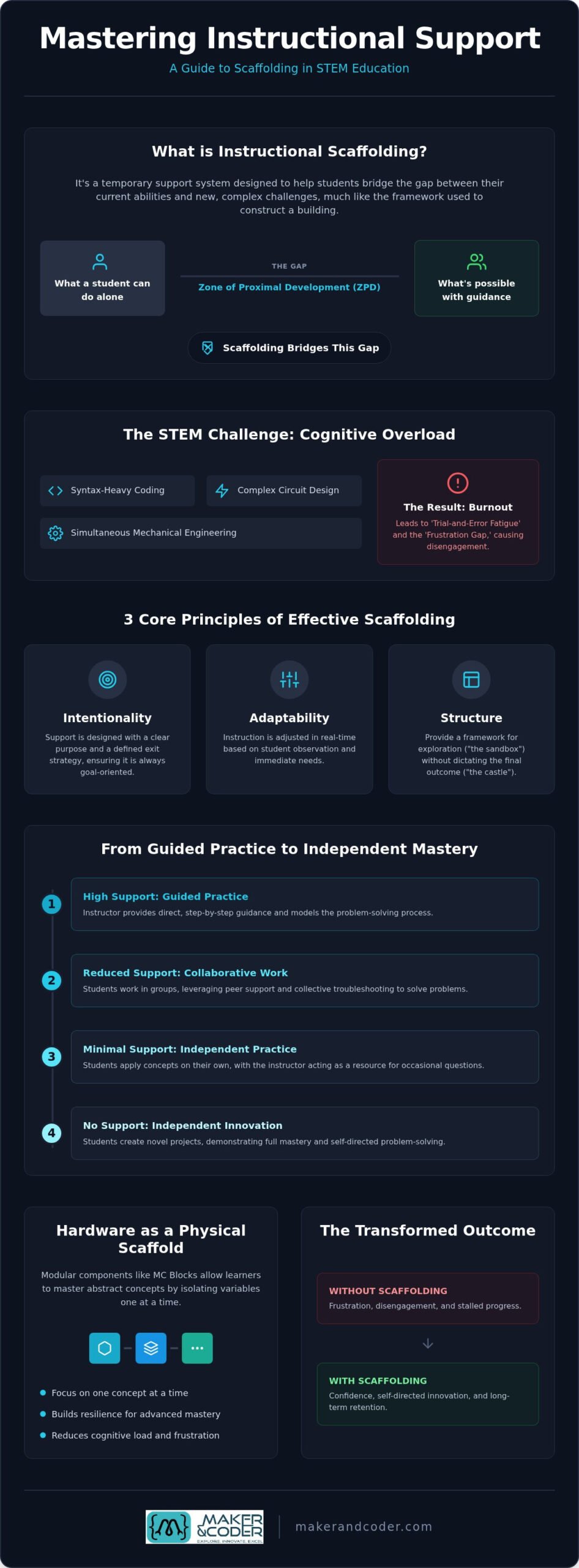
Think of scaffolding as the temporary framework used when constructing a high-rise. In the classroom, Instructional scaffolding serves a similar purpose. It provides the support necessary for a student to bridge the gap between what they can do alone and what they can achieve with guidance. This gap is known as the Zone of Proximal Development (ZPD). Within the context of scaffolding in STEM education, this isn’t just about abstract theory. It’s about active problem-solving where mathematical logic meets physical hardware.
STEM requires a unique approach to support. A student must often juggle syntax-heavy coding, circuit design, and mechanical engineering simultaneously. This intersection creates a high cognitive load that can easily lead to disengagement. As an educator, your role evolves into that of an “expert-as-enabler.” You don’t just deliver a lecture; you provide the strategic cues and modular tools that allow students to navigate complex systems with increasing autonomy.
The Core Principles of STEM Scaffolding
Effective support isn’t accidental. It relies on three pillars that transform a daunting lab session into a journey of discovery:
- Intentionality: Every prompt, hint, or partial solution has a clear purpose and a defined shelf life. We design support with a clear exit strategy in mind.
- Adaptability: Real-time observation drives the process. If a student masters sensor integration using the MC 4.0 Controller, the instructor pulls back the support immediately to encourage independent testing.
- Structure: We provide the sandbox, not the castle. Use frameworks that encourage deep exploration without dictating every final result.
Why Scaffolding is Non-Negotiable in Technical Education
Modern technical education demands more than just rote memorization. It requires “prestige-tech” confidence. When students interact with high-level tools, they need to feel like innovators rather than just passive users. Proper scaffolding in STEM education manages the cognitive load during complex tasks like Python coding or AIoT development. It ensures the brain processes new information without hitting a point of total frustration.
Reducing this “frustration gap” is critical for long-term retention. Many students lose interest in STEM during the transition to middle school because the technical hurdles feel insurmountable. By using modular components like MC Blocks, found in the Maker & Coder shop, educators can isolate variables. This allows students to focus on one concept at a time, building the resilience needed for advanced maker mastery.
Cognitive Load and Connection: How Scaffolding Transforms Student Outcomes
The journey of a STEM student is a transformative arc. It moves them from basic logical sequences to the sophisticated world of advanced AIoT applications. This transition isn’t just about learning new facts; it’s about managing the mental effort required to process complex systems. Without proper scaffolding in STEM education, students often succumb to “trial-and-error fatigue.” This is the point where a robot fails to move for the tenth time and the student’s curiosity turns into a desire to quit. Structured support prevents this by ensuring the cognitive load never exceeds the learner’s current capacity.
We view technology as an accessible tool for creative expression. To keep that vision alive, educators must balance visionary inspiration with grounded technical support. By providing a clear pathway, you allow students to focus on the joy of discovery rather than the frustration of technical roadblocks. This approach builds the “prestige-tech” confidence they’ll need for future careers in innovation.
Hard Scaffolds: Tools, Kits, and Curricula
Hard scaffolds are the static, pre-planned supports built into the learning environment. Think of the MC4.0 Base Kit as a physical foundation for a student’s ideas. These kits provide modular components that limit the number of variables a student must manage simultaneously. When a student uses pre-designed templates or follows a structured K-12 curriculum, they aren’t just following instructions. They’re using a framework that isolates specific concepts, like sensor calibration or data logging, before merging them into a larger project.
Checkpoints within these projects serve as vital safety nets. They ensure that a student masters a foundational skill before moving to the next level of complexity. This structured progression turns a daunting engineering challenge into a series of achievable wins, maintaining momentum and fostering a sense of tangible accomplishment.
Soft Scaffolds: The Teacher as a Supportive Mentor
While kits provide the framework, the teacher provides the dynamic support. Soft scaffolding is the real-time, social interaction between a mentor and a learner. It involves using dynamic questioning techniques that prompt critical thinking. Instead of giving a direct answer to a coding error, ask: “What does the controller expect to see from this sensor?” This shifts the student from a passive receiver of information to an active problem-solver.
Modeling the engineering design process through live demonstrations is another powerful soft scaffold. When you show students how to troubleshoot a circuit or refine a line of Python code, you’re teaching them the mindset of an innovator. Peer-to-peer scaffolding also enriches the lab environment. Collaborative learning allows students to verbalize their logic, which reinforces their own understanding while helping their classmates bridge their own knowledge gaps.
If you’re looking to implement these structured pathways in your own district, you can connect with our educational specialists to discuss tailored training and curriculum solutions.
Hardware as a Scaffold: Modular Design and Physical Learning
While dialogue and verbal cues are essential, physical hardware offers a tangible form of scaffolding in STEM education that theory alone cannot replicate. Coding is inherently abstract. For a student, a loop or a variable remains a ghost in the machine until it manifests as a rotating wheel or a glowing LED. Physical tools act as a bridge. They transform invisible logic into visible, touchable reality. This physical grounding provides peace of mind for educators, as it gives students a concrete reference point for every line of code they write.
The MC4.0 Controller serves as the stable “brain” or foundation for this journey. It acts as a reliable anchor that stays constant even as the complexity of the peripherals increases. By starting with a consistent controller, students build a sense of mastery over the core system before they begin exploring the vast possibilities of AIoT and advanced robotics. This reliability is key to maintaining student confidence in a high-tech environment.
Isolating Complexity with Modular Blocks
Complex systems often overwhelm beginners. To manage this, we encourage breaking down a robot into three distinct modules: sensory, processing, and action. By using Maker & Coder’s MC Blocks, students can isolate variables during the testing phase. If a robot isn’t responding to light, they can test the “sensory” block individually without worrying about a potential mechanical failure in the motor. This modularity allows learners to focus on one component at a time, ensuring they don’t break the entire system while experimenting with a single part.
This physical variable isolation mirrors the cognitive process of debugging. It provides a structured environment where failure is localized and manageable. Students build a mental model of electronic systems block by block. This methodical approach turns a daunting technical challenge into a series of logical, achievable steps. It’s a physical representation of the “from-to” growth we strive for in every classroom.
Visualizing Code through Physical Action
The connection from screen to world is a powerful motivator. Seeing a Python script move a physical motor provides immediate, non-judgmental feedback. Unlike a red error message on a screen, a motor that doesn’t spin is a puzzle to be solved. This tactile feedback helps students build a robust understanding of how software interacts with the physical world. It reduces the abstraction often associated with AI and IoT, making these high-level concepts feel like accessible tools for expression.
Hands-on kit experimentation removes the “prestige-tech” barrier. When a student holds a sensor, they aren’t just learning about data; they’re experiencing it. This physical engagement is a core component of scaffolding in STEM education, as it provides a concrete anchor for the complex mathematical and logical concepts that follow. It moves the learner from a state of curiosity to a state of tangible mastery, sparking the joy of discovery through building.
From Guided Practice to Independent Mastery: A 4-Step Framework
The transition from a curious observer to a master innovator doesn’t happen by accident. It requires a deliberate “fading” process. Fading is the systematic withdrawal of support as a student’s competence grows. In the context of scaffolding in STEM education, this means moving from highly structured templates to open-ended engineering challenges. The goal isn’t to remove the scaffold abruptly, but to thin it out so students can support their own weight. Identifying when a student is ready for this shift is a subtle art. Look for the moment they stop asking “What do I do next?” and start asking “What happens if I change this variable?”
Mastery requires a period of productive struggle. This is the final stage where you intentionally step back and allow the student to navigate technical friction. This struggle is where deep learning happens. It’s the bridge between following a recipe and creating an original solution. By embracing this 4-step framework, you ensure that every student has the confidence to tackle the unknown with the skills you’ve helped them build.
Step 1 & 2: Modeling and Guided Exploration
The journey begins with the “I Do” phase. Here, you demonstrate a specific technical skill, such as connecting an AIoT sensor to the MC 4.0 Controller. Be vocal about your thought process. Explain why you’re choosing a specific port or how you’re checking your syntax. This modeling provides the initial mental blueprint the student needs. Don’t just show the “how”; explain the “why.”
We then move into collaborative building, or the “We Do” phase. Use the MC Curriculum templates to provide a “skeleton” for the project. Students follow the established framework to complete their first iteration. This guided exploration ensures they achieve an early win, which is vital for maintaining momentum. It provides a safe environment where the basic logic is already in place, allowing them to focus on the physical assembly and initial testing without the fear of total failure.
Step 3 & 4: Independent Practice and Mastery
Once the foundation is solid, it’s time for the “You Do” phase. Start removing the templates. Encourage students to modify existing systems or add new features to their builds. If they used a basic light sensor in the previous step, challenge them to integrate a more complex component from the MC4.0 STEAM Kit. This forces them to apply their previous knowledge to a new, slightly more difficult context.
The final stage is the “Open Challenge.” Provide a real-world problem, such as designing an automated greenhouse or a smart security system, and let them build from scratch. This is the ultimate test of their growth. Mastery is the ability to troubleshoot and iterate without external guidance. At this point, the student has transitioned from a learner to a maker, capable of using technology as a tool for their own creative expression.
To bring this structured framework into your school, contact our team to learn more about our professional teacher training and K-12 curriculum options.
Future-Proofing the Classroom: Scaffolding with the Maker & Coder Ecosystem
A truly future-proof classroom doesn’t just adopt new gadgets. It implements a sustainable ecosystem where technology and pedagogy work in harmony. Effective scaffolding in STEM education requires more than just isolated lesson plans; it demands a cohesive infrastructure that supports growth over years, not just weeks. The Maker & Coder ecosystem provides this vital framework. By aligning modular hardware with a structured K-12 curriculum, we ensure that the transition from curiosity to technical mastery is seamless and empowering. We position technology as an accessible tool for creative expression, giving students the peace of mind to explore, build, and innovate without limits.
A Curriculum that Grows with the Learner
The journey begins with foundational concepts and expands into the high-tech frontiers of AI and IoT. Our curriculum is designed with vertical alignment in mind, ensuring that every grade level builds directly upon the previous one. This structured pathway moves students from basic block-based logic to advanced, Python-based robotics with the MC 4.0 Controller acting as the reliable “brain” throughout the process.
- The Foundation: Start with the MC4.0 Base Kit to master essential circuits and motor control.
- Advanced Exploration: Transition to the MC4.0 AIoT Kit to explore the intersection of artificial intelligence and the internet of things.
- Total Mastery: Use the MC4.0 STEAM Kit to solve complex, real-world engineering challenges.
Explore the full range of Maker & Coder STEM Kits to find the perfect fit for your grade level and learning goals.
Empowering the Empowerers: Professional Teacher Training
The teacher is the ultimate “scaffolder” in any learning environment. However, implementing high-level technology can often lead to “tech-anxiety” among even the most experienced educators. Our professional Teacher Training Programs are designed to be the essential support system for the instructor. We provide the hands-on experience and pedagogical strategies needed to lead a high-tech lab with confidence. This training isn’t just about learning to use a kit; it’s about becoming a forward-thinking pioneer who can inspire the next generation of innovators.
We invite you to embrace visionary technology as a bridge to student success. By combining modular hardware like MC Blocks with a robust curriculum and professional development, you create an environment where every learner can thrive. Let’s move beyond the intimidation of complex systems and toward the joy of building something tangible. Join our community of dedicated educational partners and start future-proofing your classroom today.
Empower the Next Generation of Technical Visionaries
Mastering scaffolding in STEM education is the key to transforming your classroom into a hub of independent innovation. By implementing modular hardware and structured cognitive pathways, you give students the confidence to move from basic logic to advanced AIoT mastery. We’ve explored how physical tools like MC Blocks isolate complexity, while a clear 4-step framework ensures students never face the frustration gap alone. This methodical approach doesn’t just teach code; it builds the resilience required for lifelong discovery.
The journey toward future-readiness requires a reliable partner. Our ecosystem provides a K-12 Aligned MC Curriculum and modular MC Blocks for hands-on experimentation, supported by global teacher training to ensure long-term success. You have the power to turn daunting technical challenges into accessible tools for creative expression. Empower your students with the MC 4.0 STEM Ecosystem today and watch their curiosity grow into tangible mastery. The future of STEM is waiting; let’s build it together.
Frequently Asked Questions
What is the difference between scaffolding and differentiation in STEM?
Scaffolding is a temporary instructional framework that helps all students reach the same high standard, whereas differentiation involves adjusting the content or learning environment to meet individual needs. In the context of scaffolding in STEM education, you provide the same complex coding challenge to everyone but offer different levels of support. This ensures that every learner has a path toward technical mastery without lowering the academic expectations of the curriculum.
How do I know when to remove a scaffold in a coding lesson?
You should begin the “fading” process once a student can explain the logic behind a specific command or successfully troubleshoot a syntax error without your intervention. Observation is key. If they stop asking for the next step and start experimenting with variables, they’re ready for the scaffold to be removed. Removing support too early causes frustration, but removing it at the right moment fosters deep, independent mastery of robotics and engineering.
Can scaffolding be used for advanced STEM students, or is it just for beginners?
Scaffolding is essential for all learners, including advanced students who are tackling sophisticated AIoT or Python-based projects. For these learners, support shifts from basic syntax help to high-level system architecture guidance. It allows them to manage the increased cognitive load of multi-layered technical systems. Even the most gifted makers benefit from structured pathways that help them navigate the intersection of complex math, logic, and physical hardware.
What are some examples of hard scaffolds in a robotics lab?
Hard scaffolds are the static, pre-planned supports built into your lab environment to ensure student success. Examples include pre-designed code templates in the MC Curriculum, step-by-step wiring diagrams, and physical checklists for hardware calibration. Modular hardware like the MC4.0 Controller also acts as a hard scaffold by providing a stable, reliable foundation for every project. These tools provide a safety net that allows students to explore without fear of total failure.
How does modular hardware like MC Blocks help with scaffolding?
Modular hardware like MC Blocks serves as a physical representation of cognitive scaffolding by allowing students to isolate variables during the testing phase. If a robot fails to respond, a student can test the sensory block independently of the motor block. This isolates the complexity and prevents the “trial-and-error fatigue” that often leads to disengagement. It turns a complex, integrated system into a series of manageable, logical components for the learner.
Does scaffolding inhibit student creativity in open-ended STEM projects?
Proper scaffolding actually fuels creativity by removing the technical roadblocks that stifle original thought. When a student isn’t paralyzed by a syntax error or a wiring mystery, they have the mental bandwidth to focus on visionary design. By providing a structured framework, you’re giving them the tools they need to express their ideas. Scaffolding moves them from being passive consumers of technology to becoming bold innovators who build tangible solutions.
What role does teacher training play in effective instructional scaffolding?
Professional development is the ultimate scaffold for the educator, turning “tech-anxiety” into professional authority. Teacher training programs ensure that you can effectively identify the Zone of Proximal Development for each student. This training provides the pedagogical strategies needed to implement scaffolding in STEM education with confidence. It empowers you to act as an “expert-as-enabler,” guiding students through complex engineering challenges while knowing exactly when to step back and let them lead.
How can I scaffold AI and IoT concepts for elementary students?
To scaffold AI and IoT for younger learners, start by turning abstract data into physical, tactile actions. Use the MC4.0 AIoT Kit to show how a sensor’s input directly creates a physical output, like a motor spinning when a light is detected. Focus on simple “if-then” logic before introducing complex Python scripts. This physical grounding makes high-level technology feel like an accessible tool for expression rather than a daunting academic hurdle.