The most expensive piece of technology in your classroom isn’t the one that cost the most. It’s the one that sits on a shelf because it couldn’t keep up with your students. As the 2026 CSTA standards shift focus toward Artificial Intelligence and Data Science, many educators find themselves trapped between toys that are too simple and professional gear that’s too complex. You need a solution that bridges this gap without requiring a total hardware overhaul every few years.
We understand the frustration of watching expensive equipment become obsolete. It’s overwhelming to manage disparate systems that don’t talk to each other or offer a clear path forward. This guide promises to show you how to transform your classroom with modular robotics kits for education that scale alongside your curriculum. You’ll learn how to build a sustainable STEM ecosystem that moves learners from basic block-coding to advanced AIoT execution using a single, unified platform.
We will examine how the MC 4.0 platform and modular MC Blocks provide a reliable K-12 pathway. From empowering teachers with structured training to engaging students in real-world innovation, this is your roadmap to a high-tech classroom. Let’s move from static hardware to a dynamic journey of discovery.
Key Takeaways
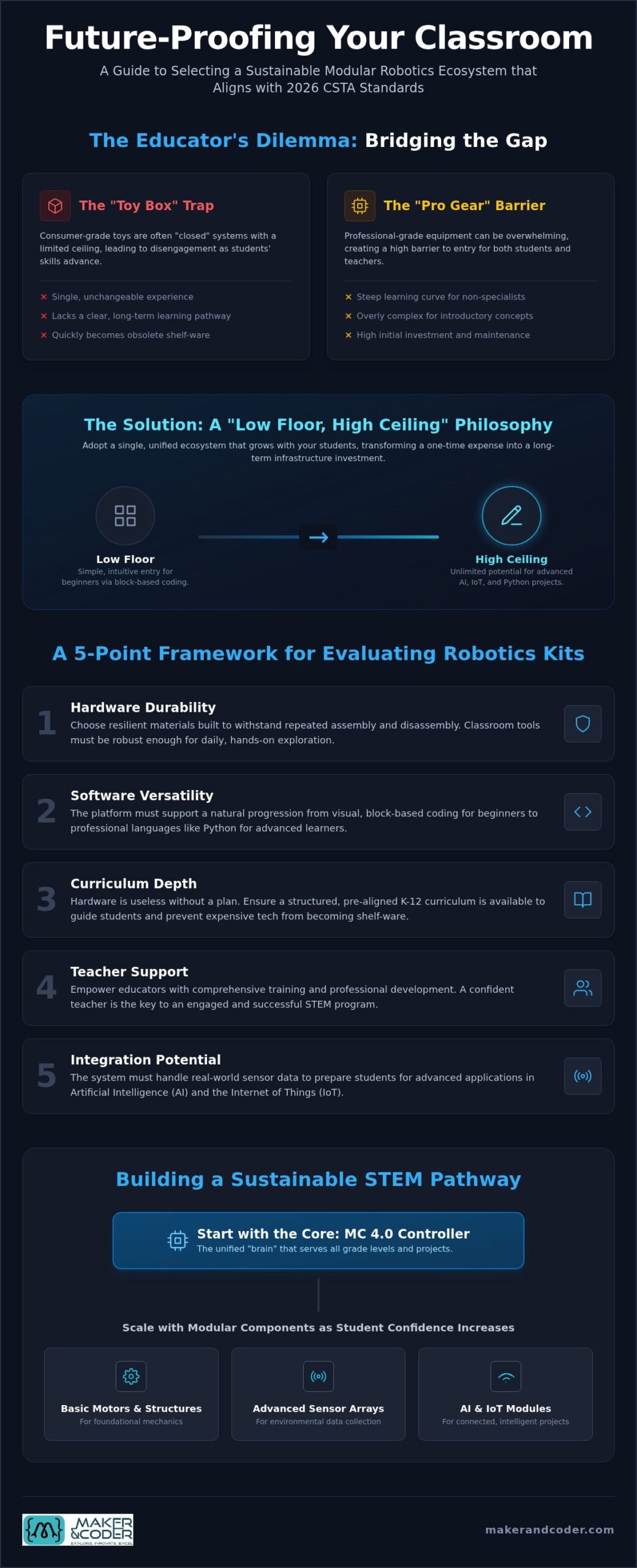
- Break the cycle of technology obsolescence by adopting a “Low Floor, High Ceiling” philosophy that ensures hardware grows with your students.
- Apply a rigorous five-point framework to select modular robotics kits for education that prioritize durability and software versatility.
- Utilize the MC 4.0 Controller as a unified brain to transition learners from visual coding to complex AI and IoT projects.
- Empower educators through dedicated training programs and a pre-aligned K-12 MC Curriculum that meets 2026 CSTA standards.
- Build a sustainable STEM pathway by starting with the MC4.0 Base Kit and scaling into advanced STEAM kits as student confidence increases.
Beyond the Toy Box: Why Modular Robotics Kits are the Foundation of 2026 STEM Education
Modular robotics represents a paradigm shift from static machines to fluid, adaptable systems. These kits consist of interchangeable electronic and mechanical components that learners can reconfigure to solve specific problems. Unlike traditional robotics, which often follows a linear build-to-finish model, modular self-reconfiguring robotic systems empower students to iterate quickly. This flexibility mirrors modern engineering and Agile development practices, where the ability to pivot and upgrade is more valuable than the initial assembly. It’s about teaching students to think in systems rather than isolated parts.
In the context of modular robotics kits for education, the “Low Floor, High Ceiling” philosophy is vital. It means a first-grader can snap together a simple light-sensing robot in minutes, while a high school senior uses the same platform to deploy complex AI algorithms. While many consumer-grade toys are “closed” systems that offer a single, unchangeable experience, open ecosystems like the MC 4.0 platform provide a scalable foundation for a decade of learning. This ensures that the technology grows alongside the student’s cognitive development.
The Cognitive Benefits of Modular Construction
Physical manipulation is a catalyst for cognitive growth. When students engage with MC Blocks, they aren’t just playing; they are developing advanced spatial reasoning through tactile experimentation. This hands-on interaction creates a vital bridge between sensory-based learning and abstract logic. As students move from building physical structures to defining their behavior through code, they develop a deep understanding of computational thinking. They learn that complex systems are simply a collection of well-coordinated, modular parts working in harmony.
Scalability: The Key to STEM Budget Efficiency
Educational budgets are often strained by hardware that becomes obsolete within two years. Modular systems solve this by separating the “brain” from the “body.” With the MC4.0 Controller, schools can invest in a single, powerful processor that serves multiple grade levels. Educators can start with basic motor control and progressively add advanced sensor arrays or AIoT modules from the Maker & Coder shop without purchasing entirely new kits. This approach transforms modular robotics kits for education from a one-time expense into a long-term infrastructure investment. It ensures that your technology remains as current as the curriculum it supports.
Selecting the Right Modular Ecosystem: A 5-Point Evaluation Framework for Schools
Choosing equipment is a high-stakes decision for any school district. It’s not just about the initial purchase price. It’s about ensuring the hardware survives the rigors of daily classroom use. When evaluating modular robotics kits for education, use this five-point framework to distinguish professional tools from short-lived gadgets:
- Hardware Durability: Look for resilient materials like those used in MC Blocks. They must withstand high-frequency assembly and disassembly across multiple semesters.
- Software Versatility: A system should support a natural progression. It should move from block-based coding to professional languages like Python.
- Curriculum Depth: Ensure there’s a structured K-12 pathway. Hardware without a roadmap quickly becomes “shelf-ware.”
- Teacher Support: Prioritize platforms that include comprehensive Teacher Training Programs to build internal confidence.
- Integration Potential: The ecosystem must handle real-world sensor data. It should prepare students for advanced AIoT applications.
Professional engineering bodies emphasize the importance of making robotics accessible while maintaining technical rigor. This balance ensures students aren’t just following instructions. They’re solving genuine problems. Effective modular robotics kits for education must bridge the gap between simple play and technical mastery.
Hardware vs. Software: The Balancing Act
The MC4.0 Controller serves as a professional-grade execution engine. It’s powerful enough for complex AI tasks yet accessible through a clean user interface. Educators need a dashboard that simplifies classroom management. Students need a workspace that doesn’t hide the underlying logic. Cross-platform compatibility is non-negotiable. Whether your district uses Chromebooks, tablets, or PCs, the software experience must remain consistent. You can explore these versatile options in the Maker & Coder shop to see how the hardware aligns with your existing tech stack.
The True Cost of Ownership in STEM
Smart budgeting looks beyond the sticker price. The real value lies in the longevity of the kit and the readiness of the staff. Many schools overspend on external consultants because their hardware lacks a structured curriculum. By choosing an ecosystem that includes professional training, you build internal capacity. Modular kits like the MC4.0 Base Kit reduce long-term spend because they’re reusable. You don’t buy new kits for every grade level; you simply add specialized blocks. If you’re ready to start discussing your specific classroom needs, we can help map out a cost-effective scaling strategy.
The MC 4.0 Architecture: Bridging the Gap from Visual Coding to Advanced AIoT
The MC4.0 Controller acts as the high-performance nucleus of the entire ecosystem. It’s designed to dismantle the barriers between visual logic and text-based programming. While many modular robotics kits for education limit students to basic loops and triggers, this controller provides the processing power required for complex execution. It transitions learners from the intuitive world of Scratch into the professional-grade syntax of Python. This shift is critical for future-readiness. A systematic review of educational robotics confirms that while modularity supports cognitive development in primary years, the hardware must evolve to maintain engagement through secondary school. The MC 4.0 architecture does exactly that.
Growth is built into the hardware. Schools typically start with the MC4.0 Base Kit to master fundamental mechanics and electronics. As student confidence climbs, the same controller integrates with the MC4.0 AIoT Kit and MC4.0 STEAM Kit. This progression ensures that the initial investment remains relevant for years. You aren’t just buying a kit; you’re building a technical foundation. The hardware adapts to the learner’s ambition.
Exploring the MC4.0 AIoT and STEAM Kits
Artificial Intelligence and the Internet of Things (AIoT) are no longer abstract concepts. They are classroom realities. The MC4.0 AIoT Kit enables students to build smart systems that respond to environmental data and cloud-based inputs. They create facial recognition locks or automated climate controls. When you move to the MC4.0 STEAM Kit, the focus expands to cross-disciplinary projects. Students blend art, science, and engineering to solve open-ended challenges. Utilizing Maker & Coder hardware facilitates real-world problem solving by providing the tools needed to prototype genuine solutions. It turns theoretical lessons into tangible innovations.
The Power of the MC Blocks Ecosystem
MC Blocks provide the physical flexibility required for high-level engineering. These modules feature standardized connectivity that allows for rapid sensor integration without messy wiring. This technical reliability encourages a “maker” culture where students feel safe to fail and iterate. They can swap a light sensor for a gyroscope in seconds. MC Blocks allow for infinite technical permutations by combining high-precision sensors with a snap-fit mechanical interface. This open-ended design ensures that modular robotics kits for education remain a primary tool for creative expression in the modern classroom. The only limit is the student’s imagination.
From Hardware to Mastery: Integrating Professional Teacher Training and K-12 Curriculum
A high-quality robotics kit is a powerful tool, but without a skilled hand to guide it, it remains just a collection of parts. The success of modular robotics kits for education depends entirely on the pedagogical framework surrounding them. We don’t just provide hardware; we provide a comprehensive K-12 MC Curriculum designed to turn every classroom into a hub of innovation. This structured roadmap aligns with the 2026 CSTA standards. It ensures students are prepared for a future dominated by AI, Data Science, and Cybersecurity.
We prioritize a “Train the Trainer” model. This approach empowers educators to become STEM leaders within their own institutions. By building internal expertise, schools ensure their investment in technology pays dividends for years. Case studies across diverse school environments show that when teachers feel supported, student engagement in complex coding and engineering tasks increases. It’s a journey from basic instruction to visionary leadership.
Implementing the K-12 MC Curriculum
Mapping modular robotics to specific learning outcomes is the core of our curriculum. Each grade level has a clear set of milestones. Students move from basic mechanical assembly to advanced Python integration in a logical, step-by-step fashion. This lockstep between hardware and curriculum reduces teacher preparation time significantly. It allows you to focus on student output rather than troubleshooting. When the MC4.0 Controller and MC Blocks are paired with structured lessons, learning becomes consistent, measurable, and deeply impactful.
Professional Development: Building Teacher Confidence
Our Teacher Training Programs are designed to eliminate “tech-anxiety” for good. You’ll move from being a source of technical support to becoming a facilitator of innovation. We provide the tools you need to guide students through open-ended problem solving with confidence. This isn’t just a one-time workshop; it’s a commitment to your professional growth. This ongoing support creates a sustainable STEM culture that survives staff transitions and technological shifts. You become the bridge between complex modern systems and the classroom environment.
If you’re ready to empower your teaching staff and secure the future of your STEM program, contact our educational consultants today to discuss a custom training and curriculum roadmap.
Future-Proofing Your Classroom: Choosing Your Maker & Coder Pathway
Investing in modular robotics kits for education is more than a simple hardware purchase. It is a strategic commitment to a sustainable pedagogical ecosystem. By choosing a modular architecture, you ensure that your classroom technology remains a vibrant, evolving tool rather than a static expense. This approach allows your school to adapt to shifting academic standards and emerging industrial trends without the need for frequent, costly replacements. You are building a technical foundation that supports a decade of student growth and discovery.
Success starts with a clear roadmap. We recommend beginning your journey with the MC4.0 Base Kit to establish core competencies in mechanical design and fundamental logic. This initial step builds the confidence necessary for both students and educators to explore more complex systems. As your program expands, you can seamlessly integrate the MC4.0 AIoT Kit or the MC4.0 STEAM Kit. This scalability ensures that your equipment stays in the hands of students, moving from basic motor control to high-level data science and artificial intelligence applications.
Customizing Your STEM Laboratory
Designing an effective STEM space requires flexibility. You can mix and match different MC 4.0 kits to meet the specific needs of various grade levels or departments. A multi-year rollout strategy allows you to distribute costs while building a consistent technical language across your entire school. This unified platform simplifies everything from storage to software updates. Visit the Maker & Coder shop to explore classroom configuration options and find the right balance of hardware for your unique environment.
A Vision for the Next Generation of Engineers
The workforce of the 2030s will demand more than just digital literacy. It will require a generation of creators who understand the systems they use. Modular robotics facilitates this shift from consumption to creation by revealing the “how” behind the “what.” Students learn to diagnose problems, iterate on designs, and deploy genuine technical solutions. Our “expert-as-enabler” philosophy is designed to support you at every stage of this journey. We invite you to contact Maker & Coder for a curriculum consultation to begin building your school’s future today. Let’s empower the next generation of innovators together.
Empower Your Students to Build the Future
The journey from simple classroom play to technical mastery requires more than just interchangeable parts; it demands a dedicated educational partner. We’ve explored how a scalable ecosystem prevents hardware obsolescence while bridging the gap between block-based logic and advanced Python coding. By selecting high-quality modular robotics kits for education, you’re investing in a multi-year roadmap that aligns perfectly with the latest 2026 academic standards. You aren’t just buying equipment; you’re establishing a legacy of innovation.
With the professional-grade MC4.0 Controller at the heart of your lab and the comprehensive K-12 MC Curriculum as your guide, your classroom becomes a launchpad for real-world discovery. Our global STEM education experts are ready to help your teaching staff transition from basic technical support to confident facilitators of engineering excellence. This isn’t just about building robots; it’s about empowering the thinkers and creators who will lead the 2030s workforce.
Don’t let your STEM budget become yesterday’s news. Equip your classroom with the MC 4.0 ecosystem today and provide your students with the tools they need to shape the world. The future of engineering begins with the very first block your students snap together. Let’s build it together.
Frequently Asked Questions
What makes a robotics kit truly ‘modular’ for education?
Modularity is defined by interchangeable electronic and mechanical components that work within a unified ecosystem. In the context of modular robotics kits for education, this means using snap-fit MC Blocks and a central MC4.0 Controller to create diverse configurations. True modularity allows for rapid iteration and high-level prototyping. It moves beyond single-purpose builds to provide an open-ended platform for continuous technical experimentation and discovery.
Is the MC 4.0 platform suitable for students with no prior coding experience?
Yes, the platform is designed with a “low floor” to welcome absolute beginners. Students start with intuitive, block-based coding that requires zero previous knowledge. This visual interface allows learners to understand logic and sequencing through tactile interaction with MC Blocks. As they build confidence, the system provides a clear pathway toward more complex technical challenges. It’s an accessible entry point for any K-12 student.
How does modular robotics support the transition from block-coding to Python?
The MC 4.0 architecture bridges this gap by allowing students to see the direct relationship between visual blocks and text-based code. Users can toggle between Scratch-style environments and professional-grade Python within the same interface. This helps them understand syntax while maintaining familiar logical structures. It transforms abstract programming concepts into tangible, real-world execution on the MC4.0 Controller. This transition is essential for building future-ready technical skills.
What is included in the Maker & Coder teacher training programs?
Our Teacher Training Programs provide a comprehensive immersive experience for educators. They include hands-on hardware workshops, deep dives into the K-12 MC Curriculum, and strategies for managing a high-tech classroom. We focus on moving teachers from technical troubleshooters to facilitators of innovation. Participants receive ongoing support to ensure they can confidently lead students through complex AIoT and STEAM projects throughout the entire academic year.
Can the MC4.0 Controller be used for advanced AI and IoT projects?
Absolutely. The MC4.0 Controller serves as a professional-grade execution engine with the processing power required for advanced AI and IoT tasks. It integrates seamlessly with the MC4.0 AIoT Kit to handle facial recognition, voice commands, and cloud-based data processing. This makes it a perfect tool for secondary students exploring the 2026 CSTA standards. It moves learners from basic motor control to high-level technical mastery.
How does the MC Curriculum align with existing educational standards?
The K-12 MC Curriculum is mapped directly to international STEM standards, including the 2026 CSTA guidelines. It emphasizes critical areas like Data Science, Artificial Intelligence, and Cybersecurity. Each module ensures that students meet specific grade-level learning outcomes while using the MC 4.0 Kit. This alignment provides administrators with the data needed to justify STEM investments and ensures a consistent educational pathway across all grade levels.
What is the difference between the MC4.0 Base, AIoT, and STEAM kits?
Each kit serves a specific stage of technical development. The MC4.0 Base Kit focuses on fundamental mechanics and electronics. The MC4.0 AIoT Kit adds specialized sensors for artificial intelligence and internet-connected projects. Finally, the MC4.0 STEAM Kit provides a broad array of modules for cross-disciplinary engineering and art challenges. All three kits utilize the same MC4.0 Controller, ensuring a unified and scalable learning experience for the whole school.
How do modular robotics kits improve student engagement in STEM?
Engagement increases when students move from passive consumption to active creation. Modular robotics kits for education empower learners to build tangible solutions to real-world problems using MC Blocks. This hands-on “maker” culture sparks curiosity and rewards experimentation. By providing a platform where failure isn’t a dead end but an opportunity to reconfigure a build, we foster a resilient mindset. Students become deeply invested in their own technical discoveries.