What if your classroom technology felt less like a plastic toy and more like the industrial systems shaping our global economy? You’ve likely experienced the frustration of kits that break after a single semester or software that fails to challenge your most ambitious learners. It’s difficult to bridge the gap between simple block coding and the complex reality of modern engineering, especially when hardware feels disconnected from your actual teaching goals. You want your students to do more than just follow instructions; you want them to innovate.
This guide demonstrates how to transform your curriculum with high-impact middle school STEAM projects that prioritize technical rigor and real-world application. We’ll show you how to move from basic electronics to sophisticated AI and IoT literacy using the MC 4.0 ecosystem. By focusing on modular hardware and structured pathways, you can foster the skills students need for the 2026 “Override” and “Level Up” seasons while reducing your own implementation anxiety. We’ll explore five project frameworks that turn your lab into a hub for future-ready engineering and measurable student growth.
Key Takeaways
- Transition from craft-focused activities to rigorous engineering labs that prepare students for the technical demands of the modern workforce.
- Demystify complex concepts like Artificial Intelligence and the Internet of Things through hands-on, hardware-driven problem solving.
- Scale your classroom impact with advanced middle school STEAM projects including autonomous navigation systems and modular environmental sensors.
- Eliminate implementation barriers by utilizing structured K-12 curriculum pathways designed to support teacher confidence and student mastery.
- Foster long-term technical growth using modular MC Blocks that adapt to increasing complexity as students progress from Grade 6 to Grade 8.
Defining High-Impact Middle School STEAM Projects
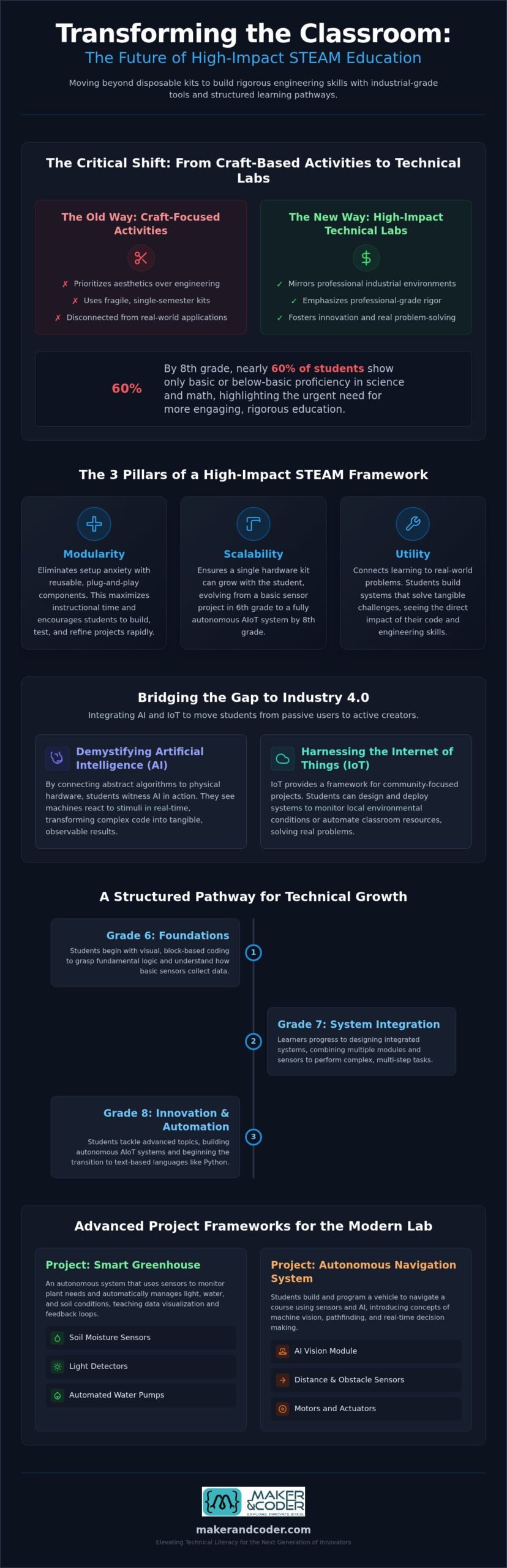
For too long, makerspaces have relied on “craft-based” activities that prioritize aesthetics over engineering. High-impact middle school STEAM projects demand a departure from this model, moving toward technical labs that mirror industrial environments. This shift is vital because middle school represents the ultimate pivot point for student engagement. Research shows that by the eighth grade, nearly 60% of American students demonstrate only basic or below-basic proficiency in science and math. To reverse this trend, we must provide projects that offer real-world utility and professional-grade rigor.
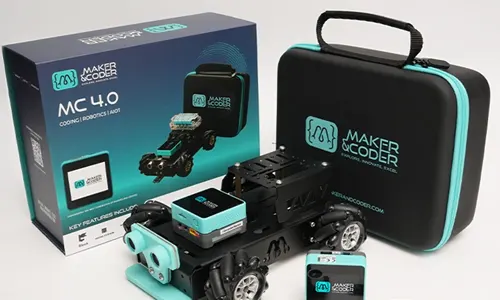
A truly Defining High-Impact Middle School STEAM Projects framework relies on three pillars: modularity, scalability, and utility. When students use professional-grade hardware like the MC4.0 Controller, their confidence surges. They aren’t just playing; they’re practicing. This sense of “expert-as-enabler” transforms the classroom from a room of consumers into a laboratory of innovators. You can explore these professional tools in the Maker & Coder shop to see how high-level hardware changes the learning dynamic.
The Evolution of Technical Literacy
Technical literacy in 2026 is the capacity to evaluate, design, and troubleshoot complex integrated systems through the synthesis of computational logic and physical hardware. It’s a journey of growth. Students begin by understanding basic logic and move rapidly into complex system design. This evolution often involves transitioning from visual, block-based coding to text-based languages like Python. By working with the MC 4.0 ecosystem, learners bridge the gap between abstract concepts and tangible results. They learn that code isn’t just text on a screen; it’s the heartbeat of a machine.
Why Modularity Matters in the Classroom
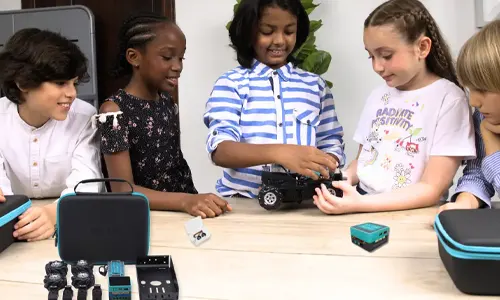
Teacher anxiety often stems from the time-consuming setup and fragile nature of traditional electronics. Modularity eliminates these barriers. Using reusable MC Blocks allows for a plug-and-play experience that maximizes instructional time. Students can iterate quickly. They build, test, and refine without the frustration of loose wires or broken breadboards. This modular approach lowers the entry barrier for beginners while maintaining the technical depth required for advanced learners. It encourages a culture of “fail fast, learn faster,” which is the hallmark of any successful engineering firm. Scalability ensures that a single kit can evolve from a basic sensor project to a fully autonomous AIoT system.
Integrating AI and IoT into the Middle School Lab
Industry 4.0 is not a distant future. It’s the present. For students to succeed in this landscape, they need to move beyond screen-based simulations. Demystifying Artificial Intelligence (AI) happens when a student sees a machine react to physical stimuli in real-time. This is where the MC4.0 AIoT Kit becomes a game-changer. It bridges the gap between abstract algorithms and tangible results. By integrating these technologies into middle school STEAM projects, we prepare learners for a workforce that values both technical skill and innovative thinking. These projects move students from being passive users of technology to active creators of smart systems.
The Internet of Things (IoT) provides a perfect framework for community-focused engineering. Students can design systems that monitor local environmental conditions or automate classroom resources. This alignment with the U.S. Department of Education’s STEM initiatives ensures that your lab meets high academic standards while sparking genuine curiosity. It’s about providing the peace of mind that comes from using curriculum-aligned hardware that actually works.
Building Smart Systems with the MC4.0 AIoT Kit
Imagine a “Smart Greenhouse” built entirely by students. They use modular MC Blocks to connect soil moisture sensors, light detectors, and water pumps. Through the MC4.0 Controller, they program the system to react autonomously to the plants’ needs. You can find these specialized components in the Maker & Coder shop. When designing advanced middle school STEAM projects like these, students gain a sense of ownership over the entire engineering cycle. This isn’t just about coding; it’s about data visualization. Students learn to interpret the ‘S’ in STEAM by analyzing sensor logs and adjusting their code based on empirical evidence. This iterative process mirrors real-world automation and industrial design. It shows them that technology is a tool for solving biological and environmental challenges.
Ethics and AI in the Classroom
Technical skill without ethical grounding is incomplete. As students build automated systems, teachers have a unique opportunity to discuss societal impact. Who owns the data collected by an IoT device? What happens when an AI makes a mistake? By embedding these questions into project-based learning, we develop critical thinking alongside coding. It’s about responsible innovation. We aren’t just teaching kids to build; we’re teaching them to lead with purpose. This approach ensures that technical literacy includes a deep understanding of how technology affects human communities. It’s a journey from basic awareness to sophisticated leadership.
If you’re ready to bring these advanced systems into your classroom, connect with our educational specialists for personalized guidance.
Overcoming the Implementation Gap in STEM Education
Success in the classroom isn’t just about unboxing a new kit. Many educators face a significant implementation gap where high-tech tools sit on shelves because of a lack of structural support. Common barriers include hardware that is too complex for non-specialists and a lack of alignment between the tools and the school’s existing goals. To bridge this divide, we must move away from one-off activities. Instead, we need to establish a continuous educational pathway that builds technical confidence year after year. A structured approach ensures that middle school STEAM projects don’t become isolated events but rather milestones in a student’s long-term development.
The MC Curriculum (K-12) serves as this essential roadmap. It provides the framework necessary for teachers to transition from facilitators to experts. By shifting the focus from what to build to how to engineer, schools can create a sustainable tech hub. This consistency gives both students and parents peace of mind, knowing that the skills learned in sixth grade will directly support the advanced challenges of eighth grade and beyond.
The Role of Teacher Training Programs
Tech-anxiety shouldn’t stall innovation. Professional Teacher Training Programs are designed to bridge the skill gap for those without an engineering background. These programs don’t just teach you how to plug in a sensor; they help you build a community of practice within your district. Leveraging Maker & Coder training ensures a high return on investment for your equipment. When teachers feel empowered, the classroom environment transforms. You move from troubleshooting basic connections to guiding students through sophisticated system design. This professional development is the catalyst that turns a simple classroom into a high-functioning innovation lab.
Curriculum Alignment and Standards
Protect your time. Pre-designed MC Curriculum modules reduce prep time significantly by providing ready-to-use lessons that map middle school STEAM projects directly to Next Generation Science Standards (NGSS). This ensures that every hour spent with the MC4.0 Base Kit or STEAM Kit contributes to measurable academic growth. Vertical alignment is critical. It ensures that the technical literacy students gain in primary school flows seamlessly into secondary education. By using standardized, modular components found in the Maker & Coder shop, districts can maintain a unified hardware standard. This stability is vital in a market where hobbyist electronics have seen significant price volatility. For instance, as of August 2026, Raspberry Pi 16GB models have reached $305, making modular classroom kits a more predictable and durable investment for school budgets.
5 Advanced Project Frameworks for the Modern Lab
Discard the popsicle sticks. While basic crafts have their place, they don’t prepare students for the complexity of 2026 engineering standards. High-impact middle school STEAM projects should challenge students to think like systems engineers. These five frameworks provide a roadmap for that transition, moving from simple input-output logic to integrated, smart technology. Each project is designed to scale in complexity, allowing students to master fundamentals before tackling industrial-grade challenges.
- Framework 1: Autonomous Navigation. Use the MC4.0 Controller to process real-time sensor data for self-driving vehicle prototypes.
- Framework 2: Environmental Monitoring Stations. Deploy modular MC Blocks to capture and visualize long-term climate data within the school ecosystem.
- Framework 3: Interactive Art Installations. Merge aesthetics with logic by programming responsive LED arrays and kinetic sculptures.
- Framework 4: Smart Home Prototyping. Build connected systems that utilize the MC4.0 AIoT Kit for remote monitoring and automation.
- Framework 5: Bio-mimicry Robotics. Study natural movements to design mechanical systems that walk, crawl, or swim.
Step-by-Step: Building an Autonomous Vehicle
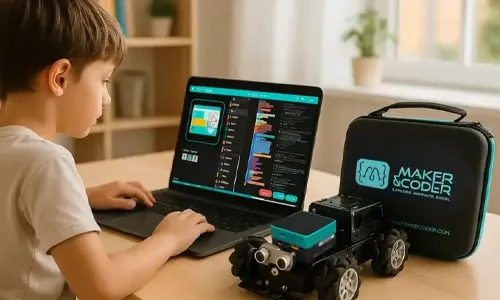
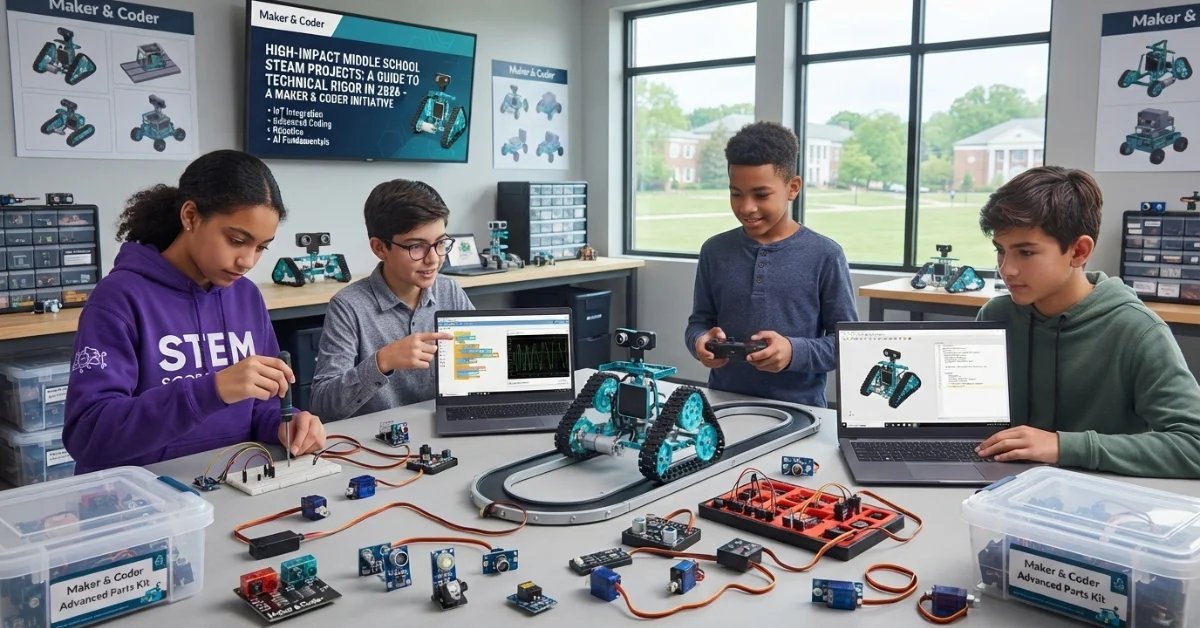
Start with the MC4.0 Base Kit to establish your foundation. Students first select a chassis and integrate the MC4.0 Controller to manage high-speed motor commands. This project is the perfect vehicle for transitioning from block-based coding to text-based Python. Text-based programming allows for more precise sensor thresholds and faster execution of obstacle avoidance algorithms. As students prepare for the 2026-2027 “Override” competition season, they must learn to deploy ultrasonic sensors to map environments. The process involves a rigorous cycle of testing, data logging, and iterative coding. When a vehicle fails a turn, students don’t just guess why; they analyze the sensor logs to find the exact point of failure. You can find the necessary components for this build in the Maker & Coder shop.
Designing for Impact: The Environmental Monitor
Identify local environmental variables that demand attention. Whether it’s monitoring CO2 levels in a crowded cafeteria or tracking humidity in the school garden, students use modular MC Blocks to capture real-time data. This isn’t just a science experiment. It’s a full-scale engineering challenge. Students must design a durable, weather-resistant housing and program a digital dashboard for data visualization. This project bridges the gap between raw engineering and clear communication. By the end of the build, students present their findings to school leadership, proving the real-world utility of their technology. They learn that engineering is most powerful when it solves a tangible problem for their community.
Ready to implement these frameworks in your classroom? To get started with a customized equipment plan, contact our curriculum experts today.
Elevating Technical Literacy with Maker & Coder
Engineering excellence isn’t a destination. It’s a journey of continuous refinement. Building a future-ready classroom requires more than a single purchase; it demands a dedicated partnership between visionary educators and industry-leading technology. By adopting the MC 4.0 platform, you ensure your middle school STEAM projects evolve alongside your students. You move them from passive consumption to active innovation. This progression is vital. It takes learners from the tactile exploration of sixth grade to the sophisticated system design required in eighth grade and beyond.
The synergy between the MC4.0 STEAM Kit and professional-grade coding is the catalyst for this growth. Students don’t just learn to code; they learn to engineer solutions. They bridge the gap between classroom theory and industrial reality. By utilizing modular, reusable components, your school builds a sustainable program that survives budget shifts and changing standards. You aren’t just buying kits. You’re investing in a legacy of technical literacy and creative confidence.
The MC 4.0 Ecosystem Advantage
The MC4.0 Controller serves as the heartbeat of the modern lab. It provides the processing power needed for everything from basic automation to complex AI interactions. When paired with the versatility of MC Blocks, the possibilities are limitless. One week, your students might build a bio-mimicry robot; the next, they’re designing a smart city prototype. This modularity allows you to tailor the experience to diverse student interests while maintaining the rigor required for advanced middle school STEAM projects. It’s a scalable solution that grows with your ambitions. Explore our full range of MC 4.0 Kits to see how these tools integrate into your specific lab environment.
Take the Next Step in Your STEAM Journey
Visionary leadership requires immediate action. Don’t let technical anxiety or complex logistics stall your progress. Accessing the K-12 MC Curriculum provides your district with a clear, standards-aligned roadmap for success. We invite you to experience this transformation first-hand. Requesting a pilot program allows your team to test the hardware and curriculum in a real-world classroom setting before committing to a full rollout. It’s time to empower your students and provide the technical rigor they deserve. Contact us to start your STEAM transformation and discover how we can support your journey toward a future-ready classroom.
Building the Next Generation of Technical Pioneers
The transition from simple classroom crafts to rigorous engineering marks the difference between a toy and a tool. Modular hardware and purposeful AI integration transform the learning environment from a room of consumers into a lab of creators. High-impact middle school STEAM projects succeed when they bridge the gap between basic coding and real-world industrial technology. This journey requires a dedicated partnership. By combining professional-grade MC 4.0 Hardware with a structured K-12 MC Curriculum and expert training, Maker & Coder provides students with a clear pathway to mastery. You have the opportunity to transform your lab into a space where innovation isn’t just a concept; it’s a tangible outcome. Imagine the growth as your students develop the technical literacy and confidence needed to solve the complex problems of tomorrow. Take the lead in building a future-ready classroom and watch your students thrive in 2026 and beyond.
Empower your students with the future of STEAM. Contact us today.
Frequently Asked Questions
What are the best STEAM projects for 6th-8th grade students?
High-impact middle school STEAM projects should focus on autonomous navigation, environmental monitoring, and bio-mimicry robotics. These projects move beyond simple crafts by using industrial-grade components like the MC4.0 Controller. By sixth grade, students can master basic automation. By eighth grade, they should be designing smart systems that solve community problems. This progression ensures they develop the technical depth required for high school engineering and future workforce demands. It’s a journey from curiosity to mastery.
How do I transition students from Scratch to Python in middle school?
Use hardware as a tangible bridge to move students from visual blocks to text-based coding. Students often find the shift to Python easier when they see how a line of code directly affects a motor or sensor. Start with block-based logic in the MC 4.0 environment. Then, introduce Python for advanced tasks like complex data logging or precise obstacle avoidance. This hands-on approach demystifies syntax and highlights the practical utility of text-based languages.
What hardware is necessary for a middle school STEAM lab in 2026?
A modern lab in 2026 requires modular, high-performance hardware that resists obsolescence. Essential components include the MC4.0 Controller, a variety of modular MC Blocks for sensing, and specialized kits like the MC4.0 AIoT Kit. Avoid fragile hobbyist electronics that require constant troubleshooting. Instead, invest in industrial-grade kits that offer plug-and-play connectivity. This ensures your equipment survives multiple semesters while providing the technical rigor students need to innovate. It’s about building a sustainable ecosystem for discovery.
How can I integrate AI and IoT into my current science curriculum?
Integrate AI and IoT by replacing abstract theories with hardware-driven experiments. Use the MC4.0 AIoT Kit to build smart systems that monitor real-world variables, such as soil moisture or air quality. Students learn to interpret the ‘S’ in STEAM by analyzing live data streams. This turns a standard science lesson into a sophisticated engineering lab. It shows students how technology acts as a tool for observing and protecting our natural environment. It’s real-world science.
Does the MC 4.0 platform align with NGSS standards?
Yes, the MC 4.0 platform is designed to align directly with Next Generation Science Standards (NGSS). The K-12 MC Curriculum provides a roadmap that maps specific middle school STEAM projects to academic requirements. This alignment ensures that every technical activity supports core science and engineering practices. Teachers can implement these projects with confidence, knowing they are meeting district standards while providing students with high-level technical literacy and problem-solving skills. It’s professional-grade education.
What kind of teacher training is available for the MC 4.0 platform?
We offer comprehensive Teacher Training Programs designed to eliminate implementation anxiety for educators of all technical backgrounds. These programs provide hands-on experience with the MC 4.0 ecosystem and pedagogical strategies for project-based learning. Training sessions help build a community of practice within your district. This support ensures long-term ROI on your equipment. You move from a state of uncertainty to a state of expert leadership in your technical lab. It’s about empowering the enabler.
Can middle schoolers actually learn real-world engineering skills?
Middle schoolers excel at real-world engineering when provided with the right tools and frameworks. By using the MC4.0 Base Kit, students engage in iterative design, troubleshooting, and data-driven decision-making. These are the exact skills used by professional engineers. When students see their code power an autonomous vehicle or a smart greenhouse, their self-efficacy grows. They aren’t just learning about engineering; they are practicing it in a meaningful, tangible way. It’s a bridge to the future.
How do I manage a STEAM project with 30 students in a single period?
Efficient management relies on modular hardware and pre-designed curriculum modules. Modular MC Blocks allow for rapid setup and teardown, maximizing precious instructional time. The MC Curriculum provides structured, step-by-step pathways that enable students to work independently or in small teams. This approach reduces the need for constant teacher intervention during the build phase. You transition from a troubleshooter to a high-level mentor, guiding 30 students toward successful project completion.