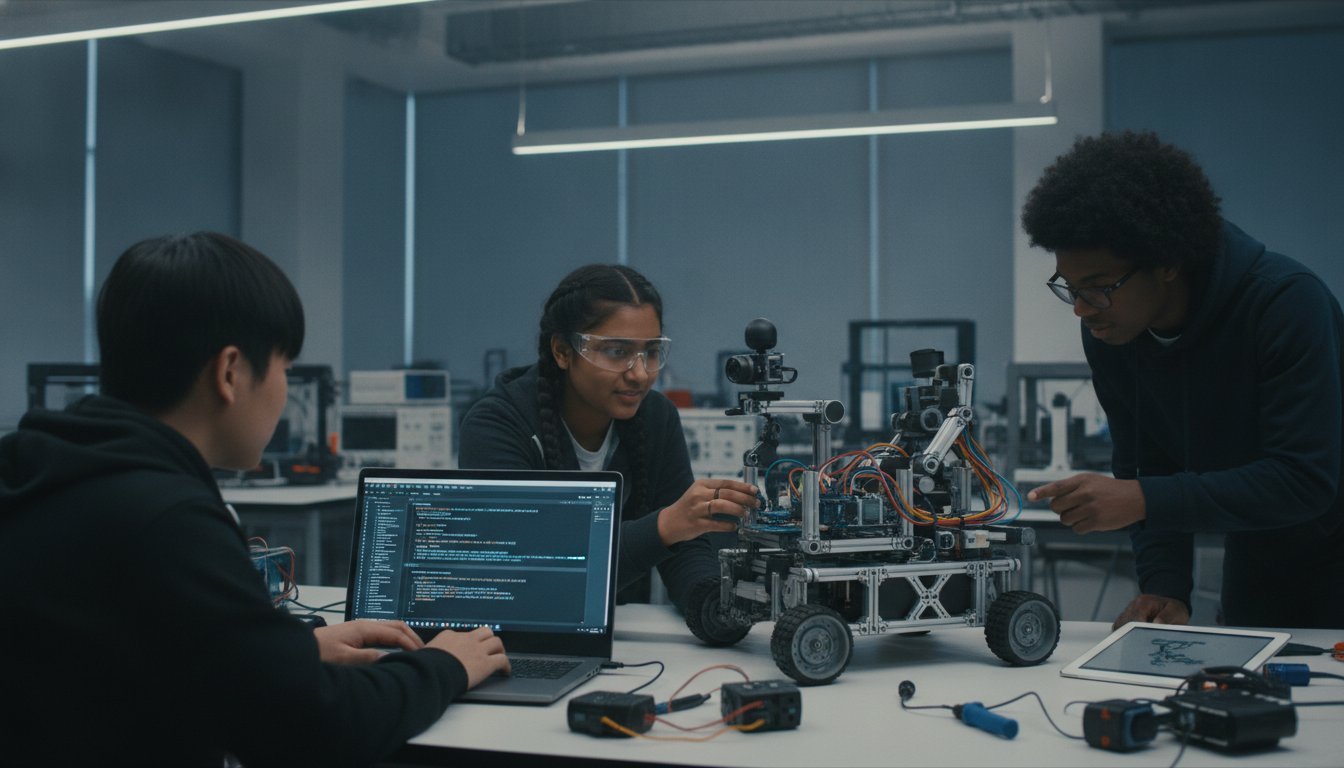
The era of “toy-based” STEM has reached its limit. If your students are still snapping together plastic bricks that lack real-world processing power, they aren’t being prepared for the 2026 engineering landscape. High schoolers today need more than a simplified interface. They require advanced robotics kits for high school that demand the same technical rigor as the systems used in modern aerospace and AI labs.
It’s a common frustration: a curriculum hits a dead end because the hardware can’t handle text-based coding or complex IoT integration. You know your students are ready for Python and autonomous navigation, but the jump from block-based logic to professional syntax often feels like a chasm. We’re here to bridge that gap. You’ll discover how to transition from basic building blocks to professional-grade AI and IoT robotics systems that mirror university engineering. We’ll explore how the MC 4.0 ecosystem, powered by modular MC Blocks and a structured curriculum, equips the next generation with industry-standard skills. It’s time to move beyond the basics and start building the future.
Key Takeaways
- Define the transition from mechanical assembly to high-level data and AI challenges found in professional engineering environments.
- Utilize the MC4.0 Controller and specialized sensors to move beyond basic touch responses toward sophisticated, autonomous robotics.
- Ensure long-term program success by pairing hardware with a dedicated K-12 curriculum and professional training to eliminate implementation friction.
- Bridge the coding gap by using advanced robotics kits for high school that facilitate a smooth shift from visual MC Blocks to industry-standard Python.
- Select the ideal modular configuration, such as the AIoT or STEAM kits, to provide a scalable learning path that grows alongside your students’ ambitions.
Beyond the Basics: Defining Advanced Robotics for High Schoolers
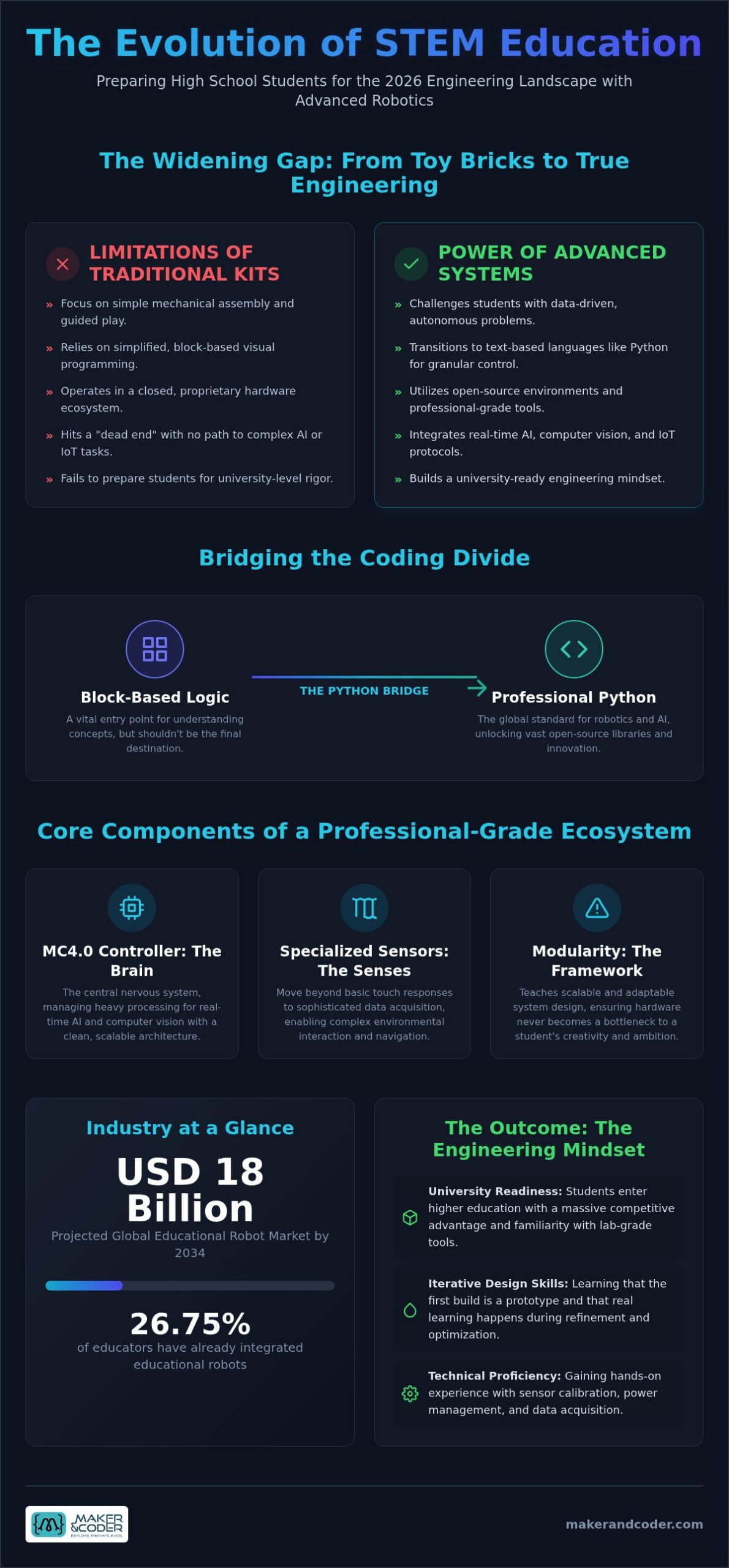
High school marks a pivotal transformation in technical education. For years, students have explored Educational robotics through colorful, snap-together components that prioritize immediate gratification over technical depth. While these kits serve a purpose in primary school, they often fail to prepare older students for the rigors of a university lab. A 2026 survey indicates that 26.75% of educators have already integrated educational robots into their teaching, but the focus is rapidly shifting from mere integration to high-level application. Today’s advanced robotics kits for high school must move beyond simple mechanical assembly. They should challenge students to solve data-driven problems using artificial intelligence and real-world sensors. This shift represents the move from guided play to autonomous engineering, where the focus pivots to data acquisition and algorithmic control.
True advancement isn’t just about more parts; it’s about shifting the focus from “what can I build?” to “how can I optimize this system?” This transition involves moving from closed, proprietary hardware to open-source environments. By using professional-grade tools like the MC 4.0 ecosystem, students stop playing with toys and start interacting with the same logic used in modern industrial automation.
The Shift from Block-Based to Professional Coding
Visual programming serves as a vital entry point, but it shouldn’t be the final destination. Professional engineering relies on text-based languages that offer granular control over hardware. Python has emerged as the global standard for robotics and AI because of its readability and massive library support. Transitioning to Python allows students to integrate complex AI libraries, enabling robots to recognize faces or navigate obstacles with real-time computer vision. Closed ecosystems that lock students into block-based logic stifle growth. They prevent learners from accessing the vast world of open-source libraries that drive modern innovation. The ‘Python Bridge’ serves as the essential link that transforms a student’s conceptual understanding of logic into the practical, text-based command of hardware required for professional success.
University Readiness and the Engineering Mindset
University labs demand precision and technical literacy. Advanced kits simulate real-world pressures by requiring precise sensor calibration and efficient power management. Modularity is the key here. When students use components like MC Blocks, they learn to design systems that are scalable and adaptable. Developing an engineering mindset means embracing iterative design; students must learn that their first build is a prototype, and the real learning happens during the refinement phase. This fosters a creative problem-solving mindset that is invaluable during technical interviews. High school is the critical window to instill these habits. It’s the time to move students from being consumers of technology to being the architects of it. By engaging with advanced robotics kits for high school found in the Maker & Coder shop, students enter university with a massive competitive advantage.
The Core Components of Professional-Grade STEM Kits
A collection of motors and beams isn’t a robot; it’s a pile of parts. True advanced robotics kits for high school distinguish themselves through the seamless integration of high-level processing and intelligent feedback. Programs like the Advanced Robotics Pathway curriculum demonstrate that college-readiness requires hardware that can handle complex logic and industrial communication protocols. To prepare students for a global educational robot market projected to reach USD 18 billion by 2034, kits must provide more than just movement. They must offer a sophisticated ecosystem where every component serves a data-driven purpose.
The Power of the MC4.0 Controller
The MC4.0 Controller acts as the central nervous system of the build. Unlike basic hubs that simply execute pre-written scripts, this controller manages the heavy processing required for real-time AI and computer vision. It’s designed with modular ports that allow for infinite expansion without messy rewiring, mirroring the clean, scalable architecture found in professional labs. This hardware serves as the physical bridge to the MC Curriculum, ensuring that as students progress through high school, their hardware never becomes the bottleneck to their creativity. Explore the full range of controllers and modules in our Maker & Coder shop.
AIoT: The Intersection of Artificial Intelligence and Robotics
Educators must look toward AIoT (Artificial Intelligence of Things) as the standard for 2026. With 80% of U.S. students already utilizing AI for schoolwork, the classroom must pivot to teaching how AI interacts with physical systems. This isn’t just about robots that move; it’s about robots that perceive. Using advanced robotics kits for high school like the MC4.0 AIoT Kit, students can build systems for smart cities or autonomous environmental monitoring. These kits move beyond simple touch sensors to include AI cameras and environmental data collectors. This allows students to solve multi-layered problems that involve both local mechanical action and cloud-based data analysis.
Durability is equally vital. High school environments require “industrial-lite” build quality, meaning hardware that’s tough enough for daily classroom use but modular enough for rapid prototyping. If you’re ready to upgrade your lab’s capabilities, feel free to reach out to our educational consultants for a tailored equipment plan.
Why Hardware Alone Isn’t Enough: The Role of Curriculum and Training
Buying the best hardware is only half the battle. Too often, schools invest in premium equipment only for it to suffer from “Dusty Shelf” syndrome. This happens when high-spec tools sit unused because they lack a structured, actionable plan for the classroom. For advanced robotics kits for high school to be effective, they must be part of a larger ecosystem that supports both the student and the educator. A professional curriculum doesn’t just provide instructions. It provides a roadmap that saves teachers hundreds of preparation hours every year. It bridges the gap between having a kit and having a career-ready STEM program.
K-12 alignment ensures that students build upon their knowledge rather than repeating the same foundational concepts. When a high schooler encounters a kit, they should feel challenged by new complexities, not bored by familiar limitations. This continuity is what transforms a simple classroom activity into a long-term journey toward university engineering. It shifts the focus from “what can I build today?” to “what skills am I mastering for tomorrow?”
Structured Pathways with the MC Curriculum
The MC Curriculum provides the structure needed to scale from basic logic to advanced AI. It begins by establishing core principles and moves steadily toward complex, data-driven applications. It aligns robotics projects with international academic standards, ensuring that every hour spent in the lab translates to measurable academic growth. By using curriculum-ready systems found in the Maker & Coder Shop, schools can implement a high-level engineering track without reinventing the wheel. This structured approach allows students to see their own growth as they move through increasingly difficult engineering constraints.
Empowering Educators through Teacher Training
Technology can be daunting. Even for seasoned educators, the leap into AI and Python can feel overwhelming. Professional Teacher Training Programs remove this friction by addressing the fear of technology directly. These programs don’t just teach which buttons to press. They cover troubleshooting, pedagogy, and how to unlock advanced features like IoT data logging. When teachers feel confident, they become mentors rather than just instructors. Data shows that trained teachers achieve significantly higher student engagement, often seeing triple the participation in elective STEM projects. This training turns a daunting challenge into an accessible tool for creative expression, giving educators the peace of mind they need to lead.
Transitioning from Block-Based to Python and AIoT
Transitioning from visual logic to text-based syntax is often the point where student interest wanes. It’s the “syntax wall.” Effective advanced robotics kits for high school dismantle this wall by providing a hybrid environment where students see the direct relationship between blocks and code. Learners begin with the familiar logic of MC Blocks and gradually reveal the underlying Python scripts. This method ensures that the conceptual understanding of logic remains intact while students master the nuances of professional programming. You can find these curriculum-ready systems in the Maker & Coder shop. This progression typically follows five distinct phases:
- Phase 1: Establishing core logic through visual programming using MC Blocks.
- Phase 2: Introducing Python syntax while maintaining a side-by-side visual reference for confidence.
- Phase 3: Implementing specialized AI libraries to handle computer vision and complex data analysis.
- Phase 4: Deploying IoT projects that allow robots to interact with real-world web data and remote sensors.
- Phase 5: Executing capstone projects, such as autonomous vehicles or complex system designs that mirror industrial applications.
Mastering Python in a Robotics Context
Learning Python through robotics is significantly more effective than screen-only coding. It creates an instant feedback loop. When a student writes a line of code, they don’t just see text on a monitor. They see a robotic arm rotate or a drive system accelerate. This physical validation makes abstract concepts like variables and loops feel tangible and purposeful. “Python isn’t just a language for robotics; it’s the gateway to the modern data economy.” By mastering this language within the context of advanced robotics kits for high school, students gain a skill set that is immediately applicable to the 2026 job market.
Building Real-World AI Applications
AI should be treated as a tool for perception rather than just a buzzword. High schoolers are now capable of using machine learning for object recognition, allowing their builds to “see” and react to their environment. The MC4.0 STEAM Kit facilitates this multi-disciplinary learning by combining mechanical engineering with high-level data science. We encourage students to solve local problems, such as building autonomous systems for environmental monitoring or smart campus infrastructure. This approach turns a classroom exercise into a meaningful contribution to their community. If you’re ready to modernize your curriculum, contact our team for a personalized equipment plan.
Implementing the MC 4.0 Ecosystem in Your STEM Program
Launching a high-level engineering track requires a strategic approach that balances immediate classroom needs with long-term institutional goals. It’s not just about procurement; it’s about integration. By selecting advanced robotics kits for high school that align with your specific learning objectives, you create a scalable pathway that grows alongside your students’ ambitions. This ecosystem approach ensures that hardware, curriculum, and training work in harmony to produce university-ready engineers.
Choosing the Right Kit for Your Classroom
The MC 4.0 ecosystem offers specialized configurations to meet different academic milestones. Selecting the right starting point depends on your program’s current maturity and desired outcomes. You can explore these options in the Maker & Coder shop to find the best fit for your lab:
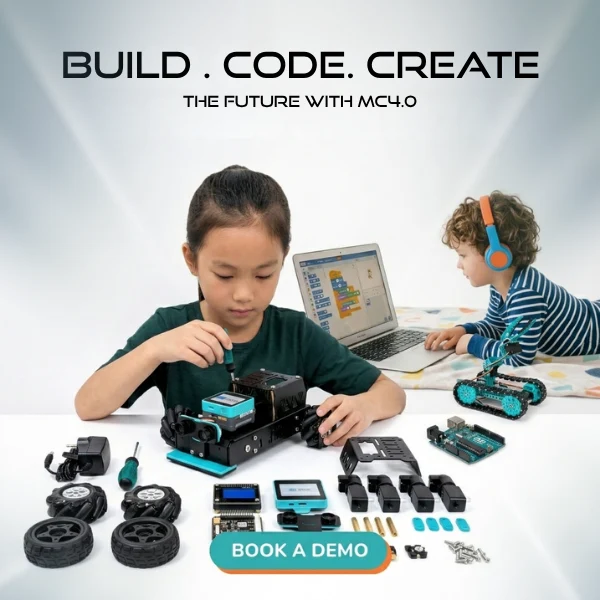
- MC4.0 Base Kit: This provides the fundamental technical education needed to master the MC4.0 Controller and core mechanical principles. It’s the ideal entry point for establishing a solid engineering foundation.
- MC4.0 AIoT and STEAM Kits: These are specialized tools designed for advanced cohorts. They introduce complex sensors for environmental monitoring, autonomous navigation, and multi-disciplinary problem-solving.
- Modular MC Blocks: These components are the secret to budgeting for longevity. Because the system is modular, you can implement year-over-year expansions without discarding previous investments. This modularity offers a much higher ROI than “closed” consumer kits.
Start Your STEM Transformation Today
Success begins with a focused pilot program. Rather than an all-at-once rollout, start with a core group of students and pair the hardware with professional teacher training. This reduces implementation friction and ensures that your educators feel like empowered mentors. Securing school board approval is often the final hurdle. When presenting your plan, emphasize that 26.75% of educators have already integrated robotics as of 2026. Highlight how these kits prepare students for a global market projected to reach USD 18 billion by 2034. Frame robotics not as an elective, but as a team sport that fosters collaboration, data literacy, and resilience.
Advanced robotics is a journey from basic logic to complex, real-world systems. By investing in modular hardware and a structured curriculum, you provide your students with a bridge to professional engineering. Our team is ready to help you navigate the technical and budgetary requirements of a modern STEM lab. Contact our educational experts to design your robotics pathway and take the first step toward a future-proof classroom.
Building the Future of Technical Education
The transition from basic building blocks to professional-grade engineering is a defining moment for any STEM program. By integrating advanced robotics kits for high school, you move beyond simple assembly into the sophisticated world of AI, Python, and IoT. We’ve explored how the right controller, a structured curriculum, and professional support turn a classroom into a high-tech laboratory. The focus shifts from merely following instructions to solving real-world data challenges.
Our modular hardware, including the versatile MC Blocks, ensures your investment grows alongside your students’ skills year after year. This ecosystem is already trusted by K-12 schools worldwide to bridge the gap to university-level engineering. We don’t just provide hardware; we provide a complete pathway that includes professional Teacher Training to ensure long-term success. It’s about giving educators the confidence to lead and students the tools to innovate.
The future of global innovation belongs to those who can master complex systems today. Ready to elevate your STEM program? Contact the Maker & Coder team today to design a customized robotics pathway for your school. Let’s empower the next generation to build something extraordinary.
Frequently Asked Questions
What are the best robotics kits for high school students interested in engineering?
The best advanced robotics kits for high school are those that bridge the gap between simple building and professional engineering. Systems like the MC 4.0 ecosystem stand out because they offer modular MC Blocks and a high-performance controller. These kits allow students to move from visual logic to industry-standard Python, ensuring they develop the technical depth required for university-level labs and modern AI research.
Is Python or C++ better for high school robotics?
Python is currently the preferred choice for high school robotics because of its dominance in the AI and data science sectors. While C++ is vital for low-level firmware, Python’s readability allows students to focus on complex logic and machine learning without getting bogged down by intricate syntax. This makes it the ideal gateway for learners transitioning from block-based environments to professional-grade programming.
How do I start a robotics program in my high school?
Successful programs begin with a clear roadmap rather than just a hardware purchase. Start by identifying your learning goals, then choose a modular platform like the MC 4.0 ecosystem that scales with your students. Investing in professional Teacher Training Programs is the most critical step. This ensures your staff can troubleshoot technical hurdles and deliver a high-impact curriculum that keeps students engaged year-round.
Can high school students learn AI and Machine Learning through robotics?
High school students can absolutely master AI and Machine Learning when provided with the right tools. By using the MC4.0 AIoT Kit, learners interact with AI cameras and sensors to build autonomous systems. They learn to implement object recognition and environmental data analysis, moving beyond simple logic to create robots that perceive and react to their surroundings in real time using 2026-standard technology.
What is the difference between a toy robot and a STEM education kit?
Toy robots are designed for fixed entertainment and often lack the depth for academic growth. In contrast, professional advanced robotics kits for high school are modular and programmable. They utilize open-source languages and standard components like the MC4.0 Controller. These kits are built to integrate with a comprehensive K-12 curriculum, preparing students for the technical rigor of higher education and industrial engineering roles.
How much does it cost to implement a robotics curriculum in a school?
Implementation costs depend on your student-to-kit ratio and whether you choose specialized sets like the AIoT or STEAM kits. For the best ROI, schools should prioritize modular systems like MC Blocks. These allow you to start with a foundation and expand your lab over time without needing to replace entire systems, ensuring your budget supports long-term technical growth across multiple grade levels.
Do teachers need an engineering degree to teach advanced robotics?
Educators don’t need a formal engineering degree to lead a successful robotics track. While technical curiosity helps, professional training programs are specifically designed to empower non-technical teachers. These programs cover everything from hardware troubleshooting to advanced Python pedagogy. With the right support, any dedicated educator can guide their students through complex engineering challenges and AI implementation with total peace of mind.
What is the MC 4.0 platform and how does it help high schoolers?
The MC 4.0 platform is an integrated ecosystem designed to transition students from basic STEM to professional engineering. It combines the powerful MC4.0 Controller with modular hardware and a full K-12 curriculum. By providing a clear path from visual MC Blocks to text-based coding, it helps high schoolers build the cognitive and technical skills necessary for success in a technology-driven economy and competitive university environments.