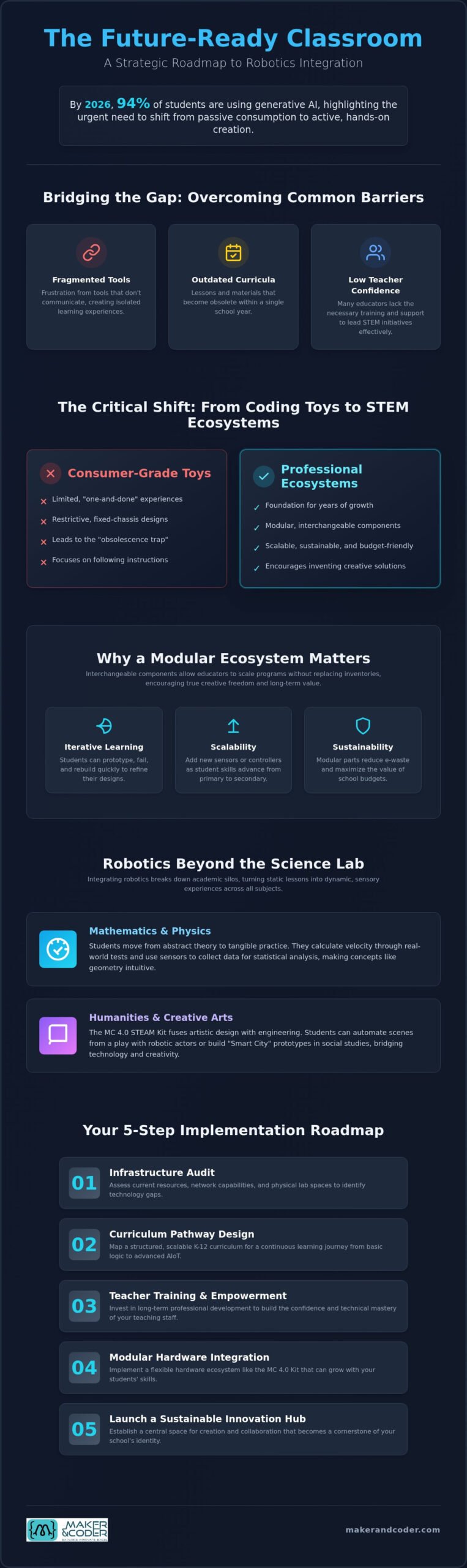
By 2026, 94% of students are already using generative AI for their schoolwork, yet many schools still struggle to bridge the gap between passive consumption and active creation. You’ve likely experienced the frustration of fragmented tools that don’t communicate or curricula that expire within a single year. Successfully integrating robotics into the classroom requires moving beyond isolated kits toward a cohesive, modular ecosystem that evolves alongside your students. It’s about turning a daunting technical challenge into an accessible tool for creative expression.
We understand that teacher confidence is the true engine of any STEM initiative. This guide provides a strategic roadmap to transform your school into a premier hub of innovation. You’ll discover how to leverage the MC 4.0 platform, AIoT integration, and structured K-12 pathways to cultivate a future-ready environment. We’ll preview the journey from basic coding to advanced real-world applications; ensuring your staff feels empowered, trained, and ready to lead the next generation of innovators.
Key Takeaways
- Define the shift from consumer-grade coding toys to professional-grade STEM ecosystems that prepare students for real-world technical challenges.
- Explore how purposeful STEAM integration allows robotics to enhance subjects from geometry to digital design, breaking down the silos of the traditional science lab.
- Recognize why a structured K-12 MC Curriculum is essential to ensure that modular hardware like the MC 4.0 Kit delivers a continuous, scalable learning pathway.
- Overcome implementation barriers by prioritizing long-term Teacher Training Programs that build confidence and technical mastery across your entire staff.
- Follow a proven 5-step roadmap for integrating robotics into the classroom, starting with an infrastructure audit and ending with a sustainable innovation hub.
Table of Contents
What is Strategic Robotics Integration in the 2026 Classroom?
Strategic integration isn’t about filling a storage cupboard with expensive gadgets. It’s the purposeful use of programmable hardware to meet specific learning objectives across the K-12 spectrum. Educational robotics has moved far beyond simple “play-based” activities. In 2026, the focus has shifted toward professional-grade STEM ecosystems that prioritize computational thinking: the ability to break down complex problems into logical, executable steps. Integrating robotics into the classroom transforms these abstract logic puzzles into physical, tangible results that students can see and touch.
We must distinguish between consumer-grade coding toys and professional-grade tools. While toys often provide a limited, “one-and-done” experience, a true STEM ecosystem like the MC 4.0 Kit offers a foundation for years of growth. It moves students from basic logic to advanced engineering. This approach ensures that technology remains an accessible tool for creative expression rather than a daunting technical hurdle.
The Evolution from Coding to AIoT
Basic movement commands are no longer enough for the modern student. As we move through 2026, the standard for middle and high school education is the Artificial Intelligence of Things (AIoT). This is where hardware meets connectivity. By integrating sensors and internet-enabled controllers, students learn how a simple robot becomes a smart system capable of making data-driven decisions. AI literacy is now a core requirement. Students don’t just program a motor; they train a system to recognize patterns, respond to environmental data, and interact with the cloud.
Why a Modular Ecosystem Matters
Schools often face the “obsolescence trap” where kits become useless as soon as one part breaks or a student outgrows the complexity level. A modular approach solves this. By using interchangeable components like MC Blocks, educators can scale their programs without replacing entire inventories. This flexibility encourages true creative freedom.
- Iterative Learning: Students can prototype, fail, and rebuild quickly to refine their designs.
- Scalability: Add new sensors or more powerful controllers as student skills advance from primary to secondary levels.
- Sustainability: Modular parts reduce electronic waste and maximize the value of school budgets.
When students aren’t restricted by a fixed chassis, they stop following instructions and start inventing solutions. Integrating robotics into the classroom through modularity ensures your lab remains a cutting-edge environment for years to come. This methodical progression builds momentum, leading students from a state of curiosity to a state of action.
Cross-Curricular Application: Robotics Beyond the Science Lab
Robotics is no longer a siloed elective. It is a universal language for problem-solving. Integrating robotics into the classroom allows educators to break down traditional academic barriers, turning static lessons into dynamic, sensory experiences. When a student sees a mathematical equation come to life through a robot’s movement, the learning becomes indelible. It’s about moving from passive observation to active engineering. By 2026, the most successful schools will be those that treat technology as a foundational tool across all departments.
Robotics in Mathematics and Physics
Geometry and physics often suffer from a lack of physical context. By using modular hardware, students can calculate velocity and acceleration through real-world testing rather than just reading from a textbook. They use sensors to collect environmental data, providing a rich dataset for statistical analysis in math class. This physical engagement with Educational Robotics and Computational Thinking proves that students grasp abstract concepts much faster when they can manipulate variables in real time. Visualizing a 90-degree turn or a parabolic arc becomes intuitive when a robot is the medium. They aren’t just solving for X; they’re programming a destination.
Humanities and Creative Problem Solving
The humanities provide a fertile ground for technical application. The MC4.0 STEAM Kit is specifically designed to bridge this gap, enabling students to fuse artistic design with functional engineering. Imagine a literature class where students automate a scene from a play using robotic actors, or a social studies unit where they use AIoT modules to build Smart City prototypes. These projects do more than teach tech; they encourage collaborative ethics discussions. Students must grapple with the implications of automation and AI in modern society. They learn to ask not just “can we build this?” but “should we?”
Data literacy is now essential for environmental and social studies. Students can deploy sensors to monitor local air quality or traffic patterns, turning their school into a living laboratory. This holistic approach ensures that technology feels like an accessible tool for creative expression. It builds a bridge between the digital and the physical world. If you want to see how these kits fit into your specific syllabus, reach out to our educational consultants for a tailored strategy. Successful schools are already integrating robotics into the classroom to meet 2026 standards and beyond.
The Ecosystem Approach: Hardware vs. Curriculum
Buying a robot is easy. Building a sustainable, multi-year program is the real challenge. Many schools fall into the trap of purchasing hardware without a pedagogical framework, resulting in expensive tools that gather dust once the initial novelty fades. Integrating robotics into the classroom requires a strategic synergy between professional-grade hardware and a structured, scaffolded curriculum. Without this link, technology remains a distraction rather than a transformative engine for growth. A true ecosystem approach ensures that every lesson builds upon the last, moving students from basic logic to advanced engineering with purpose.
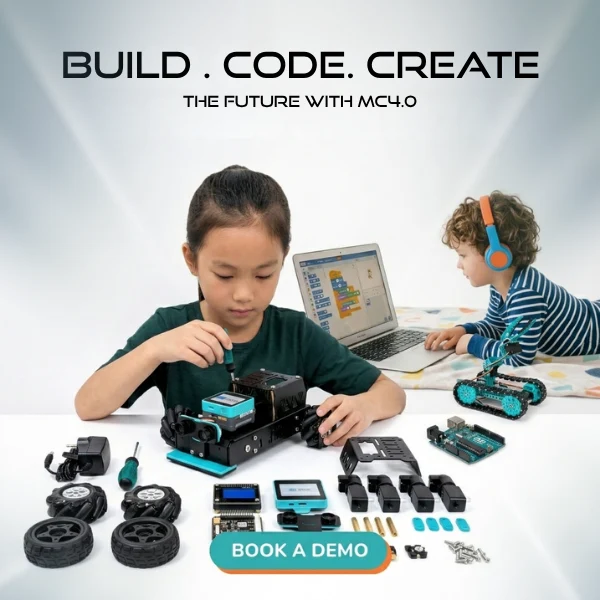
The MC 4.0 Kit is designed to be the bridge between classroom theory and industry reality. It provides a professional technical foundation that prepares students for the high-stakes demands of the modern workforce. By combining the power of the MC4.0 Controller with the MC Curriculum (K-12), schools create a seamless pathway. This methodical progression ensures that students don’t just learn to follow instructions; they learn to innovate within a complex system.
Why Standardized Hardware Simplifies Integration
Technical troubleshooting is the primary thief of instructional time. When a classroom uses a fragmented mix of tools, teachers spend more time fixing connections than teaching concepts. A unified platform like the MC4.0 Base Kit reduces this friction. It provides a reliable, standardized environment that simplifies the learning curve for both staff and students. Because the system is modular, it grows with the learner. Primary students might start with simple block-based logic, while secondary students transition to Python-based coding on the same hardware. This continuity is vital for a high-level technical transition, ensuring that the skills learned in year six remain relevant in year twelve.
The Role of the MC Curriculum in 2026
In 2026, educational standards demand more than just “exposure” to technology. The MC Curriculum (K-12) aligns directly with global STEM standards, providing a ready-to-use roadmap for busy educators. It removes the burden of lesson preparation by offering structured technical milestones and clear learning objectives. Integrating robotics into the classroom becomes a manageable reality when teachers have access to comprehensive guides that track student progress. This allows educators to focus on what they do best: mentoring and inspiring the next generation of pioneers. By following a proven curriculum, schools can guarantee that their robotics program remains a core pillar of academic excellence rather than a passing trend.
Overcoming Implementation Barriers: Training and Support
Hardware is only as effective as the person leading the lesson. Even with the most advanced tools, “Tech-Anxiety” remains the primary barrier to successfully integrating robotics into the classroom. Many educators feel they need a computer science degree before they can open a kit. This fear often leads to expensive equipment sitting idle in storage. We believe technology should be an accessible tool for creative expression, not a source of stress. Overcoming this hurdle requires a shift from viewing teachers as tech support to seeing them as visionary mentors. It’s about providing the peace of mind that comes with professional mastery.
One-off workshops rarely create lasting change. They provide a temporary spark but lack the depth needed for long-term implementation. Our Teacher Training Programs follow an “Expert-as-Enabler” model, moving staff from basic curiosity to advanced instructional confidence. This methodical progression ensures that educators don’t just learn how to operate a machine; they learn how to inspire a generation. By investing in ongoing support, schools transform their staff into a dedicated community of innovators.
Designing Effective Teacher Training
Effective professional development must be hands-on. Teachers need to build, fail, and iterate just like their students. When educators engage in physical experimentation, they demystify the technical process for themselves. Focus your training on pedagogy rather than just programming. It’s more important to teach “how to think” through a problem than “where to click” in an interface. This approach builds a resilient community of practice where STEM educators share strategies and troubleshoot together. Empower your staff to lead with curiosity. When a teacher feels confident, the entire classroom environment shifts from hesitation to discovery.
Sustainable Technical Support
Classroom management becomes much simpler when the hardware is reliable. The MC4.0 Controller provides a professional-grade foundation that minimizes technical glitches, allowing the focus to remain on learning. Using modular MC Blocks further reduces friction, making it easy for teachers to organize, distribute, and maintain kits across multiple grade levels. Reliability is the bedrock of teacher confidence. If the tools work every time, the anxiety disappears. Explore our Teacher Training Programs and MC 4.0 Hardware to see how we bridge the gap between complex systems and the daily classroom experience.
Long-term technical partnerships are essential for a sustainable roadmap. Maker & Coder doesn’t just sell kits; we act as a dedicated educational partner. We provide the supportive mentorship needed to ensure your robotics program thrives well beyond the first year. If you’re ready to eliminate tech-anxiety and empower your teaching staff, speak with our educational specialists about customized professional development. Integrating robotics into the classroom is a journey, and having a trusted guide makes all the difference.
Implementing Your Robotics Roadmap: A 5-Step Success Plan
Building a future-ready school doesn’t happen by accident. It requires a methodical transition from fragmented tools to a unified ecosystem. Integrating robotics into the classroom is most successful when educators follow a structured roadmap that prioritizes long-term scalability over short-term excitement. By moving from a state of curiosity to a state of action, you can ensure your investment in technology translates into tangible student outcomes. This plan is designed to bridge the gap between initial interest and a sustainable hub of innovation.
- Audit Infrastructure: Evaluate your current Wi-Fi capacity and device compatibility (tablets vs. laptops) before making a purchase.
- Select Scalable Hardware: Choose a foundation like the MC 4.0 Kit that can evolve with your students’ skills.
- Empower Your Staff: Invest in Teacher Training Programs at least one term before the student-facing launch.
- Execute a Focus Pilot: Start with a dedicated “STEAM” or “AIoT” group to work out implementation kinks in a controlled environment.
- Scale the Ecosystem: Expand across the K-12 pathway using modular MC Blocks to maintain technical continuity.
Phase 1: Goal Setting and Hardware Selection
Success begins with clarity. Determine if your immediate need is a Base, AIoT, or STEAM focus for your first kits. This decision should align with your specific learning goals for the year. If you’re targeting middle school engineering, the MC4.0 AIoT Kit provides the necessary sensors and connectivity to model smart systems. Securing a budget is often the biggest hurdle; position your request through the lens of long-term “future-readiness.” Administrators are more likely to support a program that demonstrates a clear, multi-year ROI rather than a one-off purchase of coding toys.
Phase 2: Launch and Continuous Growth
Don’t rush the rollout. Introduce the MC Curriculum in a way that empowers, not overwhelms. By providing teachers with ready-made lesson plans, you reduce prep time and allow them to focus on mentoring students through the creative process. As your program takes root, celebrate student “Maker” success through school-wide showcases. Seeing a peer’s robot solve a real-world problem builds more momentum than any administrative mandate ever could. Once the pilot is successful, you can easily scale the program across different grade levels by adding modular MC Blocks to your existing inventory. Equip your classroom with the MC 4.0 Ecosystem today to begin your journey toward a premier STEM environment.
Building a Legacy of Innovation in Your School
Successfully integrating robotics into the classroom is no longer a futuristic goal; it’s a present-day necessity for 2026 educators. We’ve explored how a modular ecosystem, powered by the professional-grade MC4.0 Controller, transforms learning from passive observation into active creation. By aligning high-level hardware with a comprehensive K-12 MC Curriculum, you provide students with a consistent pathway toward AIoT and industry readiness. This methodical approach ensures your school remains a leader in STEM education for years to come.
Success hinges on the confidence of your staff. Through our Global Teacher Training Support, we act as a dedicated partner to ensure your school moves beyond implementation barriers toward sustainable growth. You have the power to turn every lesson into a journey of discovery. It’s time to bridge the gap between complex modern systems and the classroom environment.
Ready to transform your school into a hub of innovation? Shop the MC 4.0 Ecosystem and K-12 Curriculum to start building your robotics roadmap today. The future of your students is waiting for the tools you provide now.
Frequently Asked Questions
Do I need a specialized computer science degree to teach robotics?
No, you don’t need a specialized degree to begin integrating robotics into the classroom. Our Teacher Training Programs are specifically designed to move educators from basic curiosity to technical mastery regardless of their academic background. We provide the pedagogy and structured lesson plans needed to make technology an accessible tool for creative expression rather than a daunting technical hurdle.
At what age should students start using the MC 4.0 Kit?
Students can begin their journey with the MC 4.0 Kit as early as primary school through our structured K-12 pathway. The modular nature of MC Blocks allows complexity to scale as the learner grows. Younger students focus on basic logic and mechanical builds; meanwhile, secondary students transition to advanced engineering and Python-based coding on the same professional platform.
How does robotics integration help with AI literacy?
Robotics integration provides a physical context for AI literacy by allowing students to train sensors and respond to real-world data. Through the MC4.0 AIoT Kit, learners move beyond simple generative AI prompts to building smart systems that recognize patterns and make autonomous decisions. This hands-on experience is essential for understanding the logic and ethics behind modern automation.
What is the difference between the MC4.0 Base Kit and the AIoT Kit?
The MC4.0 Base Kit serves as the essential technical foundation for mechanical builds and foundational coding logic. In contrast, the MC4.0 AIoT Kit includes advanced sensors and connectivity modules designed for smart city modeling and cloud-based data interaction. The AIoT version acts as the bridge for students moving from basic movement to high-level technical applications.
Is the MC Curriculum aligned with international education standards?
Yes, the MC Curriculum (K-12) is fully aligned with 2026 global education standards, including revised CSTA guidelines that emphasize AI and human-centered design. We ensure that every project meets rigorous academic requirements across multiple regions. This alignment provides administrators with the peace of mind that their robotics program directly supports core learning objectives and future-readiness.
Can I use MC Blocks with other coding platforms?
MC Blocks are specifically engineered to integrate seamlessly within the Maker & Coder ecosystem to ensure maximum hardware reliability. This modular system allows for nearly infinite creative combinations while maintaining a standardized environment that reduces technical troubleshooting. By staying within a unified platform, teachers can focus on instructional quality rather than resolving complex hardware conflicts.
How long does it take to train a teacher on the MC 4.0 system?
Initial proficiency can be achieved in a single intensive workshop, but we recommend our ongoing Teacher Training Programs for long-term instructional success. These programs follow an “expert-as-enabler” model that provides continuous mentorship and support. Most educators feel fully confident leading their first classroom sessions after a few weeks of hands-on experimentation with the MC 4.0 platform.
What is the cost of implementing a full K-12 robotics pathway?
Implementation costs vary depending on your school’s existing infrastructure and the specific kits selected for your K-12 pathway. Because our system uses modular MC Blocks and the scalable MC 4.0 Controller, schools can start with a pilot program and grow their inventory over time. We recommend contacting our educational consultants for a tailored proposal that fits your institution’s specific budget and goals.