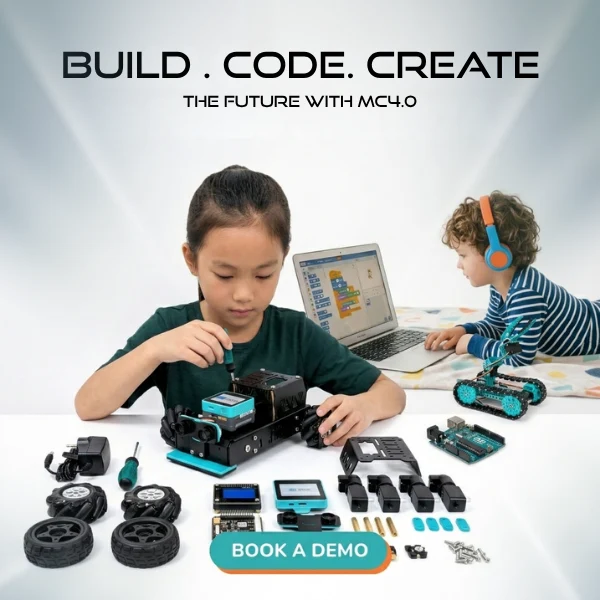
What if the most recognizable name in your STEM lab is no longer the most future-ready choice for your students? With the official retirement of the SPIKE Prime portfolio in June 2026, the LEGO Education SPIKE Prime vs MC4.0 Kit comparison has become a critical crossroads for school districts worldwide. You’ve likely felt the frustration of seeing students outgrow their hardware just as their curiosity peaks, leaving them stuck with tools that feel more like toys than professional engineering instruments.
It’s time to move from basic assembly to authentic innovation. You deserve a platform that grows with your learners from kindergarten through graduation, mirroring the hardware used in modern labs. This guide breaks down exactly how these two ecosystems stack up in the new era of AI-driven education. Discover which robotics ecosystem provides the technical depth and curriculum scalability your K-12 classroom requires for future-readiness. We’ll explore the transition from block-based coding to real-world AIoT applications; ensuring your students graduate with skills that matter in a prestige-tech world. From hardware flexibility to structured teacher support, we’re outlining the roadmap for your next-generation robotics program.
Key Takeaways
- Analyze the hardware architecture of the MC4.0 Controller compared to the SPIKE Hub to identify superior connectivity and sensor options for advanced projects.
- Discover how the MC Curriculum builds a structured academic bridge from foundational concepts to complex, real-world engineering applications.
- Compare the LEGO Education SPIKE Prime vs MC4.0 Kit to find the ideal balance between initial ease of use and long-term technical scalability.
- Learn how specialized AIoT kits and professional teacher training programs empower educators to lead high-level computer science initiatives with confidence.
STEM Evolution: LEGO SPIKE Prime vs. the MC4.0 Ecosystem
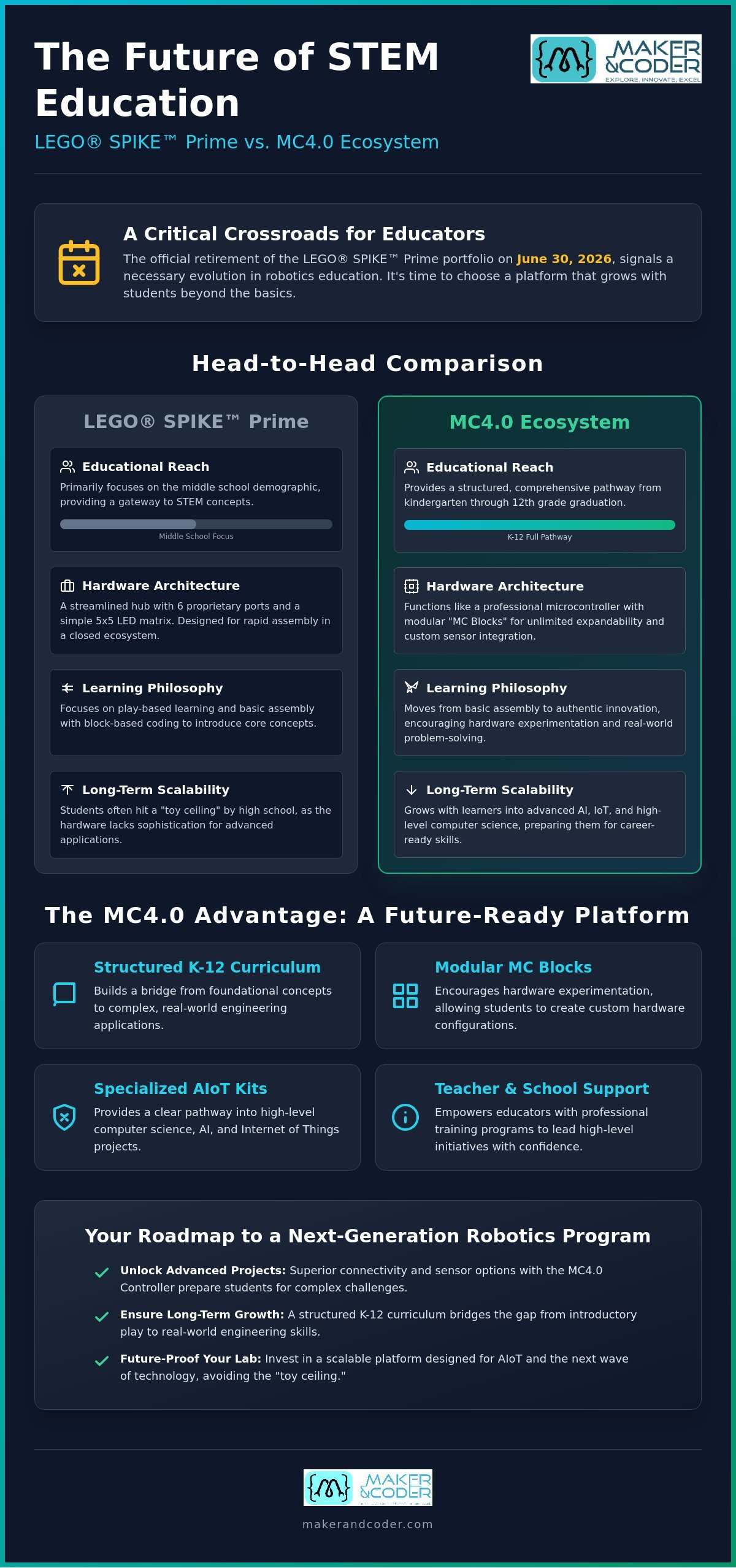
The 2026 STEM landscape is shifting rapidly. Choosing between the LEGO Education SPIKE Prime vs MC4.0 Kit is no longer just a matter of brand preference; it’s a strategic decision about student longevity. LEGO’s SPIKE Prime has long been a reliable, block-based gateway for middle schoolers. However, its scheduled retirement on June 30, 2026, signals a necessary evolution in how we teach robotics. While the LEGO Education history is rich with foundational tools, the modern classroom requires a platform that doesn’t just introduce concepts but scales with the learner.
The core challenge for educators today is the “toy ceiling.” Many students master block-based logic by the eighth grade, only to find their hardware lacks the sophistication for high school applications. This is where the MC4.0 ecosystem differentiates itself. It isn’t just a kit; it’s a modular engineering environment designed to transition students from basic play to professional technical competency. It empowers learners to move beyond pre-defined shapes and explore the raw potential of modern electronics.
The Shift from Play-Based to Technical Learning
Industry standards are moving away from fixed, proprietary components toward modular hardware. The MC4.0 Controller serves as a versatile brain that mirrors real-world microcontroller systems. Unlike traditional kits that limit students to pre-defined paths, MC Blocks encourage hardware experimentation. This modularity allows students to build, break, and refine their designs, effectively bridging the gap between classroom coding and vocational engineering. By removing the technical ceiling, Maker & Coder ensures that the tools students use in middle school remain relevant as they tackle advanced AI and IoT projects in later years.
Target Audience and Classroom Environment
Success in STEM depends on aligning hardware with educational goals. Consider these factors when evaluating your lab’s future:
- Educational Reach: SPIKE Prime focuses heavily on the middle school demographic. The MC4.0 Kit, supported by the comprehensive MC Curriculum, provides a structured roadmap from K through 12.
- Hardware Versatility: Evaluate whether your students need a closed ecosystem or an open-ended platform. The MC4.0 Base Kit and specialized AIoT Kit offer pathways into high-level computer science that traditional kits cannot match.
- Long-term Literacy: Determine if your goal is immediate engagement or career-ready skills. Modular systems prepare students for the complexity of the modern workforce.
If you’re ready to equip your lab with tools that go beyond the basics, explore the full range of modular components in our online shop. We’re here to help you build a future-ready classroom today.
Hardware Architecture: Comparing the Hub and the Controller
At the heart of every robotics kit lies its “brain,” the component that determines exactly how far a student can push their project. When evaluating the LEGO Education SPIKE Prime vs MC4.0 Kit, the architectural differences become immediately apparent. The SPIKE Prime Hub is a streamlined, user friendly interface featuring six universal ports and a simple 5×5 LED matrix. It’s designed for rapid assembly and immediate gratification. In contrast, the MC4.0 Controller is built for deep technical exploration. It functions less like a toy and more like a professional microcontroller, providing the expandability required for high level engineering projects.
Connectivity defines the ceiling of any STEM project. While the SPIKE Hub is limited by its proprietary port system, the MC4.0 Controller invites students to explore a wider range of sensor integrations. It handles complex data streams with precision, ensuring that advanced builds don’t stall due to hardware bottlenecks. Power management is equally critical. The MC4.0 system is engineered for the rigors of a full day classroom environment, maintaining consistent performance through multiple sessions without the frequent recharging cycles that can disrupt a lesson’s flow.
The Versatility of MC Blocks
Modular design is the cornerstone of authentic engineering. MC Blocks allow students to move beyond the fixed sensor layouts common in traditional kits. Instead of simply plugging in a pre-packaged sensor, learners can create custom hardware configurations that suit their specific design goals. This “building block” approach to electronics teaches students how components actually interact. In the MC4.0 Base Kit, hardware experimentation is the standard, not the exception. Students learn to navigate real world constraints, moving from simple builds to sophisticated machines that mirror industrial automation.
Sensor Precision and Real-World Application
Precision matters when students transition from play to prototyping. The MC4.0 hardware range includes ultrasonic, color, and force sensors designed for high accuracy. These aren’t just triggers for basic actions; they are tools for data collection and analysis. This level of sensitivity allows for much more complex AIoT applications, where a robot must make nuanced decisions based on environmental input. It transforms the classroom into a laboratory where students don’t just follow instructions, they solve problems.
Choosing the right hardware architecture is the first step in future proofing your STEM program. If you have questions about which setup fits your specific lab requirements, feel free to consult with our technical team for a personalized recommendation.
Curriculum Depth: K-12 Pathway vs. Lesson Plans
A world-class robotics kit is only as effective as the roadmap that guides its use. When analyzing the LEGO Education SPIKE Prime vs MC4.0 Kit, the distinction lies in the transition from isolated activities to a comprehensive educational journey. LEGO Education provides high-quality, modular lesson plans that excel in short-term engagement and competition prep. However, these lessons often feel siloed, lacking a continuous technical bridge into high school. The MC K-12 Curriculum addresses this gap by offering a sequenced progression that aligns with international STEM standards, ensuring students don’t hit a developmental wall as they age out of middle school.
Consistency is the key to technical literacy. Educators need a curriculum that builds on previous knowledge without requiring a total platform reset every three years. By aligning with global computer science standards, the MC4.0 ecosystem ensures that every project contributes to a larger portfolio of skills. This long-term vision transforms the classroom from a space of temporary play into a laboratory for future-ready innovation.
Structured Learning with the MC Curriculum
Maker & Coder sequences technical skills year-over-year to foster deep competency. While the MC4.0 Base Kit introduces students as young as seven to foundational logic, the MC4.0 STEAM Kit targets ages 12 and up with rigorous Project-Based Learning (PBL). These modules mirror professional workflows, moving students from basic assembly to complex systems engineering. This structure reduces teacher prep time significantly. Pre-built, standards-aligned modules allow instructors to focus on mentorship rather than troubleshooting, making high-level technology accessible in any classroom setting.
Transitioning from Blocks to Python
The jump from block-based coding to text-based languages like Python is often where student interest falters. Many traditional platforms treat Python as an afterthought or a complex add-on. The MC4.0 Controller, however, provides a native environment for professional coding. It allows students to see the direct relationship between their code and hardware performance in real time. This transition is vital for those aiming for university-level computer science. While SPIKE Prime introduces the concept of Python, the MC4.0 ecosystem fosters the technical fluency required for real-world engineering and AI applications.
Future-Proofing: AIoT and Advanced STEAM Kits
The workforce of 2026 demands more than basic mechanical knowledge. It requires a deep understanding of how devices communicate, analyze data, and make autonomous decisions. While evaluating the LEGO Education SPIKE Prime vs MC4.0 Kit, educators must look beyond simple “move-and-turn” commands. Traditional robotics often stops at the physical build, but the MC4.0 ecosystem pushes further into the Artificial Intelligence of Things (AIoT). This ensures students aren’t just building robots; they’re developing the cognitive frameworks needed for a hyper-connected world.
Transitioning from play to professional-grade technology requires hardware that supports complex data streams. The MC4.0 AIoT Kit provides this bridge, offering a native environment for machine learning that third-party extensions simply can’t replicate. It moves the learner from being a consumer of technology to a visionary creator. By integrating cloud connectivity and smart sensors from the start, we prepare students for the technical rigor of modern industry.
Integrating AI Literacy
AIoT is the integration of smart sensors and cloud data in educational robotics. This single sentence defines the next frontier of STEM. The MC4.0 AIoT Kit stands alone by making these advanced concepts accessible to K-12 learners. Instead of siloed exercises, students engage in data-driven automation. They learn how to train models, process environmental inputs, and leverage cloud computing. This approach eliminates the clunky, unreliable experience of adding external AI modules to a closed system. It’s a seamless, prestige-tech experience that mirrors the tools used in high-level research laboratories.
STEAM Integration Beyond Robotics
True innovation happens at the intersection of disciplines. The modularity of MC Blocks allows the MC4.0 platform to transcend the boundaries of a standard robotics kit. Students use these tools for environmental monitoring, smart city simulations, and even artistic engineering projects. This flexibility supports a journey of growth where a sensor isn’t just a part; it’s a component of a larger, purposeful system. Schools using the MC4.0 STEAM Kit have successfully implemented projects ranging from automated hydroponics to interactive public art installations. This cross-disciplinary approach ensures that every student, regardless of their primary interest, finds a pathway to technical fluency.
Equip your students with the tools they need to lead the next technological revolution. If you’re ready to integrate AIoT into your curriculum, contact our educational consultants to build a custom solution for your school district.
Implementation: Teacher Training and School Support
The best hardware in the world cannot inspire a student if the teacher feels uncertain about the technology. Professional development is the silent engine of every successful STEM lab. Choosing the LEGO Education SPIKE Prime vs MC4.0 Kit involves more than comparing hardware; it requires evaluating the support network behind the tools. While many platforms offer basic certifications that focus on the mechanics of the hub, Maker & Coder Teacher Training Programs prioritize the transfer of knowledge. We empower educators to move from being classroom managers to becoming visionary mentors in engineering and computer science.
Support doesn’t end after the initial purchase. Implementation requires a dedicated partner who understands the unique pressures of a K-12 environment. From initial unboxing to complex classroom troubleshooting, a reliable support system ensures that technical hurdles never stall student progress. When considering the total cost of ownership, look beyond the initial kit price. Evaluate the longevity of the hardware and the depth of the curriculum. A platform that students outgrow in two years creates a cycle of reinvestment, while a modular ecosystem provides a sustainable foundation for a decade of learning.
The Maker & Coder Support Ecosystem
Confidence is built through authentic experience. Our training programs ensure that educators feel fully equipped to lead sessions with the MC4.0 Controller. We don’t just sell hardware; we provide a roadmap for institutional success. As your program gains momentum, scaling becomes a seamless process. You can easily add more MC4.0 kits to your inventory, knowing that each new unit integrates perfectly with your existing curriculum and teacher knowledge base. This modular growth model allows school districts to expand their STEM offerings without the friction of retraining staff on entirely new systems.
Final Verdict: Which Kit Should Your School Choose?
When deciding between the LEGO Education SPIKE Prime vs MC4.0 Kit, the choice ultimately hinges on your school’s long-term vision. LEGO SPIKE Prime remains a familiar entry point for play-based learning and middle school competitions. However, with its scheduled retirement in 2026, it serves as a bridge to the past rather than a ladder to the future.
The MC4.0 ecosystem is the definitive choice for district leaders who prioritize technical depth and a true K-12 pathway. It offers the modularity required for high-level engineering and the AIoT capabilities essential for the 2026 workforce. If you want a platform that grows with your students and prepares them for university-level computer science, the MC4.0 Kit is the superior investment. It transforms the classroom into a professional-grade laboratory where innovation has no ceiling.
Empower the Next Generation of Engineers
Transitioning your classroom from basic robotics to professional engineering is a journey of technical empowerment. We’ve explored how the choice between LEGO Education SPIKE Prime vs MC4.0 Kit defines the technical ceiling for your students. While traditional kits offer an accessible entry point, the MC4.0 ecosystem provides the modular MC Blocks and the professional MC4.0 Controller required for authentic, real-world prototyping. It’s the difference between following instructions and inventing solutions.
Success in the 2026 workforce relies on a seamless educational pathway. By implementing the comprehensive K-12 MC Curriculum, you ensure your students never hit a developmental wall. Coupled with our professional Teacher Training Programs, your staff will have the confidence to lead high-level AIoT and STEAM projects that prepare learners for university and beyond. This isn’t just about hardware; it’s about building a sustainable culture of innovation in your school.
Shape the future of your STEM program today. Explore the full MC4.0 Hardware and Curriculum range at Maker & Coder to see how we can support your district’s vision. Let’s build something extraordinary together.
Frequently Asked Questions
Can I use LEGO sensors with the MC4.0 Controller?
No, the MC4.0 Controller is designed to work exclusively within its own modular ecosystem of MC Blocks. This ensures maximum sensor precision and architectural integrity for high-level engineering. While the LEGO Education SPIKE Prime vs MC4.0 Kit comparison often focuses on hardware compatibility, we prioritize a dedicated environment that mirrors professional engineering standards rather than using proprietary toy-based connectors.
Is the MC K-12 Curriculum aligned with NGSS or CSTA standards?
Yes, the MC K-12 Curriculum is rigorously mapped to international standards, including NGSS and CSTA. It provides a structured roadmap that ensures students meet critical benchmarks in computer science and engineering as they progress through each grade level. This alignment helps school districts maintain academic rigor while transitioning students from basic play to advanced technical literacy and career readiness.
How does the MC4.0 AIoT Kit differ from the Base Kit?
The MC4.0 AIoT Kit expands the capabilities of the Base Kit by introducing cloud connectivity and machine learning modules. While the Base Kit focuses on foundational robotics and mechanical engineering, the AIoT version enables data-driven automation. It allows students to build smart systems that interact with real-world data across the internet, providing a much higher technical ceiling for high school students.
What programming languages are supported by the MC4.0 platform?
The MC4.0 platform supports a journey from block-based coding to text-based mastery. Students start with an intuitive Scratch-like interface before progressing to native Python and Arduino C++. When comparing the LEGO Education SPIKE Prime vs MC4.0 Kit, educators often appreciate how our platform supports these professional languages natively, ensuring the hardware remains relevant as students advance toward university-level computer science.
Do I need a special certification to teach with the MC4.0 ecosystem?
You don’t need a specific prior certification to begin using the MC4.0 ecosystem in your classroom. However, our Teacher Training Programs are highly recommended to accelerate your success and maximize student impact. These sessions move beyond basic unboxing to provide educators with the pedagogical strategies and technical confidence required to lead a high-tech lab without feeling overwhelmed by the technology.
What is the typical battery life of the MC4.0 Controller in a classroom setting?
The MC4.0 Controller is engineered for the rigors of a full school day. It provides consistent power for multiple back-to-back classroom sessions, significantly reducing the need for mid-day charging cycles. This reliability ensures that your lessons flow smoothly from the first period to the last, without the technical interruptions or downtime often found in standard consumer-grade electronics.
How does Maker & Coder support schools with limited technical staff?
We act as a dedicated educational partner for schools that lack extensive technical resources. Our structured curriculum and pre-built lesson modules significantly reduce teacher preparation time and technical troubleshooting. We provide the roadmap and the professional support required, allowing your instructors to focus on student mentorship and creative expression rather than hardware maintenance or software updates.
Is the MC4.0 Kit suitable for competitive robotics like FLL or WRO?
Yes, the MC4.0 Kit is a powerful tool for competitive robotics and open-engineering challenges. Its modular design and support for professional coding languages give students a distinct advantage in competitions that require custom builds and complex logic. It bridges the gap between standard “out-of-the-box” kits and the high-performance requirements of global robotics events, fostering true engineering innovation.