What if your STEM curriculum functioned less like a collection of isolated islands and more like a masterfully engineered skyscraper? Achieving true vertical alignment in K-12 STEM education is the key to solving the recurring frustration of curriculum overlap, where students “re-learn” basic concepts every year while sophisticated hardware sits unused on a shelf. You want to see genuine growth, yet teachers often struggle with inconsistent student baselines that stall progress. It’s time to bridge the gap between elementary curiosity and high school expertise.
This guide provides a blueprint for transforming fragmented lessons into a continuous, high-impact journey. You’ll learn how to turn your classroom into an ecosystem where technology serves as a tool for creative expression and cognitive development. We’re moving from basic tactile exploration to advanced Python mastery. We’ll outline a clear roadmap for skill progression that builds teacher confidence and keeps students captivated through increasingly complex challenges. Let’s explore how to design a future-ready pathway that scales alongside your learners.
Key Takeaways
- Move beyond the “catchphrase myth” and transform your STEM curriculum into a cohesive, high-impact learning journey that builds momentum year after year.
- Discover how hardware like MC Blocks acts as a tactile anchor, helping students visualize abstract concepts as they scale from basic logic to complex AIoT.
- Implement a clear roadmap for vertical alignment in K-12 STEM education that bridges the gap between elementary play and high school expertise.
- Learn to audit your current resources to eliminate redundant lessons and ensure your hardware investments remain relevant across every grade level.
- Explore how the MC Curriculum and MC 4.0 Controller provide a ready-made pathway for seamless transitions and increased teacher confidence.
Table of Contents
- Beyond the Catchphrase: Why Vertical Alignment in STEM Fails Without a Framework
- Scaffolding Technical Complexity: From MC Blocks to Python Mastery
- Hardware-Integrated Pathways vs. Standards-Only Alignment
- 4 Steps to Auditing and Implementing a Vertically Aligned STEM Strategy
- The Maker & Coder Ecosystem: A Ready-Made Pathway for K-12 Success
Beyond the Catchphrase: Why Vertical Alignment in STEM Fails Without a Framework
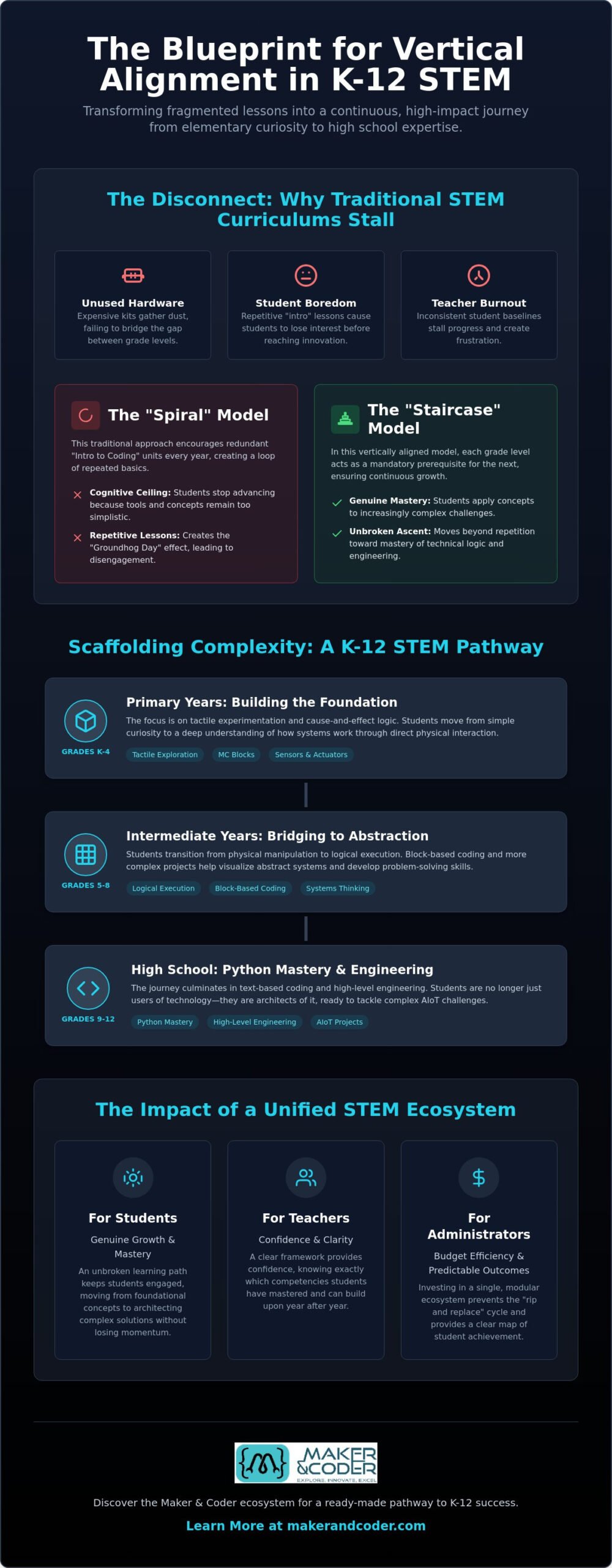
Many educators view vertical alignment as a bureaucratic exercise. It often results in a colorful spreadsheet that gathers digital dust while classrooms remain siloed. But true vertical alignment in K-12 STEM education isn’t a static document. It’s a living framework that ensures a student’s journey from Kindergarten to graduation is a single, unbroken ascent. When alignment exists only on paper, the disconnect between grade levels creates a “Groundhog Day” effect. Students find themselves trapped in a loop of introductory lessons, losing interest before they ever reach the heights of true innovation.
The cost of this misalignment is high. It manifests as student boredom, teacher burnout, and wasted tech budgets. You’ve likely seen expensive robotics kits gathering dust because they don’t bridge the gap to the next grade’s curriculum. Functional alignment requires hardware, software, and pedagogy to grow in lockstep. This shifts the focus from simply teaching a tool to building cognitive pathways. We must adopt an “expert-as-enabler” mindset. In this model, technology is an accessible medium for creative expression, and the teacher is the visionary guide who facilitates that growth.
The “Spiral” vs. The “Staircase” Model
The traditional spiral model often fails in STEM because it encourages redundant “Intro to Coding” units every year. This creates a cognitive ceiling where students stop advancing because their tools are too simplistic. We need a staircase. In a staircase model, each grade level acts as a mandatory prerequisite for the next. Students don’t just revisit concepts; they apply them to increasingly complex challenges. This ensures that vertical alignment in K-12 STEM education moves beyond repetition and toward genuine mastery of technical logic and engineering principles.
The Administrative Impact of a Unified Pathway
A unified pathway provides administrators with predictable student outcomes. A Grade 9 teacher can begin the year with confidence, knowing exactly which competencies their students mastered in Grade 8. This clarity also drives budget efficiency. By investing in modular hardware like MC Blocks, schools can utilize a single ecosystem that serves multiple developmental stages. This prevents the frequent “rip and replace” cycle of hardware procurement. Vertical alignment is the deliberate scaffolding of technical complexity across a K-12 timeline.
Scaffolding Technical Complexity: From MC Blocks to Python Mastery
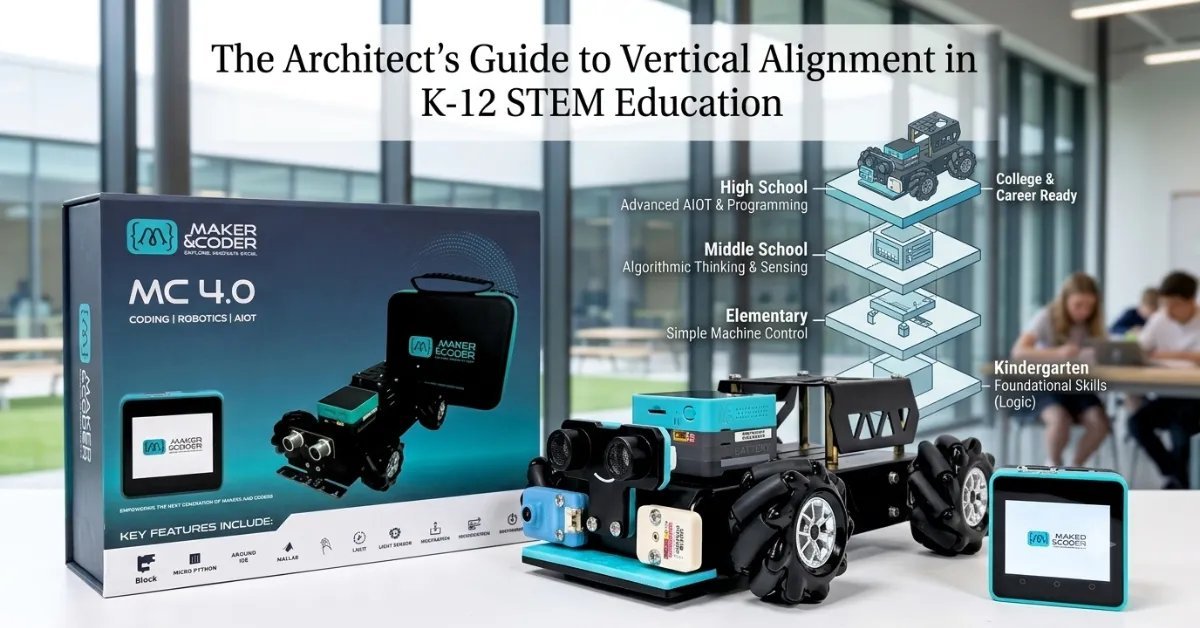
Effective vertical alignment in K-12 STEM education requires more than a shared vocabulary. It demands a hardware ecosystem that matures alongside the student’s cognitive development. By using the MC4.0 Controller as a consistent brain across all grade levels, we remove the friction of learning a new interface every year. Students can focus on solving increasingly complex problems rather than fighting with unfamiliar hardware. This tactile anchor is essential for visualizing abstract systems. Research from the National Academies suggests that intentional vertical alignment is a critical factor in creating equitable STEM pathways that keep learners engaged throughout their academic careers.
The progression of abstraction is the heartbeat of this strategy. We move students from the physical manipulation of components to the logical execution of text-based code. This journey ensures that the “how” of technology never obscures the “why.” By the time a student reaches secondary education, they aren’t just users of technology. They’re architects of it. They’ve moved from primary STEAM exploration to high-level technical engineering without ever losing the thread of their previous learning.
Primary Years: Building the Foundation with MC Blocks
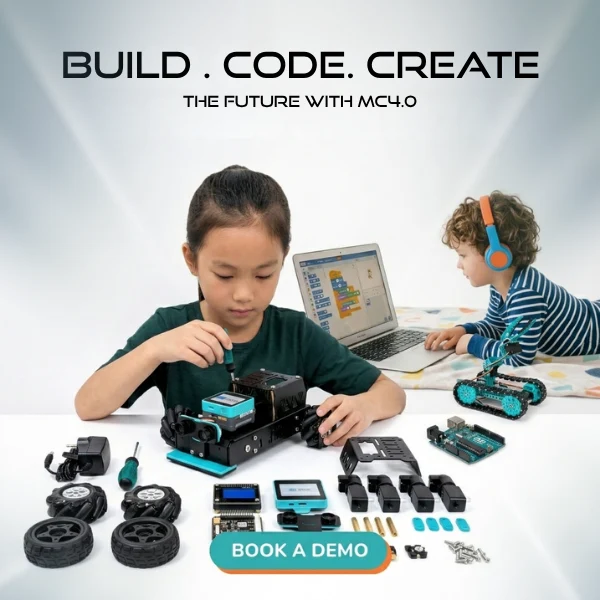
In the early grades, the focus is on tactile experimentation. We move students from simple curiosity to a deep understanding of cause-and-effect logic. Using the MC4.0 Base Kit, primary learners explore the fundamentals of sensors and actuators through direct physical interaction. They aren’t just memorizing definitions. They’re building them. This stage is about establishing the vocabulary of innovation. By using MC Blocks, students learn to assemble logical sequences with their hands before they ever touch a keyboard. It makes the invisible world of electronics visible and tangible.
Middle and High School: Transitioning to AIoT and Python
As students mature, the complexity of their tools must scale. The transition from block-based logic to text-based Python programming happens seamlessly on the same MC4.0 hardware they’ve used for years. This shift allows students to tackle real-world challenges using the MC4.0 AIoT Kit. They move from simple local circuits to global connectivity and data collection. They’re no longer just playing with tech. They’re building sophisticated systems that mirror industry-standard engineering. This progression ensures students are ready for the technical demands of the modern workforce. If you’re ready to see how this progression looks in your district, reach out to our team to discuss a tailored implementation plan.
Hardware-Integrated Pathways vs. Standards-Only Alignment
A standards-only document is often a roadmap without a vehicle. While these guides outline what students should know, they rarely provide the practical tools to get them there. This disconnect frequently results in “shelfware”—comprehensive curriculum guides that teachers ignore because they lack the physical resources to implement them. True vertical alignment in K-12 STEM education requires a hardware-integrated pathway. When the hardware and standards are fused, the learning journey becomes actionable, measurable, and sustainable across every grade level.
This is where the modular advantage changes the game. By using a system like MC Blocks, students engage in infinite reconfiguration without the burden of re-learning a new interface every year. We call this reducing the “Learning Tax.” Every hour a student spends trying to figure out a new proprietary software or hardware connection is an hour lost to actual engineering and problem-solving. A single hardware ecosystem like the MC 4.0 Controller provides a consistent “brain” for twelve years of discovery. This consistency allows students to move from basic logic to advanced applications without the friction of platform switching.
The Hidden Costs of Disconnected Tech Kits
Fragmented STEM programs often suffer from the friction of platform switching. When a district uses five different robotics systems across elementary and middle school, deep mastery becomes impossible. Teachers spend more time on troubleshooting than on teaching. Maintenance and storage also become logistical nightmares as disparate parts from various manufacturers pile up in closets. A modular ecosystem provides a significantly higher return on investment than a fragmented collection of disparate STEM toys by ensuring long-term utility across multiple grade levels. It streamlines procurement and ensures that every dollar spent contributes to a long-term developmental goal.
Creating a “Prestige-Tech” Environment in the Classroom
We must position STEM as a professional-grade pursuit rather than just playtime. High-quality hardware like the MC4.0 Controller builds student pride and a sense of ownership over their projects. It feels like real engineering because it is real engineering. When students work with tools that mirror industry standards, their engagement levels rise. They see themselves as innovators, not just students completing a task. Explore our modular STEM hardware solutions to see how kits scale across grades and provide a polished, “prestige-tech” feel to your learning environment. This approach ensures that vertical alignment in K-12 STEM education is felt in the hands of every student, every day.
4 Steps to Auditing and Implementing a Vertically Aligned STEM Strategy
Executing a visionary STEM strategy requires more than just purchasing the latest kits. It demands a methodical approach to infrastructure and instruction. Moving from a fragmented collection of lessons to a unified vertical alignment in K-12 STEM education involves four critical phases. We must transition from reactive purchasing to proactive architectural planning. This process ensures that every investment of time and capital contributes to a student’s long-term technical fluency.
Audit your current landscape by mapping every kit, software license, and lesson plan from Kindergarten through Grade 12. This bird’s-eye view reveals where your curriculum is thriving and where it is being undermined by unnecessary repetition. Once you identify these friction points, you can standardize your ecosystem around a hardware-software backbone. Choosing a consistent platform like the MC 4.0 Controller provides the technical “red thread” that connects primary exploration to secondary engineering. Finally, you must empower your educators through targeted professional development to ensure the blueprint becomes a reality in every classroom.
The Audit Phase: Uncovering Redundancy
Conducting a cross-grade audit doesn’t have to overwhelm your staff. Start by creating a “Skills Matrix” that tracks specific coding and engineering competencies rather than just project titles. Look for “orphaned hardware” that serves a single grade level but fails to bridge the gap to the next. If a robotics kit in Grade 4 doesn’t prepare students for the logic required in Grade 5, it’s a candidate for replacement. This phase is about clearing the path for a true staircase of complexity. It ensures that vertical alignment in K-12 STEM education is built on a foundation of progressive mastery rather than isolated experiences.
Teacher Training: The Bridge to Implementation
Alignment often fails when teachers feel unskilled in the technical requirements of the next grade level. We must bridge this gap through structured Teacher Training Programs that build a unified instructional voice across the district. Shifting from a “tech-shy” mindset to being “tech-enabled” requires more than a one-day workshop. It requires ongoing support and a shared understanding of the K-12 pathway. When a Grade 2 teacher understands how their lesson on simple circuits feeds into a Grade 8 AIoT project, they become architects of the larger journey. If you’re ready to transform your district’s approach, contact our educational consultants to start your curriculum audit today.
The Maker & Coder Ecosystem: A Ready-Made Pathway for K-12 Success
The Maker & Coder ecosystem serves as the ultimate vehicle for your district’s vision. We provide a structured, K-12 pathway that removes the guesswork from vertical alignment in K-12 STEM education. By centering the entire experience on the MC 4.0 Controller, we provide students with one consistent “brain” that powers everything from primary STEAM projects to advanced AIoT engineering. This continuity allows learners to build deep, intuitive familiarity with the hardware. It frees them to tackle more complex logic and syntax as they grow through the MC Curriculum. We’re moving students from simple curiosity to professional mastery.
Our Teacher Training Programs ensure that this alignment strategy actually reaches the classroom. We empower your staff to move beyond basic tool usage and become mentors in a high-tech environment. This “Expert-as-Enabler” approach transforms the teacher’s role from troubleshooter to visionary guide. The result is a generation of students prepared for a future-ready world with tangible, scalable skills. They graduate with a portfolio of work that reflects industry standards and a mindset geared toward constant innovation.
Modular Kits for Every Developmental Stage
We believe that tools should grow with the learner. Our specialized kits provide specific solutions for specific grade-level goals. These include:
- MC4.0 Base Kit: Introducing the fundamentals of sensors and logic through tactile play.
- MC4.0 STEAM Kit: Bridging the gap between creative expression and technical engineering.
- MC4.0 AIoT Kit: Challenging secondary students with real-world connectivity and data analysis.
By using MC Blocks, students simplify the transition from simple play to professional-grade engineering. This modularity ensures that hardware never becomes obsolete as students advance. Visit the Maker & Coder Shop to build your custom K-12 pathway and see how these tools scale across every grade level. It’s time to invest in a system that matures alongside your students.
Your Partner in STEM Transformation
Maker & Coder is more than a hardware provider. We are a dedicated educational partner invested in the success of the next generation. Our approach supports school administrators in navigating the complexities of modern technology integration with confidence. We provide the peace of mind that comes from knowing your curriculum is cohesive and your teachers are fully supported. We act as a bridge between complex modern systems and the primary school setting. A vertically aligned student journey empowers every learner to build a future they can touch, see, and control.
Building a Legacy of Innovation
Building a future-ready STEM program isn’t about the number of kits in your closet; it’s about the continuity of the experience you provide. By shifting from a fragmented “spiral” model to a deliberate “staircase” of complexity, you ensure that every grade level builds directly on the last. Successful vertical alignment in K-12 STEM education relies on a unified ecosystem where hardware, curriculum, and teacher confidence grow in unison. We’ve explored how a modular platform reduces technical friction, allowing students to focus on solving global challenges rather than re-learning basic interfaces every September.
The journey from tactile exploration to professional Python mastery is a blueprint for student success. With the comprehensive K-12 MC Curriculum and our modular MC 4.0 hardware platform, you can eliminate redundant lessons and maximize your budget efficiency. Our professional Teacher Training Programs act as the bridge, turning your instructional staff into visionary mentors who can guide students through every stage of development.
It’s time to transform your district from a collection of silos into a powerhouse of innovation. Architect your K-12 STEM pathway with the MC 4.0 Ecosystem today. Let’s build something tangible that inspires the next generation of engineers to reach their full potential.
Frequently Asked Questions
What is the difference between vertical and horizontal alignment in STEM?
Vertical alignment refers to the intentional progression of skills and concepts from one grade level to the next, ensuring a seamless K-12 journey. Horizontal alignment focuses on consistency across the same grade level, ensuring that every student in Grade 4 receives the same foundational experience regardless of their specific classroom. While horizontal alignment creates equity within a single year, vertical alignment in K-12 STEM education builds the long-term momentum required for advanced technical mastery.
Why is vertical alignment specifically important for coding and robotics?
Technical skills are inherently cumulative and require a solid foundation to support advanced applications. Without a clear vertical path, students often get trapped in a repetitive cycle of “Introduction to Coding” year after year, which leads to boredom and stalled growth. A vertically aligned approach ensures that students move from tactile logic to block-based programming and eventually to text-based languages without losing time to redundant lessons or unfamiliar hardware interfaces.
How does vertical alignment help reduce teacher burnout?
Alignment provides teachers with a clear instructional roadmap and predictable student baselines. When a Grade 7 teacher knows exactly which competencies were mastered in Grade 6, they can skip the weeks of diagnostic review and dive straight into new challenges. It also reduces the stress of troubleshooting multiple disconnected platforms. By standardizing on a consistent ecosystem like the MC 4.0 Controller, teachers spend less time fighting with hardware and more time facilitating creative discovery.
Can we achieve vertical alignment if we use different brands of STEM kits?
It’s possible to align different brands, but it often creates significant “platform friction” that hinders deep mastery. Switching between proprietary software and hardware interfaces forces students to pay a “learning tax” every time they enter a new grade. Using a unified hardware backbone simplifies the journey. It allows students and teachers to focus on engineering principles rather than the quirks of five different robotics systems, making vertical alignment in K-12 STEM education much more effective.
What role does Python play in a vertically aligned K-12 curriculum?
Python serves as the professional-grade destination for a student’s coding journey. In a vertically aligned system, early learners build logic with MC Blocks, middle schoolers transition to block-based code, and high schoolers apply those same logical principles to text-based Python. This progression ensures that by the time students reach secondary education, they are using industry-standard tools to solve real-world AIoT and engineering problems with confidence.
How often should a school audit its STEM vertical alignment?
Perform a light audit annually to adjust for new hardware or minor curriculum shifts. A comprehensive deep dive should occur every three years to ensure your strategy still meets evolving academic standards and technological trends like AI integration. Regular audits help identify “orphaned hardware” that no longer fits the pathway and ensure that your skills matrix remains relevant for future-ready careers.
What are the first steps for a principal to start aligning their STEM program?
Start by mapping your current landscape to uncover every kit and lesson plan across all grade levels. Identify where skills repeat unnecessarily and where they stall due to a lack of appropriate tools. Once you’ve identified these gaps, choose a hardware-software backbone that can scale from primary to secondary levels. This provides a consistent “red thread” that connects every classroom into a single, high-impact learning ecosystem.
Does vertical alignment require all teachers to be coding experts?
No, it requires a shared framework and a commitment to professional growth. A well-designed alignment strategy includes Teacher Training Programs that empower even “tech-shy” educators to become confident mentors. By providing structured resources and a consistent hardware platform, you remove the barrier to entry. Teachers don’t need to know everything; they just need to be the visionary guides who enable their students to explore and build.