Nearly 48% of school districts have now implemented AI training, but high-tech hardware often sits idle because it lacks a cohesive structure. You’ve likely seen the “closet of forgotten robots” or felt the frustration of siloed subjects that never seem to connect. It’s time to move from fragmented lessons to a purposeful, integrated STEM curriculum for elementary schools. This shift isn’t just about meeting the latest 2026 federal standards; it’s about giving your students the tools to build, think, and solve.
We understand that a teacher’s time is too valuable to spend deciphering complex manuals or manually bridging gaps between math and science. You deserve a system that empowers rather than overwhelms. This implementation guide promises to help you transform your classroom into a vibrant ecosystem where digital theory meets physical innovation. By adopting a turn-key solution like the MC Curriculum and MC 4.0 Kit, you can foster AI literacy and measurable problem-solving skills. We’ll explore how to align with the “Trinity of Innovation” to ensure your school remains at the forefront of educational excellence.
Key Takeaways
- Shift from siloed computer lab sessions to ‘Embedded Innovation’ by implementing a truly integrated STEM curriculum for elementary schools.
- Identify the essential components of a successful STEM ecosystem, focusing on the synergy between modular hardware, structured curriculum, and teacher training.
- Balance digital literacy with tactile engagement using MC Blocks to reinforce geometry and engineering principles through physical creation.
- Follow a proven five-step roadmap to audit your infrastructure and equip your staff with the tools needed for a seamless 2026 rollout.
- Prepare students for the future with AIoT and STEAM kits that turn complex digital theories into tangible, measurable classroom successes.
Table of Contents
- Beyond Silos: What True STEM Integration Looks Like in 2026
- The Core Components of an Integrated STEM Ecosystem
- Hardware vs. Software: Finding the Right Balance for Young Learners
- Strategic Implementation: A 5-Step Roadmap for Schools
- Maker & Coder: Bridging the Gap Between Theory and Tangible Innovation
Beyond Silos: What True STEM Integration Looks Like in 2026
True integration doesn’t mean scheduling an hour of “tech time” every Tuesday. By 2026, the traditional boundaries between subjects have dissolved. We now view an integrated STEM curriculum for elementary schools as a cohesive methodology where science, technology, engineering, and mathematics function as a single, fluid language for problem-solving. This isn’t just a pedagogical theory; it’s a necessary response to a world where digital and physical realities are inseparable.
Think about the shift from the isolated “Computer Lab” sessions of the past to “Embedded Innovation” within the daily schedule. Instead of visiting a specific room to learn coding in a vacuum, students use computational thinking to analyze plant growth cycles or design structural solutions for local environmental challenges. This active integration moves beyond passive consumption. It’s the difference between a student using an app to see a 3D model and a student using tools from the Maker & Coder shop to build a physical prototype that solves a real-world problem. In 2026, AI literacy and computational logic aren’t elective skills; they’re foundational requirements.
The Evolution of Elementary STEM Pedagogy
Elementary education has pivoted from rote memorization toward a “Maker” mindset. For children aged 6 to 11, cognitive development is most robust when learning is tactile and contextual. An integrated curriculum leverages the foundational concepts of STEM to spark curiosity through socio-scientific issues. When students tackle problems like water conservation or renewable energy, they aren’t just learning facts. They’re developing the critical resilience to iterate, fail, and improve. This process transforms technology from a daunting challenge into an accessible tool for creative expression.
Why Early Exposure is Non-Negotiable
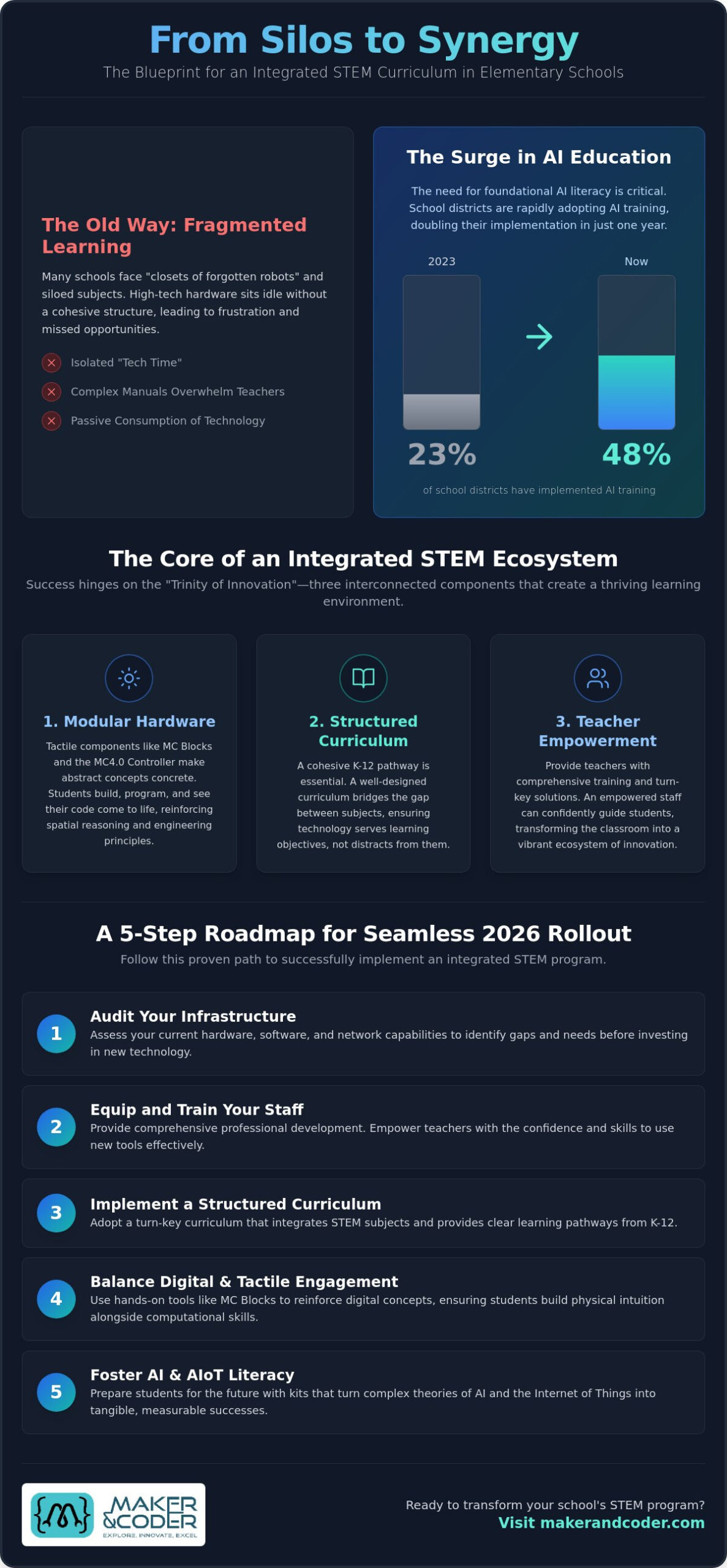
Building STEM fluency must begin long before middle school. Early access to high-quality hardware helps close the equity gap, ensuring all learners develop a comfort level with complex systems. With 48% of school districts now providing AI training—a figure that doubled from 23% in 2023—foundational literacy in these technologies is a core requirement for future-readiness. We’re preparing students for careers that don’t exist yet. By focusing on transferable skills like logic, structural design, and algorithmic thinking, an integrated STEM curriculum for elementary schools ensures the next generation isn’t just keeping up. They’re leading the way with the confidence of creators rather than just consumers.
The Core Components of an Integrated STEM Ecosystem
Success in the modern classroom requires more than just a budget for gadgets. It demands a “Trinity of Innovation”: modular hardware, a structured K-12 curriculum, and comprehensive teacher empowerment. Without this triad, expensive kits often gather dust. Research on The Core Components of an Integrated STEM Ecosystem confirms that purposeful connection between these elements is what drives lasting student engagement. An integrated STEM curriculum for elementary schools isn’t a single product; it’s a living environment where students move from basic curiosity to sophisticated application.
Most programs fail because they treat coding and science as separate units. We bridge this gap by creating a unified hardware-software experience. When students can touch the logic they’ve written, the abstract becomes concrete. This synergy is the gold standard for 2026 implementation, ensuring that technology serves the learning objective rather than distracting from it.
Modular Hardware: The MC4.0 Controller and Blocks
For young learners, the journey begins with the hands. Tactile, modular components like MC Blocks are essential for developing fine motor skills and spatial reasoning. These aren’t just building toys; they’re the physical manifestation of logical concepts. The MC4.0 Controller acts as the “brain” of every project, allowing students to see exactly how their code translates into physical movement. This transition is vital. Students start with simple mechanical builds, learning about gears and levers, before moving into complex programmed systems. It’s a journey from building a simple cart to engineering an automated delivery robot.
Structured Pathways: The MC Curriculum (K-12)
Consistency is the antidote to the “content gaps” that often plague STEM initiatives as students graduate through grades. A multi-year, structured pathway like the MC Curriculum (K-12) ensures that what a student learns in second grade builds directly upon their first-grade foundation. This progression provides a predictable roadmap for administrators and teachers alike. By aligning lesson plans with national academic standards, we ensure that creativity never comes at the expense of core competencies. The curriculum balances “Guided Instruction,” where students learn specific techniques, with “Open Play,” where they apply those techniques to solve open-ended challenges.
To support diverse learning objectives, schools can leverage specialized tools like the MC4.0 STEAM Kit or the MC4.0 AIoT Kit. These options allow educators to tailor the experience to their specific classroom goals, whether they’re focusing on artistic expression or advanced internet-of-things connectivity. If you’re ready to see how these components fit into your specific school environment, you can connect with our educational specialists to discuss a tailored implementation plan. Explore our full range of solutions at the Maker & Coder shop to find the right fit for your students.
Hardware vs. Software: Finding the Right Balance for Young Learners
The debate over screen time in elementary education reached a turning point in early 2026. With legislative shifts like Utah’s HB 273 limiting non-instructional digital use, educators must ensure technology serves a clear pedagogical purpose. A high-quality integrated STEM curriculum for elementary schools solves this by positioning the screen as a secondary tool rather than the primary destination. We believe that for students aged 6 to 11, the most profound learning happens when digital logic meets physical reality. This balance is central to the YOU Belong in STEM initiative, which emphasizes inclusive, hands-on experiences that build lasting confidence.
Consider the “Digital Twin” concept. Instead of merely watching an animation on a tablet, students write code to control a physical prototype. They see their logic manifest in the real world. This approach ensures that software is used for data collection and algorithmic design while the heavy lifting of problem-solving remains tactile. You can explore the Maker & Coder shop to see how our hardware kits are tiered by complexity, ensuring that the technology grows alongside the student’s capabilities.
The Power of Tangible Coding
Seeing a motor spin is far more impactful than watching a digital sprite move across a screen. When a student uses MC Blocks to build a crane, they aren’t just playing; they’re analyzing geometry and load-bearing principles in real time. This physical construction develops spatial reasoning that pure software can’t replicate. The journey moves from block-based logic to physical execution. It’s a transformative process. It turns abstract math into a visible, functional solution. Students learn that their ideas have the power to move objects, bridge gaps, and solve structural challenges.
Integrating Digital Tools Without Overwhelming Students
We use software as a supportive layer for logic and data. It’s vital that interfaces remain age-appropriate and intuitive to prevent cognitive overload. In 2026, modernizing the “Science Fair” project means integrating AI and IoT sensors to track environmental variables or automate simple tasks. An integrated STEM curriculum for elementary schools should treat these digital tools as natural extensions of the student’s toolkit. By focusing on “Active Integration,” we ensure that students remain the masters of the technology rather than passive observers of a digital display. This builds the foundational computational thinking required for the future without sacrificing the joy of building something with their own hands.
Strategic Implementation: A 5-Step Roadmap for Schools
Transitioning from fragmented tech sessions to a cohesive integrated STEM curriculum for elementary schools requires a methodical approach. It isn’t enough to simply purchase hardware; you must build a culture of innovation that supports both students and staff. Move from infrastructure audits to full-scale grade integration by following this proven roadmap for 2026 implementation.
- Step 1: Audit and Identify. Evaluate your existing infrastructure and identify “STEM Champions” among your staff. These lead educators will act as mentors during the wider rollout.
- Step 2: Select Your Foundation. Choose a hardware-curriculum bundle like the MC4.0 Base Kit. This ensures your tools and lessons are designed to work together from day one. Explore our tiered options at the Maker & Coder shop.
- Step 3: Empower Through Training. Conduct professional development that focuses on teacher confidence. Moving from “tech-anxiety” to “instructional authority” is the most critical step in the process.
- Step 4: Launch Pilot Projects. Start with small, high-impact projects using structured lesson plans from the MC Curriculum. This allows you to refine your approach based on real classroom feedback.
- Step 5: Scale and Synchronize. Expand the program across all grade levels to create a unified K-12 pathway. This ensures that every student graduates with a consistent, sophisticated set of future-ready skills.
Empowering Educators Through Training
Most schools fail because they treat professional development as a secondary thought. We believe in an “Expert-as-Enabler” model. Our Teacher Training Programs don’t just hand over a manual; they provide the pedagogical strategies needed to manage a high-tech classroom. By fostering professional learning communities, we help non-technical elementary teachers overcome anxiety and embrace their role as guides in the journey of discovery. Ongoing support ensures that technology remains an accessible tool for creative expression rather than a daunting hurdle.
Measuring Success in the STEM Classroom
What does success look like when the goal is innovation? Move away from simple task completion and embrace process assessment. Use digital portfolios and learning logs to document how a student’s thinking evolves over time. Evaluate success based on measurable engagement and collaborative problem-solving skills. When students can articulate why a specific design failed and how they iterated to improve it, you’ve achieved true STEM integration. This shift in evaluation provides peace of mind to administrators while celebrating the fulfillment of building something tangible.
Ready to begin your school’s transformation? Contact our implementation specialists today to design a strategic roadmap tailored to your specific district needs.
Maker & Coder: Bridging the Gap Between Theory and Tangible Innovation
Choosing an integrated STEM curriculum for elementary schools is a commitment to a student’s long-term cognitive growth. It’s about more than just buying kits; it’s about partnering with an ecosystem designed to evolve. Maker & Coder stands as the definitive choice for forward-thinking districts because we don’t treat technology as a static subject. We treat it as a dynamic tool for expression. Our ecosystem ensures that the curiosity sparked in a first-grade classroom matures into the sophisticated problem-solving skills needed for a rapidly changing world.
By 2026, the demand for AI literacy has moved from the periphery to the core of academic standards. While other programs might offer simple coding puzzles, we provide the versatility of the MC4.0 STEAM Kit and advanced AIoT options. These tools allow young learners to experiment with the Internet of Things and artificial intelligence in a way that is safe, intuitive, and deeply engaging. We’re dedicated to creating “Future-Ready” learners who don’t just understand the digital world but possess the agency to shape it. Decision-makers ready to elevate their science and math programs should explore the MC 4.0 Hardware and Kits to prepare for the upcoming semester.
The MC4.0 Advantage: Prestige-Tech for Every Classroom
We build our components for the rigors of a primary school environment. This is “prestige-tech”—high-quality hardware that feels professional yet remains accessible to a seven-year-old. The MC4.0 Advantage lies in the unique intersection of AI, IoT, and traditional STEAM principles. Most competitors struggle to bridge these gaps, but our curriculum grows with the student from K to 12. This continuity eliminates the “restarting” phase that often happens between grade levels. Instead, students build a cumulative portfolio of work, moving from simple mechanical blocks to sophisticated, cloud-connected systems that solve community-based challenges.
Join the Global Network of Maker & Coder Schools
Implementation is only the beginning. When your school adopts our curriculum, you join a worldwide community of innovative educators. This network is a vital resource for sharing pedagogical research and classroom success stories. Recent data shows that 39% of STEM educators identify collaborative learning as their top priority. Our platform facilitates this by providing access to the latest updates in hardware and instructional strategies. It’s a living partnership. We’re constantly updating our resources to reflect the latest technological advancements and educational standards. Transform your elementary school’s future today by embracing a system that values discovery as much as you do. Let’s build the next generation of innovators together.
Architecting the Future of Elementary Innovation
The transition to a sophisticated 2026 classroom requires more than just new devices. It demands a holistic shift toward “Embedded Innovation” where every lesson builds a foundation for future-readiness. We’ve seen how the right balance of digital logic and physical construction can spark a lifelong joy of discovery. By moving beyond silos, you empower students to view science, math, and technology as a single, powerful language for solving real-world problems. This isn’t just about meeting standards. It’s about fostering the resilience and creativity that define the next generation of pioneers.
Selecting an integrated STEM curriculum for elementary schools is the first step toward this transformation. With the MC Curriculum (K-12) alignment and modular MC Blocks, your school can bridge the gap between theory and tangible creation. We’re here to act as your dedicated partner, providing the professional teacher training and prestige-tech tools needed to ensure every educator feels confident and every learner feels inspired. The potential for growth is limitless. Let’s build a future where every child has the tools to turn their boldest ideas into reality.
Equip your school with the MC 4.0 Ecosystem today and lead the charge in educational excellence.
Frequently Asked Questions
What is an integrated STEM curriculum for elementary schools?
An integrated STEM curriculum for elementary schools is a methodology where science, technology, engineering, and math function as a single problem-solving language rather than isolated subjects. In 2026, this means moving beyond the traditional computer lab to embed innovation directly into the daily schedule. Students use computational thinking to solve real-world challenges, ensuring that every lesson has a purposeful, tangible outcome that bridges digital theory and physical creation.
How do I choose between different STEM kits for my school?
Selection depends on your specific learning objectives and the developmental stage of your students. For foundational skills, the MC4.0 Base Kit offers the essential components needed for introductory building and logic. If your goal is to explore the intersection of art and technology, the MC4.0 STEAM Kit is ideal. For schools ready to tackle advanced connectivity and data, the MC4.0 AIoT Kit provides the specialized sensors required for high-level exploration.
Do elementary teachers need a computer science degree to teach this curriculum?
No, educators don’t need specialized technical degrees to lead a successful STEM classroom. Our Teacher Training Programs are designed to move non-technical staff from a state of tech-anxiety to a state of instructional authority. We provide the pedagogical strategies and structured lesson plans needed to act as an expert-as-enabler. This approach ensures that teachers feel supported while they guide students through the joy of discovery and physical innovation.
Is the MC 4.0 Kit suitable for students with no prior coding experience?
Yes, the kit is specifically engineered to guide students from their first tactile build to sophisticated programmed systems. It begins with simple mechanical construction using MC Blocks, which helps develop fine motor skills and spatial reasoning. As students gain confidence, they transition into block-based logic using the MC4.0 Controller. This methodical progression ensures that every learner, regardless of their starting point, can develop future-ready skills like algorithmic thinking and structural design.
How does the MC Curriculum align with existing educational standards?
The MC Curriculum (K-12) is meticulously mapped to national academic standards, including the Next Generation Science Standards (NGSS) which remain the active framework in 2026. This alignment ensures that creative exploration never comes at the expense of core academic competencies. By following our structured pathway, administrators have peace of mind knowing that their integrated STEM curriculum for elementary schools supports measurable growth in both science and mathematics while fostering creative problem-solving.
What is the difference between a coding kit and an integrated STEM ecosystem?
A standard coding kit often focuses on isolated software puzzles or digital sprites on a screen. In contrast, an integrated STEM ecosystem provides a unified hardware-software experience. It connects digital logic to physical movement, allowing students to see their code manifest in the real world. This holistic approach ensures that technology is used as a tool for creative expression and structural engineering rather than existing as a standalone digital activity.
Can we integrate AI and IoT concepts into a 3rd-grade classroom?
Yes, 2026 educational priorities emphasize AI literacy at the foundational level to prepare students for a changing workforce. By using age-appropriate interfaces and the MC4.0 Controller, 3rd-grade students can experiment with simplified AIoT sensors to track environmental variables or automate physical tasks. This makes complex, abstract concepts tangible and accessible, allowing young learners to understand the digital systems that surround them through hands-on, active integration.
What kind of ongoing support does Maker & Coder provide for teachers?
We provide a comprehensive support structure that includes professional teacher training, access to a global network of innovative educators, and regular updates on pedagogical research. Our commitment to your success extends beyond the initial purchase. We act as a dedicated educational partner, offering the resources and community support needed to maintain a vibrant STEM environment. This ensures your school stays at the forefront of technology while providing a reliable bridge between complex systems and the classroom.