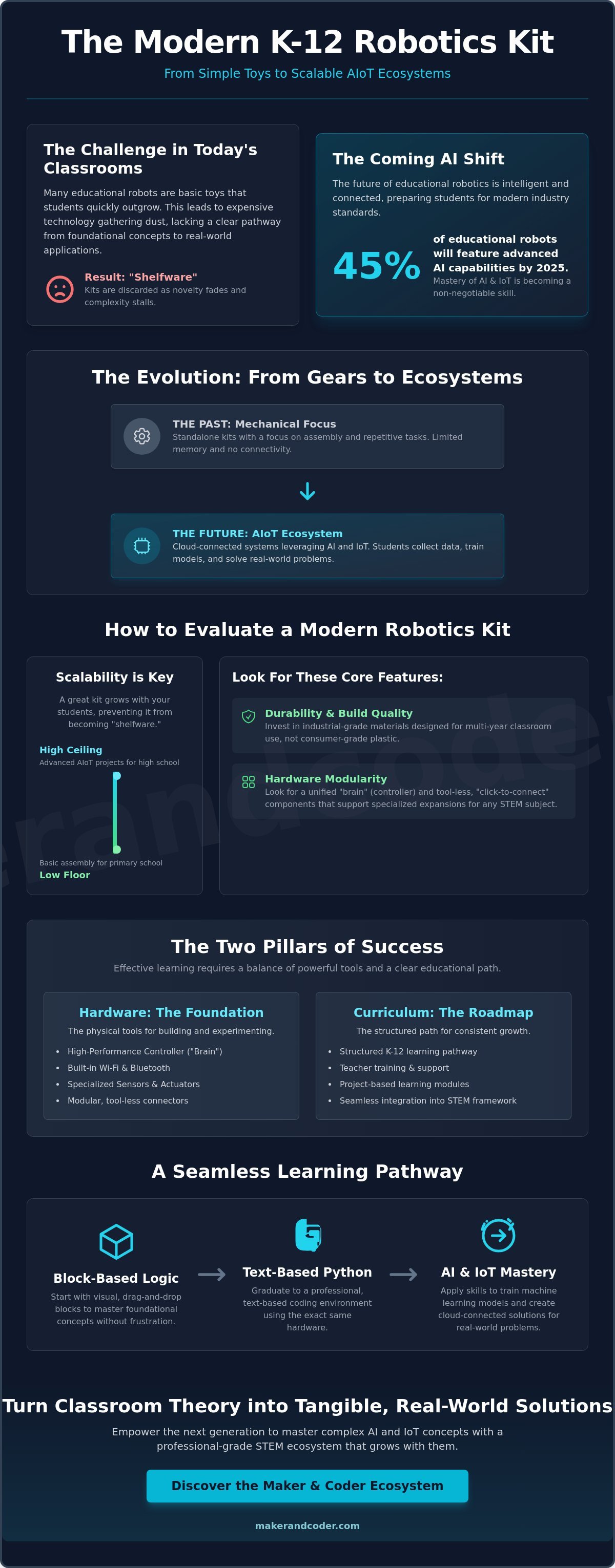
By 2025, 45% of educational robots will feature advanced AI capabilities, yet many classrooms remain tethered to basic toys that students outgrow in a single semester. It’s a common frustration for educators who watch expensive technology gather dust because it lacks a clear pathway to real-world application. You need more than a simple robotics kit; you need a scalable ecosystem that evolves alongside your students’ growing skills.
We understand that the leap from block-based coding to professional Python can feel like a chasm, especially when teachers don’t feel fully supported. This article promises to guide you through selecting a professional-grade STEM solution that transitions learners from basic assembly to advanced AIoT mastery. We’ll examine how the right platform empowers educators through dedicated training while preparing students to solve complex, modern problems using the Internet of Things and artificial intelligence. Discover how to turn your classroom into a hub of genuine innovation and future-readiness.
Key Takeaways
- Understand the evolution from basic mechanical gears to sophisticated, cloud-connected AIoT ecosystems that mirror modern industrial standards.
- Evaluate the “floor and ceiling” of any robotics kit to ensure durability and scalability for a multi-year classroom journey.
- Recognize that hardware is only the foundation; a structured K-12 curriculum is the vital roadmap for consistent student growth and teacher confidence.
- Identify strategies for integrating modular robotics across your entire STEM framework, from physics labs to creative art installations.
- Empower the next generation to master complex AI and IoT concepts, turning classroom theory into tangible, real-world solutions.
Table of Contents
- Defining the Modern Robotics Kit: From Simple Gears to AIoT
- How to Evaluate Robotics Kits for K-12 Education
- Why Hardware is Only Half the Battle: The Necessity of Structured Curriculum
- Integrating Robotics into Existing STEM Frameworks
- Elevating Technical Literacy with the Maker & Coder MC 4.0 Ecosystem
Defining the Modern Robotics Kit: From Simple Gears to AIoT
A professional-grade robotics kit is no longer just a collection of plastic gears and basic motors. It’s a modular ecosystem where hardware, firmware, and logic converge to create a functional digital-physical system. In the past, students focused almost exclusively on mechanical assembly, building static structures that performed repetitive tasks. Today, the field of educational robotics has undergone a radical transformation. We’ve moved from simple gears to cloud-connected systems that leverage the power of the Internet of Things (IoT) and Artificial Intelligence (AI).
The evolution is stark. Early classroom kits were often standalone units with limited memory and no connectivity. Modern systems act as a bridge to the professional world. They allow students to collect environmental data, send it to the cloud, and trigger actions based on machine learning models. This shift from “toy” to “tool” is what distinguishes a professional-grade educational platform from a consumer-grade toy. While toys provide a few hours of entertainment, a professional ecosystem provides a multi-year learning pathway that grows in complexity as the student matures.
The Core Components of a 2026 Robotics System
Success in the modern classroom depends on the quality of the “brain” inside the machine. The controller, such as the MC4.0 Controller, serves as the high-performance heart of the system. In 2026, processing power and connectivity aren’t optional extras. Built-in Wi-Fi and Bluetooth allow for real-time data streaming and remote control, features that are essential for exploring the Internet of Things.
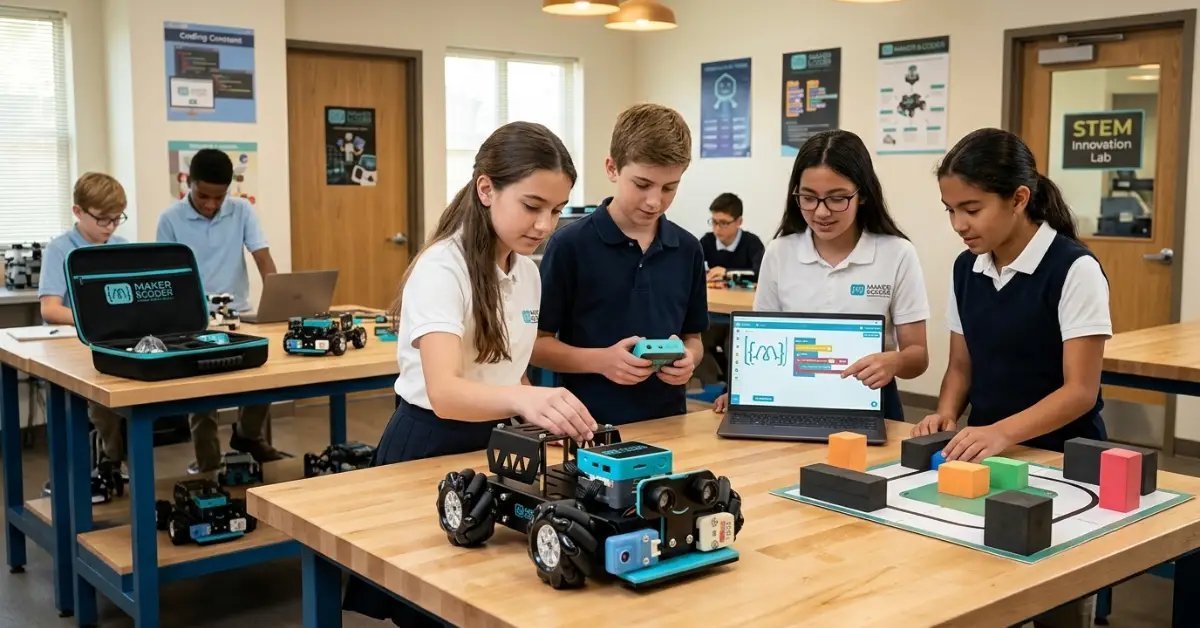
The hardware must also be modular and durable. Modern kits utilize specialized sensors and actuators that go far beyond basic light or touch detection. We now see ultrasonic distance sensors, color recognizers, and high-torque servos that allow for precision movement. These components often feature tool-less, “click-to-connect” designs, ensuring that students spend less time struggling with tiny screws and more time solving complex logic problems.
The Shift from Coding to Computational Thinking
Modern kits are designed to facilitate a seamless journey from visual, block-based logic to text-based Python. This transition is critical for future-readiness. Students start by snapping together MC Blocks to understand foundational concepts. Once they’ve mastered the logic, they can graduate to professional coding environments without changing their hardware.
This scalability allows for the integration of AI literacy. Students can now train machine learning models directly on their hardware, teaching their robots to recognize faces, voices, or specific objects. AIoT in education is the intersection of robotics, data, and intelligence. By 2025, it’s expected that 45% of educational robots will feature AI capabilities, making this mastery a non-negotiable skill for the next generation of innovators.
How to Evaluate Robotics Kits for K-12 Education
Selecting the right robotics kit requires looking far beyond the immediate “wow” factor of a moving machine. You must evaluate the “floor and ceiling” of the ecosystem. A low floor ensures that a primary student can achieve success in their first lesson without frustration. A high ceiling allows a high school senior to use that same core technology to prototype a smart city model using the MC4.0 AIoT Kit. This scalability is what prevents technology from becoming “shelfware,” a common issue where kits are discarded once the initial novelty fades.
A systematic review of educational robotics highlights that the most effective learning occurs when students can transition seamlessly from play-based assembly to rigorous engineering. Durability is a cornerstone of this transition. In a busy classroom, components are handled by hundreds of students over several years. Professional-grade materials must withstand this environment while remaining modular enough to support specialized STEAM expansions. If you’re looking for guidance on matching hardware to your specific grade levels, get in touch with our educational specialists for a tailored roadmap.
Hardware Versatility and Build Quality
Invest in industrial-grade materials. While consumer-grade plastic often cracks under repetitive use, components like MC Blocks are engineered for multi-year longevity. Look for a unified brain, such as the MC4.0 Controller, that remains consistent across different grade levels. This consistency reduces the learning curve for both teachers and students. Ease of assembly is equally vital. Modular, tool-less hardware reduces setup time. This efficiency allows educators to maximize the precious minutes spent on actual problem-solving and logic building rather than searching for tiny screws.
Software Compatibility and Future-Proofing
Software acts as the bridge between a static model and a living, intelligent machine. Ensure your chosen platform supports industry-standard languages like Python and C++. While block-based coding is an excellent entry point, students eventually need to write real-world code to remain competitive. Cross-platform IDEs are essential in modern school environments where students might switch between tablets, Chromebooks, and laptops. Finally, verify the frequency of firmware updates. A system that receives regular improvements ensures your investment remains relevant as AI and IoT technologies continue to evolve at a rapid pace.
Why Hardware is Only Half the Battle: The Necessity of Structured Curriculum
Purchasing a robotics kit is a significant first step, but hardware alone cannot sustain a long-term educational program. Many schools encounter the “shelfware” phenomenon, where expensive technology sits unused because educators lack a clear roadmap for what comes next. Without a structured narrative, students often master the basic mechanics in a few weeks and then lose interest. A professional-grade ecosystem solves this by providing a comprehensive K-12 curriculum that builds complexity year-over-year, ensuring the technology remains a vital part of the classroom for its entire lifecycle.
A well-designed curriculum transforms a box of components into a vehicle for cognitive development. It bridges the gap between simple play and rigorous engineering. By aligning projects with national standards like the Next Generation Science Standards (NGSS) and CSTA Computer Science Standards, schools ensure that every hour spent with a robotics kit contributes to measurable academic success. This structured approach provides students with a sense of progression and mastery, which is essential for maintaining deep engagement in STEM subjects. It moves the focus from “what can this robot do?” to “what problem can I solve with this system?”
Scaffolding Technical Concepts
Effective learning requires a methodical journey. The MC Curriculum provides this by scaffolding technical concepts, moving students from basic electronics and mechanical assembly to sophisticated AIoT integration. This project-based approach encourages students to tackle real-world challenges, such as designing automated climate control systems or intelligent waste management prototypes. For busy educators, this represents a turn-key solution. It removes the burden of lesson planning, allowing teachers to focus on facilitating discovery rather than troubleshooting curriculum gaps.
Professional Teacher Training and Support
The success of any robotics program rests on the confidence of the person at the front of the room. We believe in the “expert-as-enabler” model, where non-technical teachers are empowered to lead high-tech classrooms through dedicated Teacher Training Programs. Ongoing professional development significantly increases the return on investment for any robotics initiative. By building a community of practice among STEM educators, schools can share insights and successes, creating a sustainable culture of innovation. Reliable support ensures that technology remains an accessible tool for creative expression rather than a daunting technical hurdle.
Integrating Robotics into Existing STEM Frameworks
Success isn’t measured by how many boxes you buy. It’s measured by how deeply the technology permeates your school’s culture. Start by identifying your primary educational goals. Are you building a dedicated, high-tech makerspace or integrating tools into daily science lessons? A versatile robotics kit should support multiple disciplines, from complex physics calculations to creative art projects. This cross-curricular utility makes the investment far more sustainable and easier to justify to stakeholders.
Train your “STEM Champions” first. These lead teachers build the internal momentum needed for long-term success. They act as mentors for their peers, reducing the anxiety often associated with new technology. Don’t rush a full-school rollout on day one. Instead, pilot the program with a specific grade level to refine your approach and troubleshoot logistics. Measure outcomes through student portfolios and technical assessments that prove real-world competency. Ready to build your school’s STEM roadmap? Consult with our implementation experts today to design a scalable rollout plan.
From After-School Clubs to Core Curriculum
After-school clubs are excellent for enthusiasts, but robotics deserves a place in the core curriculum. Justify your budget by showing how robotics projects align with existing math and science units. This creates an inclusive environment where all students, regardless of their initial interest in tech, can discover the joy of building. When robotics is part of the grade-level standard, you ensure that every student develops the AI and IoT literacy required for the modern workforce.
Managing a Classroom Set of Robotics Kits
Classroom management is often the biggest hurdle for new programs. Use modular systems like MC Blocks to minimize lost parts and maximize build time. These components are designed for rapid assembly, ensuring students spend their time coding rather than searching for tiny screws. Establish clear best practices for storage and charging to keep your robotics kit inventory ready for action. Cloud-based software simplifies the process further, allowing students to submit projects digitally while teachers track progress through a centralized dashboard.
Elevating Technical Literacy with the Maker & Coder MC 4.0 Ecosystem
The journey from basic assembly to advanced engineering requires a platform that is both accessible and ambitious. The Maker & Coder MC 4.0 ecosystem serves as this bridge, providing a seamless transition for students throughout their K-12 experience. At the heart of this system lies the MC4.0 Controller. This high-performance hub is designed to handle the rigorous demands of modern computing while remaining intuitive for young learners. It isn’t just a component; it’s the professional-grade engine that powers every robotics kit in our lineup, ensuring that students never hit a technical ceiling as their skills evolve.
True technical literacy emerges when hardware and software work in perfect synergy. Our ecosystem combines the physical versatility of MC Blocks with the structured depth of the MC Curriculum. This integration ensures that every build has a purpose and every line of code has a real-world consequence. By providing a unified environment, we eliminate the friction of switching between disparate systems. Students can focus entirely on the joy of discovery, moving confidently from foundational STEAM concepts to the complex frontiers of artificial intelligence and the Internet of Things.
The MC4.0 Advantage: Professional Grade, Classroom Friendly
The MC4.0 Controller acts as the ideal gateway to professional engineering. It offers the processing power needed for sophisticated tasks while maintaining a rugged, classroom-ready design. For those just beginning their journey, the MC4.0 Base Kit provides the essential building blocks for foundational learning and mechanical exploration. As students mature, they can graduate to more specialized challenges. The MC4.0 AIoT kit empowers students to master the intersection of cloud data, machine learning, and hardware, providing the technical fluency required to navigate the complex, data-driven world of 2026. This progression ensures that your robotics kit remains a relevant, high-value asset for years to come.
A Partner in Future-Readiness
We don’t just sell hardware; we build sustainable STEM programs. Maker & Coder acts as a dedicated partner, supporting schools from the initial purchase through to full classroom implementation. Our Teacher Training Programs are designed to transform educators into confident mentors, regardless of their prior technical background. This “expert-as-enabler” approach ensures that the technology is utilized to its full potential, sparking curiosity and building resilience in every student. When you choose a unified hardware and software ecosystem, you’re investing in a long-term vision of success. Explore the MC 4.0 Ecosystem and transform your STEM program today.
Empowering the Next Generation of Innovators
Selecting a professional-grade robotics kit is a commitment to your students’ long-term technical literacy. We’ve explored how a scalable ecosystem bridges the gap between simple block coding and the advanced world of AIoT. You now understand that hardware is only the foundation; true success requires a roadmap of curriculum-aligned projects and supported, confident educators who feel enabled to lead. It’s about moving from passive consumption to active, creative expression in a digital-physical world.
By combining industrial-grade MC4.0 Hardware with the comprehensive K-12 MC Curriculum and our specialized Teacher Training Programs, you create a classroom environment where curiosity leads to tangible breakthroughs. This synergy ensures your investment provides value for years, evolving as your students master increasingly complex concepts. Don’t let your STEM goals remain on the shelf. Request a Consultation for Your School’s MC 4.0 Implementation to begin your journey toward classroom mastery. The future is built by those who dare to create today. We’re ready to help you lead the way.
Frequently Asked Questions
What age is a robotics kit appropriate for?
A professional robotics kit is designed to support the entire K-12 educational spectrum. Younger students in primary grades focus on tactile assembly and foundational logic through visual interfaces. As learners mature into middle and high school, the same ecosystem scales to support complex engineering challenges, advanced sensors, and text-based programming. This modularity ensures the technology remains a relevant tool for cognitive development across all age groups.
Do I need prior coding knowledge to use a robotics kit in my classroom?
You don’t need any previous programming experience to successfully lead a robotics program. Modern educational platforms utilize intuitive, block-based coding environments that allow both teachers and students to master logic before worrying about complex syntax. Comprehensive teacher training programs are also available to provide the technical confidence and pedagogical strategies needed to facilitate a high-tech learning environment effectively.
What is the difference between a toy robot and an educational robotics kit?
The primary difference lies in scalability and educational intent. While toy robots typically offer fixed, entertainment-based interactions, an educational robotics kit provides a modular ecosystem built for creative expression and problem-solving. Professional-grade kits are backed by structured K-12 curricula and industrial-grade hardware, allowing students to build functional systems that mirror real-world technology rather than just following pre-set play patterns.
How does a robotics kit help with future career readiness?
Robotics education cultivates the computational thinking and technical literacy required for the modern workforce. With STEM occupations projected by the Bureau of Labor Statistics to grow to 11.82 million jobs by 2033, students must be comfortable with automated systems. By engaging with these kits, learners gain hands-on experience with AI and IoT concepts, preparing them for high-demand roles in engineering, data science, and advanced manufacturing. Beyond STEM, specialized professional training from platforms like Multifamily Schooled is becoming increasingly vital for those looking to master other high-value sectors such as commercial real estate investing.
Can robotics kits be used to teach Artificial Intelligence (AI)?
Modern kits are specifically engineered to demystify Artificial Intelligence through practical application. Students can train machine learning models directly on high-performance controllers to perform tasks like facial recognition, voice command processing, and autonomous navigation. This hands-on approach turns abstract algorithms into tangible tools, helping students understand how AI influences the world around them.
How much does it cost to start a robotics program for a whole school?
Implementation costs depend on the size of the student body and the depth of the desired integration. Market data from June 2026 shows that professional-grade class packs for standard classroom sizes generally range from $3,000 to $5,000. When budgeting, schools should consider the total value of the ecosystem, including the longevity of the hardware, access to a structured K-12 curriculum, and ongoing professional development for staff.
What is the best programming language for students to learn with robotics?
Python is widely recognized as the ideal language for students moving beyond basic visual logic. Its readable syntax makes it accessible for beginners while remaining the industry standard for professional AI and data science applications. Most successful programs utilize a “bridge” approach, starting with block-based coding to establish core concepts and graduating to Python for advanced, real-world robotics projects.
How do I maintain and store robotics kits for multiple classes?
Effective maintenance relies on organized inventory management and dedicated charging stations. Using modular systems like MC Blocks helps reduce the frequency of lost parts because components are designed for quick assembly and secure storage. Implementing a standardized cleanup routine and using cloud-based software to manage student projects ensures that the hardware remains ready for use across multiple class periods and grade levels.