
A meeting is not a learning community unless it informs what happens in the classroom. Professional learning communities for STEM educators bring teachers together to examine instruction and student learning, share strategies, and use what they learn to strengthen teaching. In K-12 settings, that collaboration can connect science, technology, engineering, and mathematics around meaningful learning goals.
STEM educators know that strong learning takes more than sharing ideas. It takes time to explore students’ needs, reflect on teaching, and turn discussion into practical changes. A focused professional learning community makes this work collaborative, helping educators develop their practice while creating opportunities for mentoring and emerging scholar leadership.
This article explains what professional learning communities are, how they can support STEM instruction, and what helps sustain collaboration. It also shows how shared goals, student work, thoughtful reflection, and inclusive classroom practices can guide a group’s work. Move from occasional conversations to purposeful learning that supports educators and creates richer opportunities for students.
Key Takeaways
- Shape PLC discussions around a shared STEM learning goal, student needs, and a teaching strategy educators can test in class.
- Connect science, technology, engineering, and mathematics through collaborative planning and close attention to how students make sense of ideas.
- Use clear norms, focused meeting protocols, and follow-through to keep collaboration purposeful and resilient over time.
- Make mentoring reciprocal: create opportunities for educators and scholars to share expertise, reflect, and take leadership in the group’s learning.
- Explore hands-on classroom learning with the MC 4.0 Kit, supported by the K-12 MC Curriculum, MC Blocks, and Teacher Training Programs.
What Are Professional Learning Communities in Education?
Professional learning communities for STEM educators are groups of teachers who learn together to improve instruction and student outcomes. They examine classroom evidence, develop shared teaching strategies, and reflect on how those strategies work across science, technology, engineering, and mathematics. In K-12 education, the focus is practical: connect professional development to what students are learning and what teachers are implementing.
Funding and costs depend on how a school or program organizes its learning community. District budgets may support meeting time and professional development, while grant-funded programs can support structured teacher preparation. The National Science Foundation’s Noyce program at Kean University is one example. Schools can also build collaboration into existing planning time, with costs shaped by staffing, materials, and the activities selected.
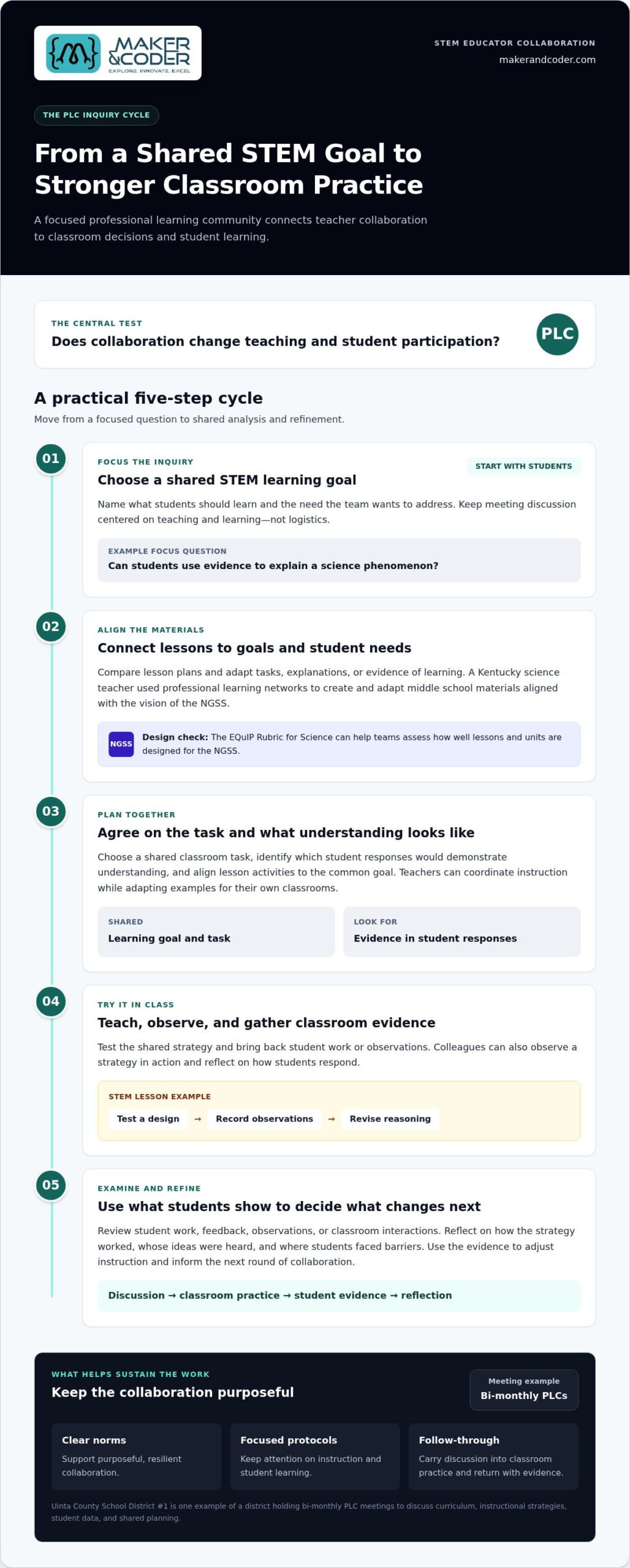
The work needs a clear focus. PLC meetings lose value when logistics take priority over teaching and learning. Instead, teachers can choose a strategy, try it in class, and return with student work or observations to discuss the results. Classroom observations add another layer: colleagues can see a strategy in action and reflect on how students respond. This makes discussion an inquiry cycle, not just a calendar meeting.
Equity-focused reflection gives that inquiry a wider lens. Teachers can examine whose ideas are heard, which routines support participation, and where students face barriers. They can reflect individually and with colleagues, using student feedback, work samples, or classroom interactions as evidence. Intentional community building helps educators identify social tensions that may affect learning and create settings where students can participate in extended science discussions.
For elementary teachers, a district-wide Science Leadership Team can build knowledge of three-dimensional science teaching and learning. Teachers can use the group to connect disciplinary core ideas, scientific practices, and crosscutting concepts when planning lessons. They can then compare student explanations and revise activities to support deeper sensemaking. Shared analysis links teacher development to specific classroom decisions.
Teacher self-efficacy matters, especially when educators integrate disciplines. One study examined high school teachers’ confidence in integrated STEM instruction through a collaborative community of practice. Kean University’s NSF Noyce STEM teacher preparation program offers another example: its five-year project recruits college juniors and seniors studying Biology or Mathematical Sciences Education. Its PLC brings scholars and faculty mentors together for professional learning.
These examples show how a PLC can support teachers at different career stages. Groups build knowledge through discussion, classroom observation, and shared analysis, while mentors help scholars connect teaching ideas with practice. The key test is whether collaboration changes teachers’ practice and improves how students participate in STEM learning.
Professional learning communities and instructional integration
Instructional integration connects STEM concepts and teaching decisions across lessons rather than treating each subject as an isolated task. A PLC gives colleagues a shared structure for planning, examining student learning, and refining classroom practice.
Adapting Instructional Materials
Adapting instructional materials means revising lessons or units to better match learning goals, student needs, and classroom evidence. A Kentucky science teacher used professional learning networks to create and adapt middle school materials aligned with the vision of the Next Generation Science Standards (NGSS). This shows how colleagues can develop resources together, then adjust explanations, tasks, or evidence of learning for their students. The EQuIP Rubric for Science can help teams assess how well lessons and units are designed for the NGSS.
Shared Planning and Instructional Goals
Shared planning is the process of agreeing on what students should learn and how teachers will support that learning. Uinta County School District #1 holds bi-monthly PLC meetings where teachers and leaders discuss curriculum, instructional strategies, student data, and shared planning. Teams can make that time purposeful by choosing a common learning goal, identifying the evidence that will show progress, and aligning lesson activities to the goal. This creates a clearer relationship between classroom plans and student needs.
Start with a focused question, such as whether students can use evidence to explain a science phenomenon. Colleagues can compare lesson plans, choose a shared task, and identify which student responses would demonstrate understanding. Shared goals help teachers coordinate instruction while leaving room to adapt examples for their own classrooms.
Instructional Practices
Instructional practices are the teaching moves educators choose to help students engage with and understand STEM ideas. A PLC can examine how teachers introduce a problem, facilitate discussion, or connect evidence to an explanation. For a middle school unit, colleagues might plan how students will test a design, record observations, and use the results to revise their reasoning. Reviewing the lesson together can build teachers’ confidence and reveal where instructions or supports need adjustment.
Student evidence keeps the work grounded. Teams can review relevant data or student work, identify a learning need, and revise the next instructional move. Without shared norms and protocols, discussions can remain superficial. A set agenda and agreed analysis process keep attention on the lesson and its effects. These practices make STEM integration visible in daily teaching, not just in curriculum documents.
For educators strengthening this collaborative approach, discuss STEM instructional learning as a way to connect planning with classroom practice.
Building and sustaining PLCs over time
Strong PLCs make collaboration part of teachers’ ongoing work, not an occasional meeting. Their routines connect shared inquiry with classroom decisions and student achievement.
Schools can measure impact by comparing student achievement data, work samples, and observed teaching practices over time. At Bray Park State High School, the share of students in the A-C range for science and maths rose from 65% to 85% after PLCs and other innovations were implemented.
Characteristics of Effective PLCs
Effective PLCs use student evidence to identify needs, agree on next steps, and revisit results. This cycle links teacher learning with changes in instruction rather than treating discussion as the outcome. Teams can compare student work, identify a recurring difficulty, and test a response. Productive groups also welcome respectful disagreement, using different interpretations to sharpen decisions instead of avoiding debate.
Benefits and Limitations
PLCs can strengthen teaching by helping colleagues share strategies, examine achievement, and respond to student needs together. But collaboration alone doesn’t ensure improvement: sharing data without acting on it leaves classroom practice unchanged. Time is another constraint, since PLC meetings may be cut first when school schedules tighten. Recognizing both the benefits and limits helps teams protect time for analysis and follow-through.
Conditions for Success
Successful PLCs need protected meeting time, shared norms, and a clear process for turning evidence into action. Teams can aim for 60 minutes each week, adapting that target to available time, or schedule meetings weekly or twice a month. Elementary teams should establish collaboration norms at their first meeting. Those agreements help members discuss student needs openly and keep the group focused when priorities compete.
Approaches to Conducting PLCs
A useful meeting structure moves from evidence to interpretation, then to a practical next step. Teachers might review student work, identify a pattern, choose an instructional response, and decide what evidence to bring back. Fortnightly meetings can provide regular opportunities to review implementation. Follow-through is essential: the next discussion should examine what teachers tried and what student work revealed.
Protecting the routine requires school leaders to treat PLC time as instructional work, especially during schedule changes. The National Commission on Teaching and America’s Future released a report on teacher learning team initiatives in 2010, reflecting broader attention to collaborative teacher development. A team can sustain momentum by recording decisions, assigning follow-up actions, and revisiting its goals as student needs evolve.
Mentoring and scholar leadership in the PLC
Mentoring makes a PLC a place where emerging educators contribute, not just receive advice. Science leaders can structure that exchange around shared problems, evidence, and ongoing professional growth.
Facilitators benefit from STEM teaching knowledge and the skills to guide discussion, invite different perspectives, and turn decisions into clear next steps. An agreed protocol can keep meetings focused, make room for scholar voices, and record follow-up actions. The facilitator supports the group’s learning rather than supplying every answer.
A district-wide Science Leadership Team offers one model for mentoring beyond a single school. It can build elementary teachers’ knowledge of three-dimensional science teaching and learning. Experienced educators can share approaches, while colleagues bring classroom questions and student responses for joint discussion. This connects leadership development with practical science instruction.
PLC Examples for Educators and Leaders
A university-based PLC can connect scholars, faculty mentors, and practicing educators through structured inquiry. At Kean University, PLC members formed small groups in May 2025 to study five guiding principles for STEM education. The activity gives scholars a defined leadership task: interpret a principle with peers, discuss its instructional meaning, and bring their thinking into the larger group.
Kean’s Noyce PLC also used a one-hour virtual seminar on teaching multilingual students. All 14 members completed a modified self-efficacy survey covering 40 competencies, with an overall mean score of 6.9. These details offer a model for linking mentoring with targeted learning and reflection. A facilitator can use a focused seminar, followed by group discussion, to help scholars connect new knowledge with teaching decisions.
Finding Local and Online Networks
Educators can start with science leadership teams or PLCs that operate across a district or state. These structures help teachers find colleagues when their school has no STEM counterpart. Online communities such as #NGSSChat, @OfficialNGSS, and @NSTA connect educators with peers, resources, and experts. A clear question about lesson design or student engagement gives an online exchange a practical focus.
The Science Peer Review Panel offers another example of an ongoing professional learning community. Its US educator cohort brings expertise in the Next Generation Science Standards and the EQuIP Rubric for Science. Members develop expertise through materials reviews, consensus conversations, and in-person meetings. Their feedback helps developers improve instructional materials and supports free, publicly available examples for educators.
Across a district team, university PLC, or online network, scholar leadership grows through meaningful participation. Give emerging educators a role in choosing questions, reviewing evidence, or facilitating part of a discussion. These responsibilities make mentoring reciprocal: experienced leaders share knowledge, while scholars contribute fresh analysis and strengthen the group’s understanding of science teaching.
Professional learning communities in STEM education
STEM PLCs connect teacher collaboration with the integrated thinking students use in science, technology, engineering, and mathematics. Their purpose is to improve classroom practice through sustained attention to student learning, not simply to coordinate subject schedules.
Strong school-based professional learning communities support STEM teaching and student achievement by helping educators learn together. The benefit comes from shared inquiry: teachers compare instructional choices, examine student responses, and adapt lessons. Ask whether a PLC’s discussions change classroom practice and give teachers evidence to consider at their next meeting.
A study by Liu and colleagues reported evidence involving 16,072 STEM teachers in research on professional learning communities, digital professional development, and instructional integration. The scale of that study points to a key design challenge: integrating learning across disciplines requires more than placing subjects side by side. Teachers need shared planning time to connect concepts, teaching approaches, and the evidence students produce.
For example, a team planning an engineering design challenge can ask how students will apply mathematical reasoning and scientific evidence. Teachers can agree on a shared problem, then identify where each discipline contributes meaningfully. Afterward, they can review student explanations and design choices. This sequence helps distinguish genuine integration from a project that merely carries several subject labels.
Digital professional development can widen access to expertise and learning resources, while a PLC connects those ideas to local classroom decisions. Teachers might explore an online demonstration, adapt it for their students, and bring work samples back for discussion. The group’s shared purpose keeps technology in service of learning rather than treating a new tool as the outcome.
To keep integrated STEM instruction focused, teams can return to three questions:
- What concept or problem connects the disciplines in this lesson?
- What student evidence will show understanding across those connections?
- What will teachers adjust after reviewing that evidence?
These questions make collaboration observable and actionable. A team can track whether planned instructional changes appear in lessons, student explanations, and project decisions. It should also examine whose ideas shape classroom sensemaking, since participation affects how students engage with STEM tasks. This links instructional integration with equitable opportunities to contribute.
For professional learning communities for STEM educators, the clearest measure of progress is the connection between teacher learning and student work. A strong PLC moves from shared purpose to integrated instruction, then uses classroom evidence to refine the next learning experience. If your educators are developing that collaborative STEM practice, connect with Maker & Coder about STEM learning.
Maker & Coder: MC 4.0 Kit
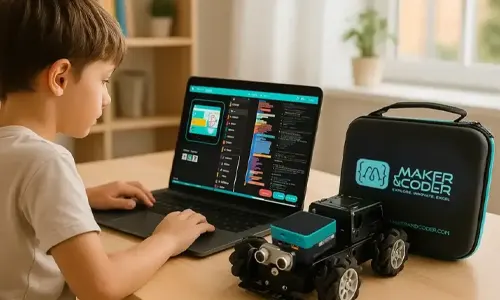
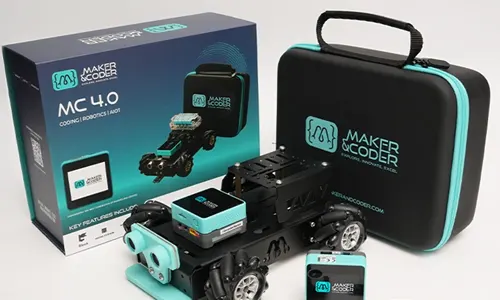
Maker & Coder’s MC 4.0 Kit can give STEM teams a shared platform for planning hands-on learning and classroom activities. It fits when educators want to connect collaborative inquiry with practical work in technology and engineering.
Teams can pair the kit with MC Blocks and the MC Curriculum (K-12) to shape a structured learning pathway. Teachers can use shared activities as a basis for planning, compare student work, and discuss how lessons support their learning goals. Teacher Training Programs can help educators build their familiarity with the curriculum and hardware, giving PLC conversations a practical point of connection.
Choose resources that match your group’s instructional purpose, then use classroom evidence to guide future planning. Contact Maker & Coder to explore how its STEM education offerings can support your educators.
Turn shared learning into the next classroom possibility
The next step for professional learning communities for STEM educators is to give shared ideas a clear path into classroom practice. Choose a learning goal for your team, then consider what tools and curriculum can help educators shape that experience together.
Maker & Coder offers the MC 4.0 Kit, MC Curriculum (K-12), and MC Blocks. These resources can support PLC teams as they plan hands-on STEM learning and develop a common instructional direction. The right starting point is the one that fits your learners, your goals, and the questions your educators want to investigate.
Bring your team’s ideas into focus and explore how these offerings could support your next learning project. Contact Maker & Coder to discuss a path forward. Each purposeful conversation can help turn collaboration into new opportunities for discovery and growth.
Maker & Coder for STEM Educator Learning
Maker & Coder provides a specialized STEM education ecosystem centered on the MC 4.0 hardware platform and modular MC Blocks. For educators looking to put ideas from a professional learning community into structured, hands-on technical learning, its MC4.0 Controller and Base, AIoT, and STEAM kits offer hardware options to explore.
Maker & Coder also offers a K-12 MC Curriculum designed to integrate with its hardware. Turn to the curriculum when your team is ready to shape shared STEM learning into a structured educational pathway.
Frequently Asked Questions
What are the benefits of a PLC?
A PLC helps educators learn from one another and make more intentional teaching decisions. For example, a teacher can bring a student misconception to the group, compare possible explanations with colleagues, and adapt an upcoming lesson. This shared problem-solving can also support professional satisfaction and teachers’ development over time. The benefit depends on using discussions to inform classroom practice, not treating meetings as a routine obligation.
What is an example of a PLC?
An elementary science PLC might bring together teachers preparing students to explain a local weather pattern. Members could compare how they introduce the phenomenon, discuss student questions, and decide which examples make the science accessible. Each teacher can then gather student explanations for the next discussion. This gives the group a specific teaching challenge to explore, with evidence and ideas from each classroom.
What are the benefits of STEM teacher professional learning communities?
STEM PLCs help teachers connect concepts across subjects and build confidence in integrated instruction. A science teacher and a mathematics teacher, for instance, can plan how students will use measurements to interpret an investigation. Colleagues can then examine whether the activity supports both learning goals. These communities also create space to reflect on equitable participation and whose ideas are heard during collaborative problem-solving.
What does research say about the effectiveness of STEM educator PLCs?
Research points to potential benefits, but results depend on what a PLC does with its time. A knowledge synthesis reviewed nearly 200 STEM education research articles and reports on K-12 learning communities. Research also describes teachers in strong learning communities as more satisfied with their careers and more likely to remain in teaching long enough to become accomplished educators. These findings support purposeful collaboration, while not proving that meetings alone cause improved outcomes.
What are examples of successful STEM PLC models and programs in the United States?
Kean University’s NSF Noyce STEM teacher preparation project provides a U.S. example of connecting scholars, faculty mentors, and STEM teaching development. The Science Peer Review Panel offers a different model, bringing educators together to strengthen their expertise in reviewing instructional materials. The first supports teacher preparation; the second builds professional knowledge through review and collective discussion. Schools can adapt either structure to their learning goals.
How do schools start a professional learning community for STEM teachers?
Start with a shared instructional challenge, such as helping students explain why a design failed. Invite teachers whose knowledge can illuminate the question, then agree on a student-learning goal and how to examine classroom evidence. Set discussion norms and assign someone to record decisions. Before the first cycle ends, decide what each teacher will try and what evidence the group will bring back to judge whether the approach needs revision.
What topics and activities should a STEM educator PLC include?
Useful topics include interdisciplinary lesson design, student reasoning, assessment, participation, and ways to make scientific uncertainty visible. Activities should produce something teachers can use: examine an anonymized student response, rehearse a discussion prompt, or compare how two lesson tasks invite evidence-based explanations. A group might also assess whether a project genuinely combines disciplinary learning. Choose activities based on students’ current learning needs, not simply because a topic is popular.
How often should STEM teacher PLCs meet, and how much time do they require?
A workable rhythm is weekly or twice monthly, with teams aiming for 60 minutes each week when schedules allow. The essential requirement is enough protected time to consider evidence, agree on a teaching response, and revisit what happened. A shorter meeting can still be useful if it has one clear focus and a record of next steps. Consistency matters because long gaps can weaken follow-through between discussion and classroom implementation.