
What if every STEM project moved students one step forward instead of sitting on the calendar as a fun activity with no clear connection to what came before? That’s the purpose of STEM curriculum mapping: connect standards and learning goals to a teachable sequence, hands-on projects, and evidence of student understanding.
Standards, lessons, and projects can feel like separate pieces. A build may spark curiosity, but without a clear learning target and a way to assess progress, it’s hard to know what students have learned or what they’re ready to tackle next.
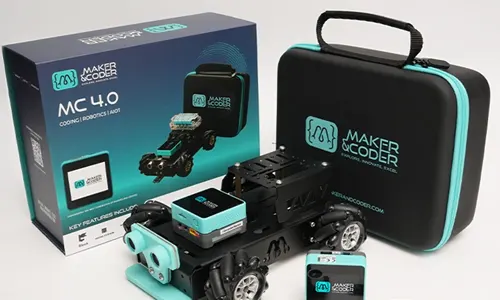
This guide will help you plan a practical map for the new school year, from defining a progression of learning goals to choosing projects that make student thinking visible. You’ll also explore how to organize the map across grades and subjects, support classroom implementation, and revise the plan as you learn what works. Maker & Coder’s structured K-12 MC Curriculum, MC 4.0 hardware, modular MC Blocks, and teacher training provide connected resources for bringing mapped learning into the classroom.
Key Takeaways
- Use STEM curriculum mapping to connect applicable standards with learning goals, a deliberate sequence, learning experiences, and assessment evidence.
- Choose projects based on what students will learn and do, the materials available, and the evidence teachers can observe.
- Make the map a practical planning tool by establishing shared ownership, planning time, materials preparation, and teacher feedback.
- Connect mapped hands-on experiences with curriculum, hardware, and classroom implementation support.
- Explore how Maker & Coder’s K-12 MC Curriculum, designed to integrate with MC 4.0 hardware, can fit into your school’s learning sequence.
What Is STEM Curriculum Mapping, and Why Start Before the School Year?
A STEM curriculum map is a shared planning overview that connects learning goals to their sequence, classroom experiences, timing, and assessment evidence. A concise definition for colleagues: A curriculum map shows what students are working toward, how learning progresses, and what evidence will help teachers recognize that progress. In STEM curriculum mapping, the overview helps teams see how science, technology, engineering, and mathematics learning can build across a grade, subject, or school year.
A map serves a different purpose from a daily lesson plan or unit plan. A lesson plan describes what happens in a particular class, while a unit plan organizes a focused stretch of instruction. The map shows how those pieces relate across a broader timeline. It’s also more purposeful than a collection of appealing activities: each experience has a place because it supports a learning goal or helps students apply earlier learning.
This shared view matters when teachers plan across subjects, grade levels, or teams. Without it, one class may revisit an introductory idea while another assumes students have already mastered it. A coherent map makes connections visible, giving educators a basis for coordination while leaving room to adapt instruction to their students.
What belongs in a useful STEM curriculum map?
Keep the overview focused on information teachers need to coordinate. Include learning goals, approximate timing, key concepts, student experiences, and the evidence that will help show what students understand. For example, a map might show when students encounter a design challenge, which concept they apply, and what work or explanation teachers can review afterward.
That’s enough to guide shared planning without scripting every classroom move. Daily instructions, discussion prompts, and step-by-step activity directions belong in lesson materials, not necessarily in the year-level map. For broader context, Curriculum mapping describes the practice and its use in organizing what students learn and how that learning is assessed.
Why map the curriculum before teaching begins?
Start early enough to spot gaps, repetition, and rushed sequences while there’s still time to adjust. If a later project depends on students interpreting data, for instance, the map can help the team see whether earlier learning gives them a chance to practise that skill. The progression then becomes intentional rather than dependent on assumptions about what another class covered.
Advance planning also turns broad intentions into practical decisions. Teams can estimate when shared materials will be needed, place projects within the school schedule, and identify where teachers may need preparation or collaboration time. A map won’t predict every classroom need. Treat it as a revisable guide: return to it during the year, use teacher observations to refine the sequence, and keep what supports meaningful learning.
Building a STEM Curriculum Map: Standards to Progression
Turn applicable curriculum requirements into a sequence teachers can explain and students can experience. In STEM curriculum mapping, the goal isn’t to copy standards into a spreadsheet. It’s to make deliberate choices about what students should learn, how learning develops, and what will show their progress. Use the standards and learning requirements that apply to your school or jurisdiction, since curricula and grade expectations vary across regions.
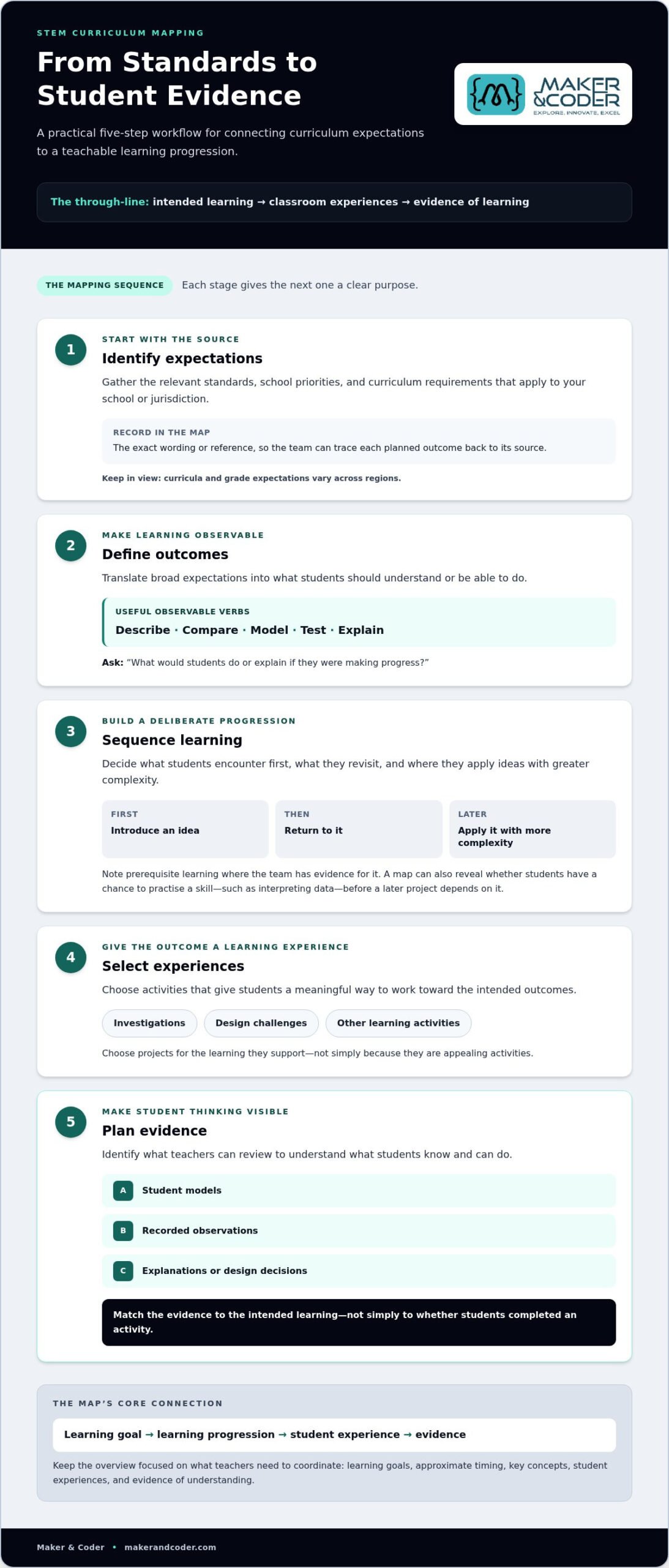
A map links intended learning with evidence of learning. Use that principle to connect each project, concept, and assessment to a clear purpose. A practical workflow moves from requirements to classroom experiences:
- Identify expectations. Gather the relevant standards, school priorities, and curriculum requirements. Record their exact wording or reference so the team can trace each planned outcome to its source.
- Define outcomes. Translate broad expectations into what students should understand or be able to do. Use observable verbs such as describe, compare, model, test, or explain.
- Sequence learning. Decide what students need to encounter first, what they’ll revisit, and where they’ll apply ideas with greater complexity. Note prerequisite learning where the team has evidence for it.
- Select experiences. Choose investigations, design challenges, or other learning activities that give students a meaningful way to work toward the outcomes.
- Plan evidence. Identify what teachers can review, such as student models, recorded observations, explanations, or design decisions. Match the evidence to the intended learning, not simply to whether students completed an activity.
How do you turn standards into clear learning outcomes?
Start with one expectation and ask, “What would students do or explain if they were making progress?” For example, a broad goal related to design might become an outcome about testing a model and using observations to explain a revision. Keep related expectations together under a shared theme when that helps planning, but preserve their distinct meanings. Check each outcome against the applicable curriculum language before adding it to the map.
How can a map show progression across grades?
Use a simple matrix with grades or grade bands in columns and key concepts or skills in rows. Mark where students first encounter an idea, return to it, and apply it in a more demanding context. A team might trace how students move from describing a pattern to using evidence to explain one. Treat this as a planning question, not a universal sequence: verify local expectations and label proposed steps that still need team discussion.
Look across the matrix for blank spaces, repeated experiences that don’t deepen learning, or sudden jumps in complexity. Separate verified requirements from assumptions in the map itself. That distinction makes planning conversations more precise and helps teams decide what to investigate before finalizing a progression.
If your team is translating learning goals into a practical STEM sequence, discuss your curriculum goals as a starting point for shaping the map.
How to Choose STEM Projects and Assessments That Fit the Map
Choose a project after identifying the learning goal, not simply because the activity looks exciting. A useful fit connects four things: the intended learning, what students will do, the materials and time available, and the evidence teachers can use to assess understanding. This check makes STEM curriculum mapping practical: it helps teams select experiences for a reason and adapt them to classroom realities.
Engagement matters, but enjoyment or a polished final build doesn’t prove that students met the intended outcome. A hands-on project earns its place when students must use the concept or skill the map targets and teachers can see evidence of that thinking. For instance, if the goal is to explain how a design changes after testing, plan for students to record a test, make a design decision, and explain why they revised their work.
How do you match a hands-on project to a learning goal?
Start with the concept or skill, then ask what students need to do to apply it. Compare possible projects against the same criteria: Does the activity require the target learning, fit the available materials and schedule, and create evidence teachers can review? MC Blocks or MC 4.0 activities can provide a hands-on context when they directly support the mapped outcome. Keep the learning goal in focus, and don’t assume a tool alone demonstrates learning.
Concept practice: Students focus on applying or explaining a defined idea. Look for evidence such as a response, model, or explanation connected to that concept.
Design challenge: Students develop and test a solution within a defined task. Look for the reasoning behind their choices, test observations, and revisions.
Open-ended project: Students have more choice in what they create or investigate. Set clear learning criteria and checkpoints so the range of possible outcomes still produces assessable evidence.
What evidence shows students are learning through a STEM project?
Match evidence to the outcome rather than grading novelty, visual appeal, or completion alone. Depending on the goal, useful evidence may include an explanation, a design decision, test results, a revision, or completed work. Assessment evidence keeps hands-on work academically purposeful by showing whether students can explain a concept, apply a skill, use test results to make a decision, revise an approach, or communicate what their work demonstrates.
Build in brief checkpoints during the activity. A prompt to explain a choice, a quick sketch before building, or a short record of what happened during a test can reveal understanding while there’s still time to respond. Keep each checkpoint manageable: it should capture evidence tied to the goal without interrupting the work with unnecessary paperwork.
For school teams exploring how hands-on learning can support mapped outcomes, discuss your curriculum goals.
How to Make a STEM Curriculum Map Work for Teachers
A map becomes useful when teachers can return to it while making real planning decisions. If it exists only to satisfy a reporting requirement, it won’t help a team coordinate learning or respond to classroom needs. Give the map shared ownership: involve the teachers who will use it, agree on who maintains it, and make updates easy for the team to find.
Protect shared planning time, even if the team uses it to review one grade band, unit, or upcoming project at a time. Use that time to coordinate timing, identify prerequisite learning, and plan materials. A project may fit the learning goals but still need adjustment if equipment, classroom time, or teacher preparation isn’t accounted for. Flag those needs early, assign follow-up steps, and record decisions in the map or an accompanying planning document.
How can teachers use the map during the school year?
Use the map as an overview for shaping unit plans, not as a script for every classroom interaction. Teachers can adapt pacing, examples, and teaching approaches while keeping sight of shared learning goals. As instruction unfolds, invite them to flag timing changes, resource gaps, or prerequisite knowledge students need more time to develop. Bring student work into planning conversations so adjustments respond to what learners demonstrate, not only to what the calendar says.
Keep feedback specific and actionable. Rather than noting that a project “took too long,” record which part required extra time and what students needed to complete it. If teachers notice a concept needs another opportunity for practice, capture that observation alongside relevant student evidence. This gives the team a practical basis for refining the map without treating every classroom difference as a problem.
When should a school review and revise its curriculum map?
Set review points before launch, during implementation, and after the school year. Before teaching begins, check timing, materials, and teacher preparation. During the year, use planned team discussions to address emerging issues and consider whether the sequence is working. After the year, review teacher observations and student evidence to identify adjustments for the next cycle.
Keep a brief change record: note what changed, why the team changed it, and what evidence or feedback informed the decision. This prevents useful learning from disappearing when planning passes to a new team or school year. It also makes the map a living resource. STEM curriculum mapping works best when educators can improve a shared plan while retaining professional judgment in their own classrooms.
Ready to shape a map around your school’s priorities? Discuss your school’s STEM curriculum goals.
Connect Your STEM Curriculum Map to MC 4.0 Learning Experiences
Technology belongs in a curriculum map when it helps students work toward a clear learning goal. Treat curriculum, hardware, modular tools, and teacher preparation as connected parts of implementation, rather than separate purchases or activities to fit into every unit. Maker & Coder’s K-12 MC Curriculum is designed to integrate directly with its MC 4.0 hardware, giving teams a pathway to plan hands-on experiences in relation to intended learning.
How can hardware-based learning fit into a curriculum map?
Start with the mapped goal, then decide whether a hands-on technical experience will help students explore or apply it. For example, if students are expected to explain a design decision, plan an activity that gives them a reason to make a decision and a way to describe their thinking. The equipment supports the learning experience; it doesn’t replace the goal or the evidence teachers need to see.
MC Blocks are modular tools students can use for experimentation within a planned experience. Consider where this kind of work fits the sequence and what students should learn from it. If a unit’s goals are better served by another approach, don’t add hardware just for its own sake. That selectivity keeps STEM curriculum mapping focused on learning purpose while making room for meaningful technical exploration.
When a mapped outcome calls for a hands-on experience, include MC 4.0 educational kits in planning the classroom activity. Connect the choice to the intended student work, available materials, and evidence teachers plan to gather. In the map, note where the experience occurs and how it supports the wider progression, so the activity has a clear role rather than standing alone.
How can schools prepare educators to implement the map?
Plan teacher preparation alongside the learning experiences, not after the map is complete. Teacher training can support educators as they implement STEM technology in classroom settings. Tie that preparation to the activities and outcomes in the map: identify what teachers need to understand before an experience, what students will be asked to do, and what evidence will help reveal their learning.
Shared preparation also gives teachers space to consider practical classroom questions and coordinate how an activity fits their sequence. Maker & Coder brings together a structured K-12 curriculum, MC 4.0 hardware, MC Blocks, and teacher training as connected implementation elements. School teams can use these resources to plan from learning goals toward classroom experiences, then reflect on how those experiences support the map.
Ready to connect your mapped goals with classroom implementation? Talk with Maker & Coder about your curriculum plan.
Put Your STEM Map Into Motion
Turn your plan into a starting point your teaching team can act on. Choose one learning sequence to review together, identify what students should be able to demonstrate, and decide how you’ll learn from the first classroom experience. That first cycle can give your team a practical basis for refining STEM curriculum mapping over time.
Maker & Coder’s structured K-12 MC Curriculum, designed to integrate with MC 4.0 hardware, works alongside teacher training programs that support classroom implementation. Connect those elements to your school’s priorities, then shape a pathway that fits the learning you want students to pursue.
Discuss your STEM curriculum goals with Maker & Coder and take a confident next step toward a map your teachers can put to work. A clear plan can open the door to purposeful exploration and lasting student curiosity.
Frequently Asked Questions
What is STEM curriculum mapping?
STEM curriculum mapping is a way to see how intended learning connects across a school year, rather than viewing each class activity in isolation. It gives educators a shared reference for deciding what belongs in a learning sequence and what students might produce to demonstrate understanding. Unlike a daily lesson plan, it works at a broader level. Teams can adjust it as classroom experience reveals what needs strengthening or changing.
How do you create a curriculum map for a new school year?
Begin with the requirements that apply to your school, then turn them into outcomes students can demonstrate. Organize those outcomes into a progression, choose experiences that support them, and decide what evidence will show learning. For example, a team planning a design unit might first agree on what students should explain, then choose an activity and work sample that can reveal that understanding. Collaborate across relevant teaching teams and review timing, resources, gaps, and repetition.
What should a STEM curriculum map include?
Include the grade or course, learning outcomes, sequence or timing, key concepts, student experiences, required resources, and assessment evidence. A team might also add columns for teacher notes or cross-subject connections if those support local planning. Keep the layout scannable: educators should be able to find a unit’s purpose and practical needs without sorting through daily teaching instructions. There’s no single template required for every school system, so shape the format around how your team works.
How is a curriculum map different from a scope and sequence?
The terms can overlap, so schools benefit from agreeing on how they’ll use each document. A scope and sequence usually emphasizes what content is covered and when. A curriculum map may also show intended outcomes, learning experiences, connections across subjects, and evidence teachers will gather. For example, a scope and sequence might place a topic in a term, while a map can clarify what students will do with that topic and how teachers will recognize learning.
How often should a school update its STEM curriculum map?
Review the map before teaching begins, check it during implementation, and conduct a fuller review after the school year. The right rhythm depends on your planning cycle and what teachers observe. If a resource is unavailable or students need more time with a concept, record the adjustment and the reason. A brief change log helps next year’s team distinguish purposeful updates informed by classroom evidence from edits made only to refresh the document.
Can one STEM curriculum map work across different grade levels?
A shared framework can help teachers coordinate themes across grades, but outcomes and project demands should reflect each grade’s learning needs. For instance, several grades might explore a common theme while students engage with it in increasingly complex ways. Use the framework to compare grade-specific plans and notice where learning may be missing or repeated without development. Check the sequence against your school’s own curriculum requirements rather than assuming one progression applies everywhere.
How do you assess hands-on STEM projects in a curriculum map?
Start with the outcome, then decide what student work would make that learning visible. If the goal involves reasoning through a design, evidence might include a student’s explanation, design choices, test notes, or revisions. Plan checkpoints and assessment criteria before the activity so teachers can notice thinking while students work. A lively project or attractive final result can be engaging, but neither alone shows whether students understand the intended concept or skill.