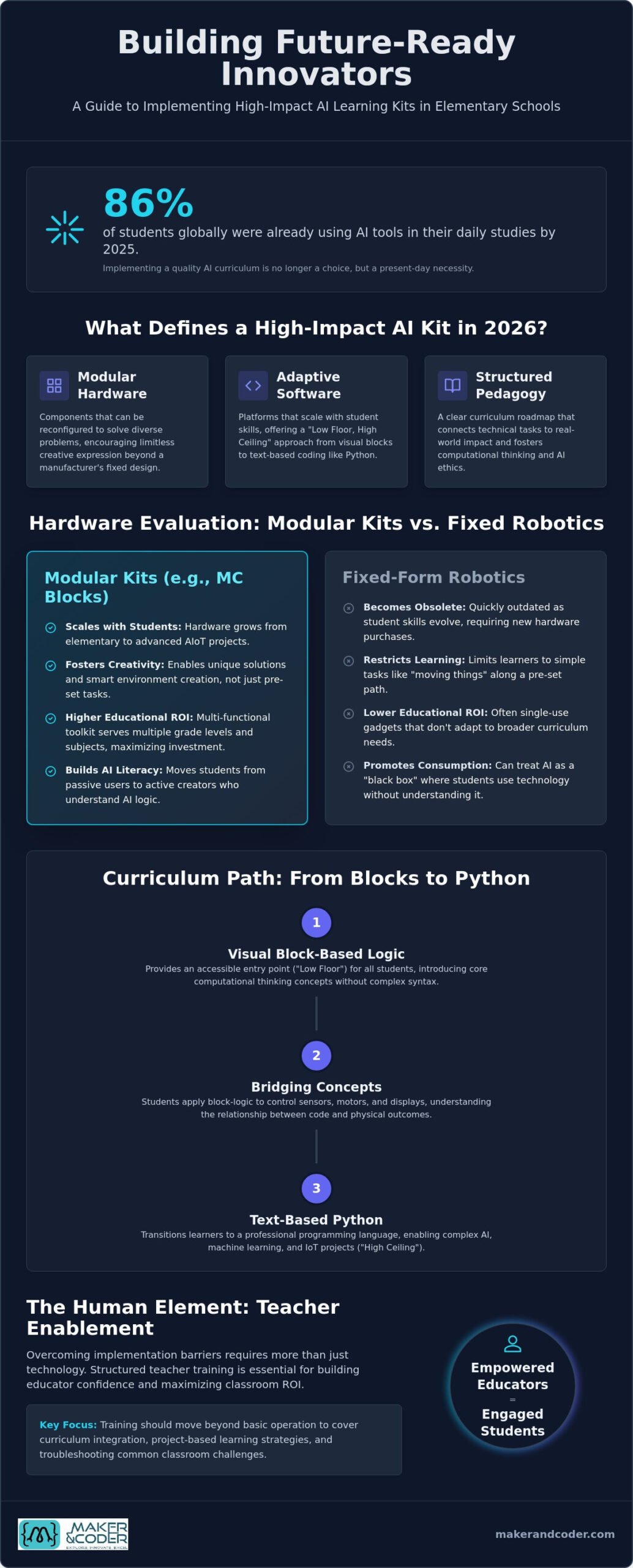
By 2025, 86% of students globally were already using AI tools in their daily studies. This shift means that implementing a high-quality AI curriculum for elementary school is no longer a choice for the future; it’s a requirement for the present. We understand the frustration of dealing with fragmented curricula and hardware that lacks the longevity to scale across grade levels. It’s difficult to feel confident when the technology seems to move faster than the classroom can adapt.
This guide serves as your professional roadmap to evaluate and implement AI learning kits that transform students from passive technology users into future-ready innovators. You’ll learn how to select a modular ecosystem, like the MC 4.0 platform, that balances teacher ease of use with significant technical depth. We’ll outline how to move from basic block-based coding to advanced AIoT applications, ensuring your investment delivers high student engagement and measurable educational ROI. Let’s explore how to build a classroom environment where technology is an accessible tool for creative expression and purposeful discovery.
Key Takeaways
- Learn why high-impact AI kits in 2026 must synthesize advanced sensors and machine learning to move students beyond simple instructional coding.
- Evaluate the long-term benefits of modular systems like MC Blocks over fixed-form robotics to ensure your hardware scales as student skills evolve.
- Discover a clear progression path for an AI curriculum for elementary school that transitions learners seamlessly from visual block-based logic to text-based Python.
- Overcome implementation barriers by prioritizing structured teacher training programs that maximize classroom ROI and build educator confidence.
- Explore the synergy of the MC4.0 AIoT Kit and the MC4.0 Controller as a unified ecosystem for developing future-ready innovators.
Table of Contents
- What Defines a High-Impact AI Learning Kit for Classroom Use?
- Evaluating AI Hardware: Modular Kits vs. Fixed Robotics
- Software Progression: Navigating the Path from Blocks to Python
- The Human Element: Teacher Training and Curriculum Integration
- The Maker & Coder MC 4.0 Ecosystem: A Future-Ready Solution
What Defines a High-Impact AI Learning Kit for Classroom Use?
A high-impact AI learning kit represents far more than a programmable toy. It is a sophisticated synthesis of advanced sensors, robust processing power, and accessible machine learning algorithms. In 2026, the educational focus has shifted away from basic instructional coding toward data-driven AI decision-making. Students no longer just tell a robot to move; they train it to recognize patterns and make autonomous choices. This evolution moves learners from “black box” AI, where they merely consume technology, to “open glass” AI, where they build and understand the underlying logic. Success in this new landscape depends on three critical pillars:
- Modular Hardware: Components that can be rearranged to solve diverse problems.
- Adaptive Software: Platforms that scale from visual blocks to text-based coding.
- Structured Pedagogy: A clear roadmap that connects technical tasks to real-world impact.
The Core Components: Sensors, Controllers, and Cloud
High-performance hardware is the foundation of any effective AI curriculum for elementary school. Controllers like the MC4.0 are essential because they provide the processing power needed to run local AI models without constant cloud reliance. This localized processing allows for immediate feedback during voice recognition or vision sensor experiments, which is vital for maintaining student engagement. Integrating IoT connectivity is also vital. It bridges the gap between classroom theory and real-world applications like smart cities or automated environmental monitoring. By grounding Educational robotics in these technical realities, we prepare students for the interconnected systems they’ll manage in the future. You can explore these professional-grade components in the Maker & Coder shop.
Pedagogical Alignment: From STEM to AI Literacy
Effective tools must meet 2026 standards for computational thinking and ethics while maintaining a “Low Floor, High Ceiling” design. This approach ensures every student can engage with complex concepts regardless of their starting point. Hardware modularity is key. While fixed robotics kits offer a pre-assembled experience, modular systems like MC Blocks allow for limitless creative expression. Students aren’t restricted by a manufacturer’s design. They build the physical form that best solves the problem at hand. This flexibility is what transforms a standard lesson into a journey of discovery. A robust AI curriculum for elementary school thrives when students have the freedom to build, test, and iterate on their own unique ideas. This process moves them from being passive users to becoming confident innovators who understand how to harness AI for good.
Evaluating AI Hardware: Modular Kits vs. Fixed Robotics
Choosing the right hardware is a long-term commitment for any school district. In the 2026 educational landscape, the choice between modular kits and fixed-form robotics determines whether your technology investment grows with your students or becomes obsolete within a single semester. Fixed robotics often limit learners to “moving things” along a pre-set path. In contrast, modularity allows for the creation of smart, autonomous environments. This versatility is essential when building a sustainable AI curriculum for elementary school. Modular systems provide the flexibility to pivot from basic robotics to complex AIoT applications without purchasing new hardware every year.
Durability remains a non-negotiable factor for high-traffic classrooms. Modern kits must withstand rigorous drop tests and offer extended battery longevity to survive back-to-back class periods. When you evaluate the cost-per-student, multi-functional kits like the MC4.0 AIoT Kit offer superior ROI compared to single-use gadgets. Instead of buying a device that performs one task, you’re investing in a toolkit that scales across multiple grade levels and subjects. Research from the Association for the Advancement of Artificial Intelligence emphasizes the need for an AI curriculum to cultivate students’ AI literacy through hands-on creation rather than passive observation.
The Power of the MC4.0 Controller
The MC4.0 Controller acts as the central intelligence for every classroom project. It isn’t just a power source; it’s a high-performance hub capable of processing local AI models. This “brain” supports multiple input and output modules, allowing students to build multi-sensor systems that react to their environment in real time. Whether they’re integrating vision sensors or voice recognition, the controller ensures seamless operation. It also integrates effortlessly with existing classroom interactive displays, making it a natural extension of your digital ecosystem.
Why Modular MC Blocks Outperform Fixed Robots
Fixed-form robots often lead to “kit fatigue.” Once a student builds the pre-designed model, the learning journey often flattens. Modular MC Blocks solve this by demanding “Design Thinking.” Students must engineer their own form factors, deciding exactly how sensors and motors should interact. This process facilitates a natural transition from building simple gadgets to engineering complex, autonomous smart systems. By offering infinite configuration possibilities, these blocks remain challenging for older students while staying accessible for beginners. This adaptability is what makes a modular AI curriculum for elementary school so effective at maintaining high engagement. If you’re planning a district-wide rollout, reach out to our educational consultants for tailored hardware recommendations.
Software Progression: Navigating the Path from Blocks to Python
Mastering software progression is the bridge between playing with technology and building it. A successful AI curriculum for elementary school must provide a clear, scaffolded journey that respects a student’s cognitive development while pushing the boundaries of what they can create. This path doesn’t require a constant rotation of new gadgets. Instead, it relies on a software ecosystem that matures alongside the learner. The MC4.0 ecosystem facilitates this transition seamlessly, allowing the same modular hardware to serve a first-grader and a middle-schooler with equal efficacy.
- Step 1: Foundational Logic. Implement visual block-based coding to introduce core AI concepts like “if-then” logic and loop structures without the barrier of syntax.
- Step 2: Hybrid Environments. Introduce platforms where visual blocks and text-based code coexist, allowing students to see the direct translation of their logic into professional scripts.
- Step 3: Professional Integration. Transition to full Python environments to train professional-grade AI models directly on the MC4.0 Controller.
- Step 4: Real-World Execution. Scale projects through API calls and cloud-based data processing, connecting classroom builds to global data streams.
Demystifying AI Models for Elementary Students
Kits should do more than just follow commands. They must demystify how machines “see” and “hear.” By using modular sensors for image recognition and speech synthesis, students begin to grasp the mechanics of machine learning. This approach supports a modern framework for AI literacy in elementary education, where the goal is “Explainable AI.” Students don’t just use a sensor; they train it. They learn how data inputs shape the machine’s output, transforming a mysterious “black box” into a transparent, understandable tool for innovation.
Python: The Language of the AI Future
Python proficiency is the ultimate objective for high-performing STEM programs. It’s the industry standard for artificial intelligence and data science. The MC4.0 Controller acts as a bridge-builder here, handling professional-grade scripts that would typically overwhelm basic educational microcontrollers. This capability encourages collaborative coding and version control, mimicking real-world engineering environments. When students move from blocks to Python, they aren’t just learning a new language. They’re gaining the power to command complex, autonomous systems. Master the basics, then execute the vision. This progression ensures that the AI curriculum for elementary school remains relevant, challenging, and deeply rewarding for every student in the room.
The Human Element: Teacher Training and Curriculum Integration
Standards-Aligned K-12 MC Curriculum
A comprehensive K-12 MC Curriculum removes the heavy burden of lesson planning from time-constrained educators. These “plug-and-play” modules are meticulously mapped to CSTA, ISTE, and evolving 2026 educational standards. Whether you’re teaching basic logic or complex machine learning, the curriculum provides clear assessment frameworks to grade student progress effectively. This structure allows teachers to focus on student engagement rather than trying to invent an AI curriculum for elementary school from scratch. You can find these structured resources and the hardware that supports them in the Maker & Coder shop.
Professional Development for 21st Century Educators
Modern professional development must move beyond the basic user manual. It should offer deep dives into AIoT architecture that are accessible to non-technical teachers. By understanding how the MC4.0 Controller interacts with modular sensors, educators gain the confidence to facilitate complex projects. Ongoing support is the hallmark of a successful ecosystem. It ensures that as technology evolves, your teaching staff evolves with it. This methodical progression starts with a high-level vision and moves toward a concrete solution in every classroom. To start building a future-ready teaching team, book a consultation for our Teacher Training Programs.
The Maker & Coder MC 4.0 Ecosystem: A Future-Ready Solution
The transition from passive technology user to future-ready innovator requires more than just a single gadget. It demands a cohesive environment where hardware, software, and pedagogy converge. The MC 4.0 ecosystem represents the pinnacle of modular AI learning, providing a unified strategy for cognitive development. By combining modular MC Blocks, the high-performance MC4.0 Controller, and a structured K-12 curriculum, schools can finally move beyond fragmented STEM tools. This synergy ensures that every lesson builds toward a larger goal of technical literacy and creative confidence. The prestige-tech design of the hardware inspires professional ambition in students. It makes them feel like the innovators they are destined to become, rather than children playing with toys.
MC4.0 AIoT Kit: Beyond Simple Robotics
Most competitors treat AI as a subset of robotics. We treat it as an integrated AIoT ecosystem. The MC4.0 AIoT Kit allows students to tackle real-world challenges like smart cities, health-tech, and environmental monitoring. While the MC4.0 Base Kit and MC4.0 STEAM Kit provide a foundational entry point, the AIoT Kit is where complex problem-solving truly begins. Students learn to connect devices and process data in ways that pre-assembled robots simply cannot match. They build systems that react to environmental changes or monitor health metrics. This versatility is the hallmark of a high-performing AI curriculum for elementary school. Explore the full range of MC 4.0 hardware to start customizing your laboratory.
Scaling Your AI Lab: From Single Kits to School-Wide Adoption
Planning for growth is essential for school budgets. The MC 4.0 ecosystem scales effortlessly. It allows districts to start with a single pilot class and expand to school-wide adoption as confidence grows. Our success stories span global classrooms. Students have used these tools to build everything from automated gardens to wearable health trackers. This real-world impact is the true measure of a successful AI curriculum for elementary school. Don’t settle for inconsistent hardware or fragmented support. Instead, choose a partner that acts as a bridge between complex systems and the classroom environment. We provide the tools, the training, and the roadmap for long-term success. Ready to pilot the system in your district? Contact our educational consultants for a tailored implementation plan that fits your school’s unique needs.
Building the Future of Classroom Innovation
The journey from basic coding to sophisticated AIoT mastery requires a foundation built on modularity and expert support. By choosing ecosystems like the MC 4.0, you ensure that your hardware evolves alongside your students’ ambitions. You’ve seen how modular MC Blocks unlock unlimited creativity and how a structured software path leads naturally into professional Python environments. These tools aren’t just gadgets; they’re the building blocks of tomorrow’s solutions.
Implementing a successful AI curriculum for elementary school depends on more than just high-performance controllers. It thrives on the confidence of the educator. This is why our comprehensive K-12 MC Curriculum and professional teacher training are vital components of the Maker & Coder experience. We don’t just provide tools; we provide a roadmap for long-term success and classroom ROI. It’s about transferring knowledge and sparking a lifelong joy of discovery.
It’s time to transform your classroom into a hub of discovery and future-readiness. Empower your students with the MC 4.0 AIoT Kit today. The next generation of innovators is waiting for the tools to build their vision. Let’s build it together.
Frequently Asked Questions
What is the best age to start using an AI learning kit in the classroom?
Literacy can happen as early as kindergarten. Modern AI curriculum for elementary school frameworks emphasize the Five Big Ideas, including perception and societal impact. Starting early transforms students from passive users into confident creators. It builds the foundational logic needed for more complex machine learning projects later in their academic journey. Early exposure sparks curiosity and prepares them for a future-ready world.
Do teachers need a computer science degree to use the MC 4.0 Kit?
You don’t need a specialized degree to lead an AI-powered classroom. Our Teacher Training Programs act as a bridge between complex systems and the learning environment. We provide the professional authority and pedagogical tools required to facilitate discovery. You’ll move from basic setup to guiding advanced AIoT projects with the confidence of an industry leader. We’re here to transfer knowledge and support your growth.
How do AI learning kits differ from standard coding or robotics kits?
AI kits focus on data-driven decision making rather than just pre-programmed instructions. Standard robotics follow rigid logic; AI kits use machine learning to react to environmental inputs. This “open glass” approach allows students to understand how models are trained. Using modular MC Blocks, students build truly autonomous, smart systems. It moves beyond moving a robot from point A to point B toward creating intelligent solutions.
Is the MC 4.0 hardware compatible with both Mac and Windows environments?
The MC4.0 Controller offers full compatibility with Mac, Windows, and most interactive classroom displays. We’ve designed the hardware for seamless integration into your existing digital infrastructure. This ensures that technical barriers don’t interrupt the joy of discovery. You can focus on building and innovating without worrying about hardware conflicts or software limitations. It’s a reliable bridge between complex modern systems and your students.
Can the MC4.0 AIoT Kit be used for high school capstone projects?
The MC4.0 AIoT Kit is designed to scale from foundational concepts to professional-grade complexity. While it’s accessible for younger learners, the support for Python and modular sensor arrays makes it ideal for high school capstone projects. Students can engineer sophisticated solutions for smart cities or environmental monitoring. It provides the technical depth required for advanced academic research and complex, autonomous smart systems that solve real-world problems.
What kind of ongoing support does Maker & Coder provide for schools?
We offer more than just hardware; we provide a dedicated educational partnership. This includes structured Teacher Training Programs and access to a community of STEM coordinators. Our goal is to transfer knowledge to your staff, ensuring long-term classroom ROI. You’ll receive ongoing support to navigate emerging technologies and maintain high student engagement throughout the school year. We act as a trusted guide for your entire district.
How does the MC Curriculum stay updated with rapidly changing AI trends?
The K-12 MC Curriculum undergoes regular updates to reflect the latest shifts in technology and educational standards. We monitor state-level frameworks in regions like California and Massachusetts to ensure your AI curriculum for elementary school remains relevant. This methodical progression means your classroom always has access to current AIoT trends. We keep the content grounded and purposeful for the next generation of bold innovators and creative thinkers.
Are there specific grants available for purchasing AI learning kits for schools?
Schools can often leverage federal STEM funding or state-specific AI literacy grants to acquire new technology. Regions like Georgia and Massachusetts have established pilot programs and state-funded curricula that support hardware integration. We recommend checking with your local Department of Education for the latest 2026 funding opportunities. Our team can provide the technical documentation needed for your grant applications to help secure these essential resources for your students.