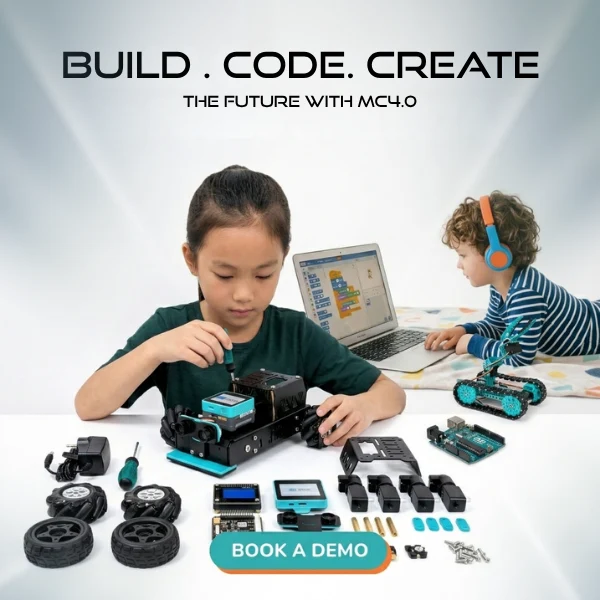

What if the most complex technology of our time felt as tangible to your students as a set of building blocks? Learning how to teach artificial intelligence in middle school often feels like chasing a moving target, especially when the subject seems trapped behind a screen. You likely recognize that AI shouldn’t feel like magic, yet finding a way to make it practical, ethical, and engaging without specialized training remains a significant hurdle.
This guide offers a structured, hardware-integrated approach to demystifying these concepts and empowering your students to build the future. We will move from abstract theories to concrete applications, using the MC 4.0 AIoT Kit to bridge the gap between code and reality. You’ll gain a clear roadmap for curriculum integration that replaces screen fatigue with the excitement of physical prototyping. Prepare to transform your classroom into a hub of innovation where students see AI as a tool they can master and control.
Key Takeaways
- Transition from concrete reasoning to abstract algorithmic thinking during the critical middle school development window.
- Demystify complex systems by visualizing the Data-Model-Output loop through physical sensors and real-world inputs.
- Learn how to teach artificial intelligence in middle school by integrating hardware like the MC 4.0 AIoT Kit to make abstract code tangible.
- Implement a balanced curriculum that prioritizes human-centric ethics alongside technical, block-based coding skills.
- Build educator confidence and long-term program sustainability through structured professional training and modular hardware ecosystems.
Table of Contents
Why Middle School is the Critical Window for AI Literacy
Middle school represents a unique developmental phase. Students are no longer just absorbing facts; they’re beginning to question how the systems around them actually function. This curiosity makes it the perfect time to introduce artificial intelligence in education as a foundational pillar of modern literacy. In the context of 2026, AI literacy has evolved. It’s no longer enough to know how to prompt a chatbot. True literacy now requires algorithmic thinking, which is the ability to understand how data is processed, how models are formed, and how those models impact the physical world.
Ages 11 to 14 are the cognitive sweet spot for this journey. During these years, the young brain transitions from concrete operations to formal operational thought. Students gain the capacity to grasp abstract variables and hypothetical scenarios. They’re ready to move beyond “using” technology to “understanding” its underlying mechanisms. When educators explore how to teach artificial intelligence in middle school, they aren’t just teaching code. They’re preparing the next generation for an AI-augmented workforce where technical fluency is a prerequisite for innovation.
Defining AI for the Middle School Classroom
To demystify these concepts, we must simplify without losing technical accuracy. We should define Machine Learning as a process where a computer finds patterns in examples, much like a student learns to recognize different types of fruit by seeing them repeatedly. You can explain Neural Networks by using the analogy of a human brain, where connections grow stronger as the machine identifies the correct output. It’s also vital to distinguish between Narrow AI, which excels at specific tasks like facial recognition, and General AI, which remains a theoretical concept of human-like intelligence. This clarity helps students see technology as a purposeful tool rather than a mysterious force.
The Shift from Passive Consumers to Creative Builders
Many students view technology as a “black box” that simply works. This perspective can lead to a lack of agency. By introducing a maker mindset, we encourage students to treat AI as just another material they can use to build solutions. When a student uses their own training data to make a motor on an MC 4.0 Controller spin, the magic disappears and is replaced by mastery. This transition fosters a sense of digital citizenship. It empowers learners to ask “how does this work?” and “how can I improve it?” rather than simply accepting the output of an algorithm. We are training them to be the architects of future systems, not just the users of them.
Demystifying the Black Box: Foundational AI Concepts
To move beyond the screen, students must first understand that AI isn’t a sentient brain; it’s a mathematical engine fueled by information. When exploring how to teach artificial intelligence in middle school, the most effective starting point is the Data-Model-Output loop. This cycle illustrates how machines transform raw input into intelligent action. Sensors serve as the machine’s sensory organs, perceiving light, sound, or motion from the physical environment. This data then passes through a model, where the algorithm identifies patterns and generates a specific output. By visualizing this loop, students stop seeing technology as magic and start seeing it as a predictable system they can manipulate.
Pattern recognition is the core of this process. It’s the ability of an algorithm to find meaning within the noise of massive datasets. However, this process is only as reliable as the information we provide. If a student trains a model to recognize “healthy plants” using only photos of green leaves, the AI might fail to recognize a healthy red succulent. This introduces the critical concept of bias. The data we feed an AI determines its “personality” and its accuracy. Programs like the teacher-driven curriculum called Shark AI highlight how students can engage with these concepts by analyzing real-world environmental data to make predictions.
Data: The Fuel of Artificial Intelligence
Training data is the historical record a machine uses to predict the future. In the classroom, you can make this concept concrete through a simple classification activity. Ask students to collect and label fifty different objects, such as various types of leaves or classroom supplies. They quickly discover that “more data” isn’t always “better data.” High-quality, diverse datasets are essential for building robust models. This hands-on labeling process teaches students that they are the architects of the machine’s intelligence, emphasizing their role as responsible creators.
Neural Networks Without the Complexity
Neural networks can be visualized as layers of decision-making, similar to how biological neurons fire in the human brain. You can represent these layers using physical MC Blocks to show the flow of information.
- Input Layer: The raw data captured by sensors.
- Hidden Layers: Where the “weighting” happens, as the machine decides which features are most important.
- Output Layer: The final decision or action taken by the system.
Adjusting the weights is how the machine “learns” to reach the correct answer. This cross-curricular connection to biology helps students see AI as an extension of human ingenuity. If you’re looking for ways to bring these technical concepts into your lab, you can reach out to our educational consultants for a personalized implementation strategy.
Hardware vs. Software: Choosing the Right Tools for Hands-on AI
Middle schoolers live in a physical world, so their education should reflect that reality. While web-based machine learning tools offer a low barrier to entry, they often leave students feeling like passive observers of an algorithm. To truly master how to teach artificial intelligence in middle school, we must pivot from “talking about AI” to “building with AI.” This shift requires a move from screen-only applications to tangible, hardware-integrated projects. When a student sees their code move a motor or change a light based on a perceived gesture, the abstract becomes concrete. This physical interaction is what transforms a theoretical lesson into a lasting skill.
Choosing the right tools is about balancing technical depth with classroom feasibility. Modular hardware, such as MC Blocks, reduces the friction of complex wiring and soldering. This allows the class to focus on logic, data, and design rather than troubleshooting hardware failures. By using a unified ecosystem, you create a seamless journey from basic concepts to advanced applications. This approach ensures that the technology remains an accessible tool for creative expression rather than a daunting technical hurdle.
The Limitations of Screen-Only Learning
Screen-only AI tools, like simple chatbots or image generators, frequently lead to digital disengagement. This “Zoom fatigue” of the coding world happens when students don’t see the real-world impact of their work. Physical feedback loops change this dynamic by accelerating the debugging process. If a robotic arm doesn’t move when the AI “sees” a specific object, the student receives immediate, visual feedback. This “wow” factor of building a device that perceives and reacts in real-time creates a level of engagement that software alone cannot replicate. It moves the learner from a state of curiosity to a state of purposeful action.
Integrating AIoT: Bringing Intelligence to Life
The ultimate challenge for the modern middle schooler is the Artificial Intelligence of Things (AIoT). This involves using the MC 4.0 Controller to bridge the gap between digital intelligence and physical objects. The MC4.0 AIoT Kit simplifies complex sensor integration, making it possible for 12-year-olds to build sophisticated systems. Consider the potential of these projects:
- Smart Plant Monitors: Systems that use AI to identify specific plant species and adjust environmental conditions accordingly.
- Gesture-Controlled Robotics: Machines that learn to recognize and respond to human hand signals through neural networks.
- Automated Sorting Systems: Devices that use computer vision to categorize recycled materials in real-time.
These projects empower students to see themselves as innovators. They begin to understand AI not as a “black box” but as a customizable material they can use to solve real-world problems. This is the core of how to teach artificial intelligence in middle school effectively: giving students the power to bring their ideas to life.

Designing an AI Curriculum: From Ethics to Execution
Middle school is the bridge between play-based learning and professional preparation. Integrating AI into the classroom requires a logical, phased approach that prioritizes purpose over mere technicality. When determining how to teach artificial intelligence in middle school, the journey must begin with human-centric ethics. Before a student writes a single line of code, they should grapple with the “should we?” question. This initial step ensures that technology is viewed as a tool for social good rather than just a technical exercise. Once the ethical foundation is set, you can move through a structured execution plan:
- Step 1: Start with human-centric ethics to establish a moral compass for innovation.
- Step 2: Introduce block-based coding to manipulate and understand simple AI models.
- Step 3: Transition to active data collection and model training for custom, student-led projects.
- Step 4: Implement physical hardware, like the MC 4.0 Controller, to solve tangible real-world problems.
- Step 5: Conduct peer reviews and ethical audits to evaluate the fairness and impact of student-built systems.
Scaffolding the Learning Journey
Success depends on meeting students where they are while pushing them toward advanced concepts. The K-12 MC Curriculum provides a clear pathway for this growth. We start with Scratch-like blocks to lower the barrier to entry and focus on logic. As confidence builds, students transition to Python-based AI logic. This move allows for more granular control over neural networks and data processing. This “low floor, high ceiling” philosophy ensures that every learner feels capable of building something meaningful, regardless of their starting skill level. It transforms the classroom into a laboratory for experimentation where failure is just another data point in the learning process.
Addressing Ethics Through Design Challenges
Ethics shouldn’t be a separate lecture; it should be integrated into the design process itself. Algorithmic bias is the reflection of human prejudices in machine decisions. In our “Design for All” challenge, students investigate why certain facial recognition models fail to recognize diverse groups. They then work to retrain those models with more inclusive datasets. We also explore sustainable AI by discussing the environmental impact of training massive models. By confronting these issues through hands-on experimentation, students become conscientious creators rather than passive observers. If you’re ready to bring this structured approach to your school, contact our curriculum specialists today to discuss your implementation strategy.
By following this roadmap, you ensure that your students aren’t just learning how to teach artificial intelligence in middle school through theory. They are gaining the practical skills and moral framework needed to lead in an automated world. This comprehensive approach turns a complex subject into an accessible, exciting journey of discovery.
Implementing AI Success with the Maker & Coder Ecosystem
Implementing a successful program requires more than just a list of lessons; it demands a cohesive ecosystem that supports both the student and the educator. When schools evaluate how to teach artificial intelligence in middle school, the primary challenge is often the lack of a unified platform. Fragmented tools lead to technical friction and teacher burnout. The MC 4.0 Kit solves this by providing a comprehensive classroom solution that integrates modular hardware with the K-12 MC Curriculum. This alignment ensures that every project, from simple light sensors to complex neural networks, feels like a natural progression rather than a series of disconnected tasks.
Scaling these programs from a single pilot classroom to a district-wide STEM strategy requires a focus on future-proofing. Technology moves fast. The modular nature of MC Blocks ensures that your lab doesn’t become obsolete. Instead of replacing entire systems, you can simply add new sensors or updated controllers as AI capabilities evolve. This adaptability provides peace of mind to administrators and ensures that the school’s investment continues to deliver value year after year. We act as a bridge between complex modern systems and the daily reality of the middle school environment.
Empowering Educators Through Specialized Training
The most sophisticated kit is only as effective as the teacher leading the class. Many educators face “tech-phobia” when confronted with machine learning. Our Teacher Training Programs are designed specifically to build educator confidence, regardless of their computer science background. We provide a structured pathway for professional development, offering certification that empowers STEM leads to become mentors within their own buildings. By fostering a supportive community and providing ongoing technical support, we ensure that teachers feel like innovators alongside their students. You aren’t just buying hardware; you’re joining a network of forward-thinking pioneers.
The MC4.0 AIoT Kit: Your Classroom’s AI Lab
For advanced experimentation, the MC4.0 AIoT Kit serves as the ultimate laboratory for discovery. It allows students to move beyond basic automation into the realm of intelligent, connected systems. Because the MC Blocks are modular, student groups can rapidly iterate on their designs. They can swap a sound sensor for a camera module in seconds, allowing them to test different inputs for their AI models without restarting the entire build. This speed of prototyping is essential for maintaining engagement in the middle school age group. It encourages a “fail fast, learn faster” mindset that is critical for technical mastery. To begin transforming your lab, explore our full range of STEM kits to start your AI journey. We are here to help you master how to teach artificial intelligence in middle school with confidence and clarity.
Empower the Next Generation of AI Architects
The transition from passive consumer to active creator begins when students realize AI is a tool they can shape. By integrating physical hardware and human-centric ethics, you move beyond the abstract and into the realm of tangible innovation. Mastering how to teach artificial intelligence in middle school requires a shift toward these hands-on, hardware-integrated experiences that spark genuine curiosity and long-term engagement.
Success in this technical landscape depends on a reliable foundation. The Maker & Coder ecosystem provides the stability you need to scale from a single project to a district-wide strategy. With modular MC Blocks for endless creativity and a comprehensive K-12 MC Curriculum included, you have a clear roadmap for student growth. Our Professional Teacher Training programs ensure your staff feels confident and supported throughout the implementation process. We don’t just provide tools; we provide a partnership for future-readiness.
Equip your classroom with the MC 4.0 AIoT Kit today to bridge the gap between complex code and physical reality. Let’s build a future where every student has the agency to innovate with confidence and purpose.
Frequently Asked Questions
Is middle school too early to start teaching artificial intelligence?
Middle school is actually the optimal time to begin. Students at this age are transitioning from concrete to abstract reasoning, making them perfectly primed to understand algorithmic thinking. Starting early ensures they view AI as a manageable tool rather than a mysterious “black box.” This foundational literacy prepares them for more complex technical challenges in high school and beyond while building essential digital citizenship skills.
Do I need to be a computer scientist to teach AI to my students?
You don’t need a degree in computer science to lead a successful classroom. Our Teacher Training Programs are designed to empower educators from all backgrounds with the confidence to facilitate AI projects. By using the structured K-12 MC Curriculum, you can guide your students through complex concepts using clear, step-by-step pathways that ensure both you and your learners succeed together without technical frustration.
What are the best hardware tools for teaching AI in a middle school lab?
The most effective tools are those that make abstract code tangible, such as the MC 4.0 AIoT Kit. This kit combines the power of the MC 4.0 Controller with modular MC Blocks, allowing students to build physical systems that react to their environment. Using hardware like this is a key strategy for how to teach artificial intelligence in middle school because it provides immediate, visible feedback that screen-only tools lack.
How can I teach AI ethics without it being a boring lecture?
Transform ethics into an active discovery process through hands-on design challenges. Instead of lecturing, ask students to audit a facial recognition model they’ve built to see if it recognizes everyone in the room. By identifying “algorithmic bias” in their own projects, they learn the importance of representative data through experience. This approach makes ethical considerations a practical part of the engineering process rather than a separate, theoretical topic.
Does the MC 4.0 platform support both block-based and Python coding?
Yes, the MC 4.0 platform fully supports both block-based coding and Python. This dual capability allows you to scaffold the learning journey, starting with visual blocks to master logic before transitioning to text-based Python for advanced AI applications. It’s a “low floor, high ceiling” approach that ensures the hardware grows alongside your students’ evolving technical skills and creative ambitions, providing a seamless path to mastery.
How do I align AI lessons with existing STEM standards like ISTE or CSTA?
The K-12 MC Curriculum is specifically mapped to global standards such as CSTA and ISTE. These lessons focus on computational thinking, data analysis, and the societal impacts of technology, ensuring your program meets rigorous academic requirements. By following our structured pathways, you can confidently integrate AI into your existing STEM framework while meeting the essential learning objectives required by your school or district for future-readiness.
What is the difference between teaching coding and teaching AI?
Traditional coding involves giving a computer a specific set of rules to follow, while AI involves training a machine to find its own patterns in data. While coding is the language used to build these systems, AI literacy focuses on the Data-Model-Output loop. Understanding this distinction is vital when researching how to teach artificial intelligence in middle school, as it shifts the focus from writing syntax to managing data.
Can AI projects be integrated into science or social studies classes?
AI projects are highly cross-curricular and fit naturally into science or social studies. In science, students can use the MC 4.0 AIoT Kit to build smart environmental monitors that predict plant health based on sensor data. In social studies, they can analyze the historical data used to train algorithms, sparking deep discussions about fairness and digital citizenship. These integrations show students that AI is a universal tool for solving diverse problems.