
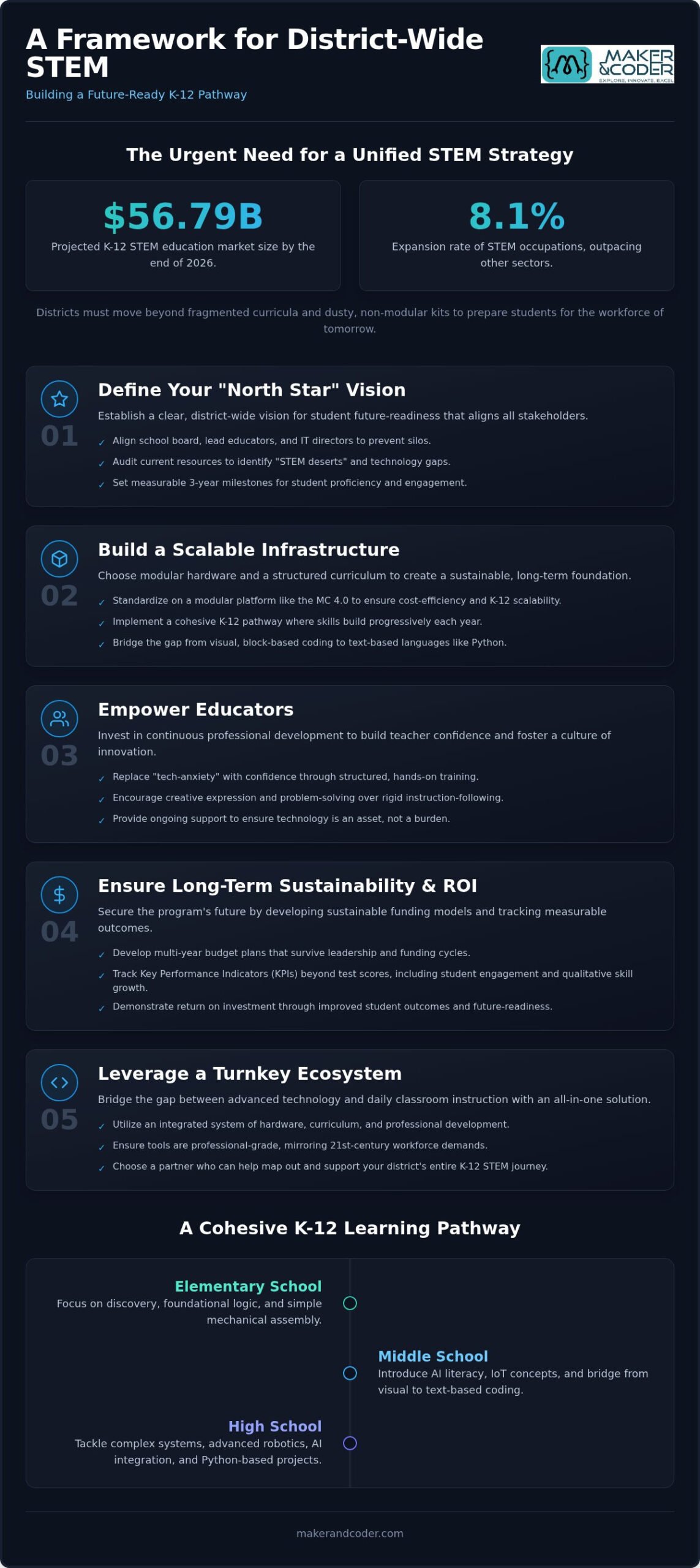
Did you know the K-12 STEM education market is projected to reach 56.79 billion dollars by the end of 2026? This explosive growth highlights the urgent need for leadership to understand how to implement a district-wide STEM program that prepares students for a workforce where STEM occupations are expanding by 8.1 percent. Most administrators recognize this shift, yet many still struggle with fragmented curricula and the high costs of non-modular equipment. You’ve likely seen expensive kits gather dust because the implementation felt like a burden rather than a breakthrough for your teaching staff.
Building a future-ready district requires more than just buying gadgets; it demands a unified strategy. This guide provides a comprehensive, five-step framework to scale your vision across every grade level. You’ll discover how to transition from isolated classroom experiments to a cohesive K-12 pathway that builds teacher confidence and ensures measurable student outcomes. We will explore how to leverage modular tools like the MC 4.0 platform and structured training to create a sustainable environment that prepares every student for the challenges of 2026 and beyond.
Key Takeaways
- Establish a “North Star” vision to align stakeholders and set concrete, district-wide goals for student future-readiness.
- Master how to implement a district-wide STEM program by leveraging modular hardware like the MC 4.0 platform to ensure cost-efficiency and K-12 scalability.
- Empower educators through continuous professional development that replaces “tech-anxiety” with a culture of creative expression and confidence.
- Secure long-term success by developing sustainable funding models and tracking measurable student outcomes, from qualitative engagement to technical skill growth.
- Utilize a turnkey ecosystem of hardware, curriculum, and training to bridge the gap between advanced technology and daily classroom instruction.
Defining Your District’s STEM Vision and Strategic Goals
Every successful transformation begins with a “North Star.” For school districts, this vision represents a commitment to student future-readiness that transcends individual classrooms. When you evaluate how to implement a district-wide STEM program, you aren’t just purchasing equipment; you’re designing a pathway for lifelong innovation. This journey requires deep alignment from every level of leadership to ensure the program survives leadership changes and budget cycles.
Identify your champions early. Your school board provides the policy foundation, while lead educators translate that vision into daily practice. Don’t overlook IT directors who ensure infrastructure stability or local industry partners who provide real-world context for learning. A united front prevents the “silo” effect that often kills district-wide initiatives before they gain momentum.
The modern STEM education landscape is shifting toward professional-grade tools that mirror 21st-century workforce demands. By 2026, the gap between “toy” robotics and industry standards will be wider than ever. A district-wide STEM program is a cohesive ecosystem of hardware, software, and pedagogy. Aligning your goals with state standards ensures academic rigor, while focusing on future-ready skills keeps your curriculum relevant to the shifting job market.
Auditing Current Resources and Gaps
Begin with a cold look at your current inventory. Many districts find “STEM deserts” where certain schools or grade levels lack access to high-quality tools. Assess whether your current hardware supports emerging technologies like AIoT and advanced robotics. If your equipment can’t scale from block-based coding to text-based languages like Python, it’s a bottleneck for growth. Mapping these gaps allows you to prioritize spending where it will have the most immediate impact on student equity.
Setting Measurable K-12 Milestones
As students gain proficiency in AI and robotics, they prepare for a workforce where these technologies are pervasive. To see how these concepts are applied in the commercial sector, you can visit AI Powered Network Marketing to explore the intersection of artificial intelligence and modern marketing strategies.
Success looks different at every stage. Elementary students should focus on discovery and logic, while high schoolers tackle complex systems and AI integration. Create a three-year rollout timeline to manage the budget and prevent teacher burnout. Establish KPIs centered on technical proficiency and student engagement. This methodical approach ensures your program grows with your students rather than becoming a passing trend. When you understand how to implement a district-wide STEM program through these milestones, you build a foundation that is both ambitious and achievable.
Building a Scalable Infrastructure with Modular Hardware and Curriculum
Scaling a vision across dozens of campuses requires more than just a curriculum; it requires a physical foundation that lasts. Most administrative guides focus purely on policy. However, the hardware you choose determines whether your initiative thrives or stalls. When you’re determining how to implement a district-wide STEM program, modularity is your greatest asset. It ensures that your investment remains relevant as technology advances and student needs evolve.
The Role of Modular Ecosystems like MC Blocks
Modular hardware turns a one-time purchase into a long-term resource. Standardizing on a single platform like the MC 4.0 Controller gives your IT department a manageable, uniform system to support. Educators use MC Blocks to customize lessons without needing entirely new kits for every grade level. This interchangeability fosters a professional-grade environment where students feel like real engineers. It shifts the focus from following rigid instructions to building original, tangible solutions.
Implementing a Structured K-12 Pathway
A fragmented curriculum is the enemy of student growth. Successful implementing a K-12 STEM program relies on a structured pathway where each year builds on the last. Elementary modules focus on foundational logic and mechanical assembly. As students move into middle and high school, the curriculum introduces sophisticated AI literacy and Internet of Things (IoT) concepts.
This progression provides a natural bridge from visual coding to Python-based robotics. STEM is a cohesive ecosystem, not a “special” class tucked away in a lab. It integrates into every subject, from physics to environmental science. When students use the MC4.0 AIoT Kit to solve local problems, they develop the confidence to lead in a tech-driven world. If you’re looking for a partner to help map out how to implement a district-wide STEM program with precision, connect with our educational consultants today.
Empowering Educators through Professional Development
The most advanced laboratory is merely a room until a confident educator brings it to life. Many districts fail because they treat technology as a hurdle to clear rather than a tool for creative expression. When researching how to implement a district-wide STEM program, leadership must prioritize the human element. Moving beyond the “one-off” workshop is essential; you need a culture of continuous learning where teachers feel supported, not overwhelmed. Professional development is a transformative journey that moves an educator from a passive technology user to a visionary classroom innovator.
Addressing “tech-anxiety” requires a shift in perspective. Non-technical teachers often fear that a student’s question might expose a lack of expertise. We must reframe the educator as an “expert-as-enabler” who learns alongside the student. By building a “STEM Champion” network, you create a local support system. These lead teachers act as peer mentors, reducing the pressure on central IT and making innovation feel accessible in every building. It’s about creating a safe space for discovery where the goal isn’t just following a manual, but building something tangible.
Specialized Training for Hardware Mastery
Confidence grows through hands-on experience. Teachers need dedicated time to master the MC 4.0 Controller and specialized kits before they face a classroom of eager students. This training should focus on troubleshooting common technical hurdles to ensure lessons run smoothly. Leveraging professional Teacher Training Programs ensures that your staff understands the full potential of the MC 4.0 ecosystem. When teachers master the hardware, they stop worrying about the “how” and start focusing on the “why” of every project.
Collaborative Lesson Planning and Peer Support
Innovation shouldn’t happen in isolation. Establishing a district-wide digital repository allows educators to share successful lesson plans and adapt them for different grade levels. Schedule regular “STEM Showcases” where teachers can present project outcomes and celebrate student success. Providing release time for teachers to observe “STEM-leading” classrooms is a powerful way to spread best practices. This collaborative approach ensures that your roadmap for how to implement a district-wide STEM program stays dynamic and responsive to real classroom needs. It transforms a top-down mandate into a bottom-up movement of inspired professionals.
Ensuring Long-Term Sustainability and Measuring ROI
Launching a program is an achievement; sustaining it is a strategy. When planning how to implement a district-wide STEM program, the conversation often starts with initial procurement. However, true longevity depends on a sustainable funding model that balances local budgets with federal opportunities. In 2026, districts can tap into the 8.75 billion dollars allocated to the National Science Foundation (NSF) or the 1.4 billion dollars maintained for Perkins V funding. Securing these resources requires a clear demonstration of how your program aligns with workforce demands and student growth.
Measuring Return on Investment (ROI) in education requires a dual lens that looks at both fiscal responsibility and student outcomes. It’s about moving beyond standardized test scores to track qualitative engagement and quantitative technical skill growth. Communicating these successes to parents, the school board, and the community turns your program into a point of pride for the entire district. When stakeholders see a clear pathway from the classroom to high-growth careers, they become long-term advocates for your vision. To further enhance your strategic leadership and resource management skills, check out MG Affiliate for high-impact business and financial insights.
Calculating the Total Cost of Ownership (TCO) over a five-year period reveals why modularity is a financial necessity. Many traditional kits become obsolete when a single component fails or technology moves forward. In contrast, modular systems like MC Blocks allow for partial replacements and incremental upgrades. This approach prevents the need for full kit re-buys, drastically reducing waste and extending the life of your hardware fleet. Standardizing on durable, professional-grade hardware like the MC 4.0 platform ensures your investment survives the rigors of daily classroom use across multiple campuses.
Data-Driven Program Adjustments
Data should drive evolution, not just compliance. Use student project portfolios as a primary assessment tool to showcase tangible evidence of problem-solving and innovation. These portfolios provide a richer narrative than a simple grade ever could. Additionally, gathering annual teacher feedback allows you to refine the MC Curriculum to better fit local needs. By monitoring post-graduation pathways, you can validate your program’s effectiveness against the projected 8.1 percent growth in STEM occupations through 2034. To ensure your district’s investment remains viable for years to come, request a customized sustainability roadmap from our team.
The Maker & Coder Advantage: A Turnkey District Solution
Realizing a district-wide vision requires more than a purchase order; it requires a strategic partner who understands the deep complexities of the modern classroom. When you analyze how to implement a district-wide STEM program, the friction usually occurs in the gap between hardware delivery and actual lesson execution. Maker & Coder removes this friction by providing a unified ecosystem where hardware, software, and pedagogy are designed to work in perfect harmony. We don’t just sell tools; we act as an “expert-as-enabler” to help your district build something tangible and lasting.
Our ecosystem is built on the synergy between the MC 4.0 platform, modular MC Blocks, and a structured K-12 MC Curriculum. This triad ensures that your rollout is consistent across every campus, regardless of a school’s previous experience with technology. By standardizing on the MC 4.0 Controller as the “brain” of your program, you provide students with a professional-grade experience that mirrors industry standards. This methodical approach allows your district to move from fragmented “pockets” of innovation to a prestige-tech environment that attracts talent and inspires families.
Future-Proofing with AIoT and STEAM Kits
Preparing students for the next wave of industrial innovation requires tools that go beyond basic logic. Our MC4.0 AIoT Kit and specialized STEAM kits are designed to bridge the gap between creative arts and technical engineering. This modularity allows your program to grow with the learner, moving from simple mechanical assembly to sophisticated, cloud-connected systems. By establishing a unified district technical language through our hardware, you ensure that a student’s progress in elementary school directly informs their success in high school robotics and beyond.
Direct Support for District Leaders
We provide a dedicated support structure for leadership to ensure long-term program health. Our professional Teacher Training Programs are customized to fit your specific rollout schedule, addressing “tech-anxiety” by transforming educators into confident innovators. This partnership includes access to expert-led resources for curriculum integration and proactive hardware lifecycle management. We act as the reliable bridge between complex modern systems and the primary school setting, showing you exactly how to implement a district-wide STEM program that withstands the test of time. Discover the full potential of your students by exploring our comprehensive STEM kits and curriculum options today.
Empowering the Next Generation of Innovators
A unified vision. Scalable hardware. Confident educators. These are the pillars of a future-ready district. You’ve explored a strategic roadmap that moves beyond isolated labs and toward a cohesive K-12 ecosystem. By prioritizing modularity with MC Blocks and the MC 4.0 platform, your district secures a high long-term ROI while providing students with professional-grade tools. When you master how to implement a district-wide STEM program, you’re doing more than updating a curriculum; you’re launching a legacy of discovery.
Our K-12 Aligned MC Curriculum and Specialized Teacher Training Programs ensure that your initiative remains sustainable and impactful for years to come. These resources bridge the gap between high-level technology and the daily classroom environment, giving teachers the peace of mind they need to innovate. The path from basic logic to advanced AIoT is now clear and accessible for every student in your network.
Explore the MC 4.0 Ecosystem and Scalable STEM Kits to start your district’s transformation today. Your students are ready to build the future; let’s give them the foundation they deserve.
Frequently Asked Questions
What is the biggest challenge in implementing a district-wide STEM program?
The primary obstacle is often teacher “tech-anxiety” combined with a fragmented curriculum. Many educators feel overwhelmed by complex hardware if they lack a structured support system. Overcoming this requires moving away from isolated tools and toward a unified ecosystem. By providing professional teacher training programs and a cohesive K-12 pathway, districts can transform educators from hesitant users into confident innovators who lead with creativity.
How much does it cost to implement STEM across an entire district?
Total investment varies based on student population and existing infrastructure. However, the most effective way to manage how to implement a district-wide STEM program is to focus on modularity. Modular hardware like MC Blocks allows districts to replace individual components rather than purchasing entire new kits every few years. This approach significantly lowers the total cost of ownership while ensuring the technology remains current with industry standards.
Which grade level is best to start a district-wide STEM rollout?
While a full K-12 rollout is ideal, many districts find success starting at the middle school level. This age group is developmentally ready for the technical rigor of the MC 4.0 platform while still possessing the creative curiosity found in younger learners. Starting here allows you to build a strong “proof of concept” before expanding downward to elementary logic or upward to advanced high school robotics and AIoT applications.
How can we ensure teachers actually use the STEM equipment provided?
Usage depends entirely on professional development and accessible resources. Equipment often sits idle when teachers don’t feel empowered to troubleshoot technical hurdles. Providing hands-on teacher training programs and a structured MC Curriculum ensures that the hardware feels like a helpful tool rather than a burden. When teachers see tangible student engagement and have a clear lesson roadmap, the technology becomes a natural part of their daily instruction.
What is the difference between a coding program and a comprehensive STEM program?
A coding program focuses primarily on software syntax and logic. In contrast, a comprehensive STEM program is a multidisciplinary ecosystem that integrates hardware, software, and engineering. For example, using the MC 4.0 Controller allows students to apply their code to physical robotics and AIoT sensors. This transition from the screen to the physical world is what builds true future-readiness and deepens a student’s understanding of complex systems.
How do we measure student success in a non-traditional STEM environment?
Success is best measured through a combination of technical skill growth and qualitative engagement. Standardized testing rarely captures the problem-solving abilities developed in a hands-on lab. We recommend using student project portfolios and technical milestones defined within the MC Curriculum. These portfolios provide tangible evidence of a student’s ability to innovate, collaborate, and apply engineering principles to real-world challenges, offering a much richer data set for administrators.
Can modular hardware like MC Blocks work for both elementary and high school students?
Yes, the modularity of MC Blocks is designed specifically for K-12 scalability. Younger students use the blocks for basic mechanical assembly and logical discovery. As they progress, high school students use the same ecosystem to tackle complex tasks involving the MC4.0 AIoT Kit and text-based coding in Python. This standardization creates a unified technical language across the district, making it easier for students to build on their knowledge each year.
How often should a district-wide STEM curriculum be updated?
A district-wide STEM curriculum should undergo a formal review annually. Technology like artificial intelligence and the Internet of Things evolves rapidly, so your educational pathway must stay dynamic. Annual updates allow you to integrate teacher feedback and adjust modules to better align with the latest state standards or workforce demands. This consistent refinement ensures your roadmap for how to implement a district-wide STEM program remains relevant and high-impact for every student.