
Your robotics lab shouldn’t be a graveyard of retired hardware and proprietary systems that no longer receive updates. With the 2026 CSTA standards placing a heavy emphasis on AI, data science, and cybersecurity, the “toy-like” kits of the past decade simply cannot keep pace with modern academic rigor. You need more than just a robot; you need a future-proof investment. Understanding how to choose a robotics kit for your classroom requires looking beyond the immediate “wow” factor to find a modular ecosystem that scales with your students.
It’s frustrating to see expensive equipment sit idle because of high teacher turnover or a lack of technical depth. We agree that your tools should be as ambitious as your curriculum. This guide empowers you to find a unified K-12 pathway that supports everything from basic mechanical blocks to advanced AIoT applications. We will break down the essential criteria for robust teacher support, alignment with state standards, and the critical transition from visual coding to industry-standard Python.
Key Takeaways
- Prioritize technical literacy over novelty by selecting kits that integrate AI and IoT capabilities to meet the rigorous 2026 academic standards.
- Learn how to choose a robotics kit for your classroom by auditing your technical infrastructure and defining long-term goals for core instruction or competition.
- Evaluate the “brain” of your system to ensure the controller provides enough power and modularity to scale from basic builds to complex engineering projects.
- Adopt a curriculum-first framework that provides a continuous K-12 learning pathway, preventing hardware from becoming unused or outdated equipment.
- Bridge the gap between visual coding and professional development with a unified ecosystem that supports a seamless transition to industry-standard Python.
The Evolution of Classroom Robotics: From Toys to Technical Literacy
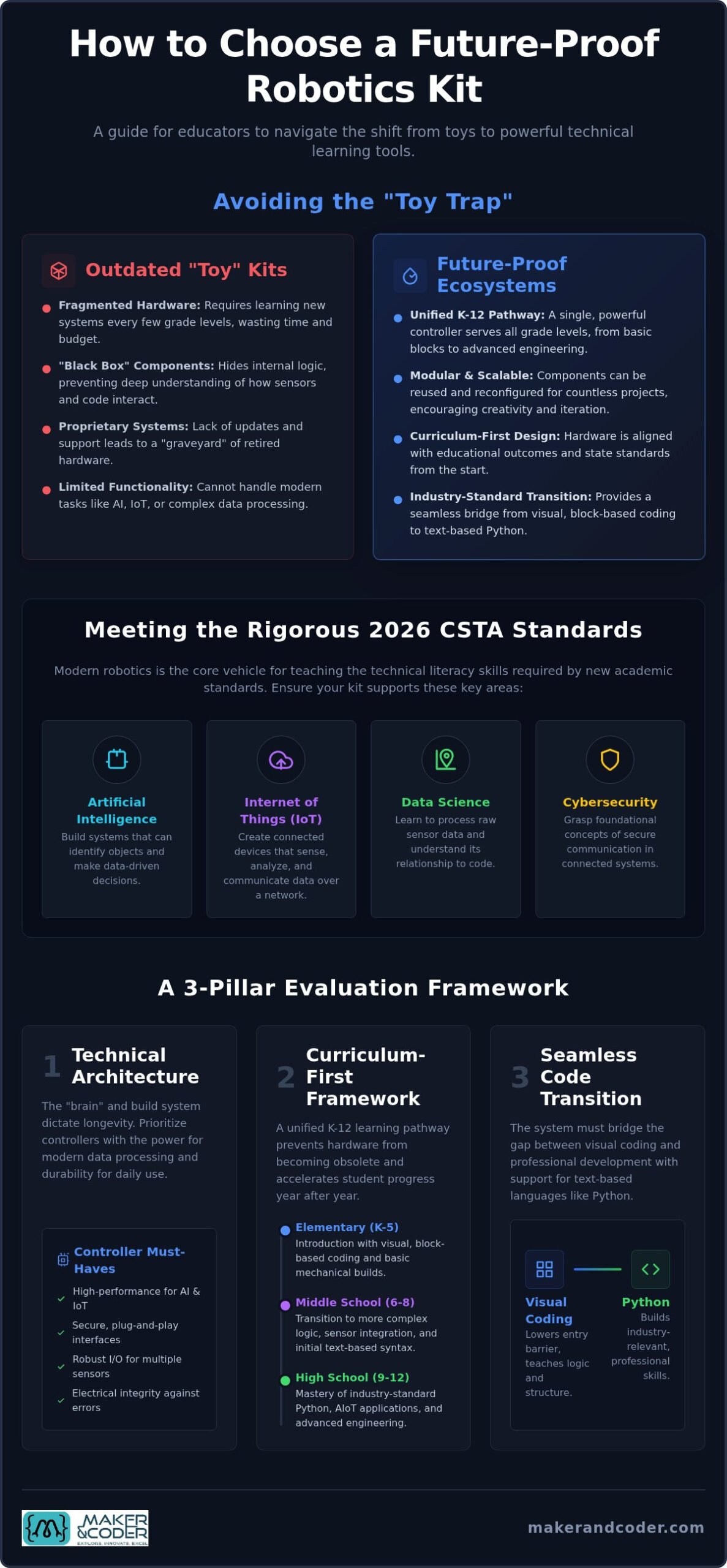
The 2026 educational landscape has undergone a massive shift. Robotics is no longer just an elective or a Friday afternoon treat; it’s a core vehicle for teaching AI literacy and the Internet of Things (IoT). The revised CSTA standards now prioritize data science and cybersecurity, meaning a robot that simply follows a line is no longer enough. To prepare students for a “Smart World,” educators must look for tools that offer genuine technical depth. This is the first hurdle in learning how to choose a robotics kit for your classroom: distinguishing between a high-tech toy and a professional-grade learning tool.
Many schools fall into the “Toy Trap.” They invest in consumer-grade kits that look impressive on a shelf but lack the modularity needed for rigorous engineering. These kits often feature “black box” components where the internal logic is hidden from the student. Real learning happens when students can see the relationship between a sensor’s raw data and the code that processes it. A true robotics ecosystem bridges the gap between creative play and technical mastery by integrating three pillars: robust hardware, versatile software, and research-backed pedagogy.
The Role of AIoT in Modern STEM Education
Modern robotics has moved beyond simple movement to data-driven interaction. AIoT, the combination of Artificial Intelligence and the Internet of Things, allows students to build systems that sense, analyze, and communicate. Imagine a classroom project where a robot doesn’t just avoid an obstacle but identifies it using machine learning and uploads that data to a shared cloud. This hands-on experimentation with sensors and connectivity transforms students from passive users into active innovators. They learn to navigate a world where everything is connected, developing the critical thinking skills required for future careers in automation and data science.
The Problem with Fragmented Hardware
Switching platforms every two grade levels is a hidden tax on both school budgets and student progress. When a student has to learn a completely new controller and interface every year, their cognitive load is wasted on basic navigation rather than complex problem-solving. This fragmentation slows the journey from basic concepts to advanced applications.
A unified “Brain” provides a consistent foundation for growth. For example, the MC4.0 Controller serves as the central hub across the entire MC 4.0 ecosystem. Using a single, powerful controller allows students to master the hardware once and then focus on increasing the complexity of their builds. This approach reduces teacher prep time and ensures that the equipment you buy for fifth grade remains relevant and functional through middle school and beyond.
Technical Architecture: Evaluating Controller Power and Modular Scalability
When researching how to choose a robotics kit for your classroom, the technical architecture is often overlooked in favor of aesthetics. However, the internal “brain” and the physical build system dictate whether a kit lasts a semester or a decade. Modular robotics represents a shift away from single-purpose builds toward a system where components are reimagined across dozens of projects. This flexibility is vital. It allows students to prototype rapidly, failing and iterating without the frustration of fragile, fixed parts.
Evaluating input and output (I/O) flexibility is equally critical. A robust system must handle multiple sensors and motor types simultaneously. In the 2026 classroom, durability isn’t just about surviving a drop from a desk; it’s about electrical integrity. You need hardware that resists common student errors, such as reversed polarity or incorrect pin placement, while still providing the precision required for high-level engineering. If your hardware can’t withstand the rigors of daily student use, the educational mission stalls before it begins.
The MC 4.0 Controller Advantage
The MC4.0 Controller acts as the sophisticated command center for the entire ecosystem. Unlike basic boards that struggle with modern data processing, this controller provides the high-performance overhead necessary for real-time AI and IoT applications. Its design emphasizes ease of connectivity, replacing fragile jumper wires with secure, plug-and-play interfaces. This reliability ensures that lessons focus on logic rather than troubleshooting hardware failures. Most importantly, it supports a seamless transition from visual, block-based coding to text-based Python, allowing the same hardware to serve students as they advance in technical maturity.
Modular MC Blocks vs. Fixed Kits
Fixed kits often lead to “one-and-done” builds that stifle creativity. In contrast, MC Blocks encourage a culture of invention. These modular components allow students to build everything from a simple rover to a complex automated greenhouse or a smart manufacturing arm. This “rebuildability” drives deeper engagement because the hardware doesn’t dictate the outcome; the student’s imagination does. It turns the classroom into a laboratory of possibilities where students feel like real engineers.
From a budgetary perspective, modularity is a game-changer. Cross-compatible components mean you aren’t forced to buy entirely new sets for different grade levels. You can expand your lab incrementally, adding specialized sensors or actuators as needed. If you are ready to audit your current tech stack, you can connect with our specialists to discuss a scalable implementation plan that fits your specific goals.
The Curriculum-First Framework: Aligning Hardware with Educational Outcomes
Buying hardware without a pedagogical plan is like purchasing a library of books in a language you don’t speak. It looks impressive on a shelf, but it offers no utility to the learner. When you evaluate how to choose a robotics kit for your classroom, the curriculum must be the foundation, not an afterthought. A truly scalable system offers a 10-year learning journey that grows alongside the student. This ensures that the investment you make today remains relevant as learners move from foundational logic to complex systems engineering.
The 2026 CSTA standards place a renewed emphasis on AI, data science, and cybersecurity. Your chosen platform must reflect these priorities. Effective robotics programs integrate these subjects naturally into Math, Science, and ELA. For instance, calculating gear ratios reinforces proportional reasoning, while documenting the engineering process supports technical writing standards. Assessment tools should go beyond simple “pass/fail” builds. Look for rubrics that measure debugging skills, iterative design, and the ability to explain logical flow. This holistic approach transforms the robotics lab into a space of rigorous academic inquiry.
The K-12 MC Curriculum Structure
The MC Curriculum (K-12) is designed to scaffold complexity through a project-based learning (PBL) model. Students begin their journey with the MC4.0 Base Kit to master basic mechanics and visual coding. As their confidence grows, they transition to specialized MC4.0 AIoT Kits and MC4.0 STEAM Kits. These modules challenge students to solve real-world problems, such as designing automated urban gardens or smart disaster-response systems. Every module includes teacher-ready resources, such as slide decks and detailed rubrics, which allow educators to focus on student discovery rather than administrative prep.
Teacher Readiness and Professional Development
Hardware alone doesn’t teach; teachers do. However, the “Teacher-as-Enabler” model recognizes that you don’t need a degree in computer science to lead a successful robotics lab. Specialized Teacher Training Programs are the most significant predictor of STEM program longevity. These programs empower educators to facilitate high-level learning by providing the technical confidence to guide students through complex builds. Ongoing support is vital to move beyond the initial setup phase. It provides a safety net as teachers and students push the boundaries of what their MC Blocks and controllers can achieve together.
Practical Implementation: A Step-by-Step Selection Framework
Selecting the right hardware is a high-stakes decision that impacts your school’s budget and student engagement for years. You need a framework that respects your current reality while planning for future growth. A successful rollout isn’t just about unboxing new tech; it’s about building a sustainable culture of innovation. Use these five steps to master how to choose a robotics kit for your classroom without falling into the “one-and-done” trap.
- Step 1: Audit Infrastructure. Check your Wi-Fi strength and device compatibility. Assess teacher comfort levels through a brief survey to identify who needs the most support.
- Step 2: Define Goals. Determine if your primary focus is core classroom integration, an after-school competition club, or a dedicated STEM elective.
- Step 3: Evaluate Floor and Ceiling. Ensure the kit is simple enough for a novice to start but powerful enough for a senior to explore AI.
- Step 4: Calculate Total Cost of Ownership (TCO). Factor in the cost of Teacher Training Programs and storage solutions, not just the initial kit price.
- Step 5: Run a Pilot. Deploy a small batch of MC4.0 Base Kits to a single grade level to gather feedback before a full-school rollout.
Low Floor, High Ceiling: The Scalability Test
A beginner should be able to get their first robot moving within twenty minutes. If the initial setup is too complex, student frustration will kill the momentum of the lesson. However, the kit must also offer enough depth to challenge a high school senior who is ready for complex sensor arrays and data processing. Scalability in classroom robotics is the capacity of a single ecosystem to remain intellectually challenging as a student’s technical proficiency evolves from basic logic to professional programming. By using the MC4.0 Controller as your foundation, you ensure that the same “brain” can power everything from a simple rover to an advanced IoT weather station.
Budgeting for Success: Beyond the Initial Purchase
Budgeting for a robotics lab requires foresight. Schools often forget to allocate funds for replacement MC Blocks or the “lost piece” factor that is inevitable in a busy classroom. You should also set aside a portion of your budget for annual curriculum updates to stay aligned with the latest 2026 CSTA standards. If funding is tight, look for grants that specifically target AIoT and “future-readiness” initiatives. Many organizations are eager to fund programs that bridge the gap between education and industry-standard skills like Python coding. If you need help drafting a proposal or selecting the right hardware mix, book a consultation with our implementation team today.
Future-Proofing Your STEM Lab with the Maker & Coder Ecosystem
Building a successful STEM program requires a shift from viewing robotics as an isolated activity to seeing it as a cultural pillar. When you evaluate how to choose a robotics kit for your classroom, you aren’t just buying hardware; you are selecting a partner for your school’s long-term growth. The Maker & Coder ecosystem is designed to grow with your students, moving them from basic mechanical understanding to professional-level system architecture. This journey transforms learners from passive consumers of technology into visionary creators who can solve real-world problems.
Integration starts with the MC 4.0 platform, a system that adapts to your existing school culture rather than forcing you to change it. Start small with a single grade level and watch the excitement spread. As students master the basics, the transition to advanced concepts becomes seamless. They move from building simple rovers to designing complex automated systems, all while using the same reliable controller. This consistency builds deep technical confidence, allowing students to focus on innovation rather than relearning basic interfaces every year.
Foster a vibrant community of makers by hosting student showcases and local competitions. These events provide a stage for students to present their “Smart World” solutions, from AI-driven recycling bins to IoT-enabled classroom monitors. A modular, curriculum-backed system wins because it provides the structure needed for academic success while maintaining the creative freedom that keeps students engaged. It is the ultimate insurance policy for your STEM lab, ensuring your equipment remains relevant as technology continues to evolve.
Selecting the Right Kit for Your Goal
Identify your immediate educational objectives to select the ideal starting point. Use the MC4.0 Base Kit for foundational coding and mechanical engineering, perfect for introducing younger students to the logic of automation. Advance to the MC4.0 AIoT Kit when your students are ready to tackle smart-city initiatives and data-driven projects that require internet connectivity. For high-level, cross-disciplinary engineering that merges physics, art, and complex electronics, master the MC4.0 STEAM Kit. Each kit serves as a building block toward a comprehensive K-12 pathway.
Next Steps: Launching Your Robotics Journey
Take the first step toward a future-proof classroom today. Book a consultation with our education specialists to develop a custom K-12 curriculum plan tailored to your school’s unique needs. Visit the Maker & Coder shop to evaluate our hardware options and see how modular blocks can revolutionize your lab. Finally, join our professional teacher training network to connect with other forward-thinking educators and access ongoing support. Empower your students to build the future, one block at a time.
Empowering the Next Generation of Innovators
The landscape of educational robotics has transitioned from simple toys to sophisticated tools for technical literacy. Success hinges on selecting an ecosystem that values longevity over novelty. By prioritizing modularity and a unified “brain” like the Scalable MC4.0 Controller Platform, you ensure your investment scales from foundational logic to complex AIoT engineering. Hardware is only as effective as the pedagogy behind it. Aligning your choices with a Comprehensive K-12 MC Curriculum and robust Professional Teacher Training Programs bridges the gap between basic play and professional-grade skill development.
Learning how to choose a robotics kit for your classroom is the first step toward creating an environment where curiosity meets concrete engineering. Don’t let your lab become a collection of disconnected parts. Instead, build a coherent pathway that empowers every student to become a confident innovator who is ready for the technical challenges of the future.
Ready to transform your school’s technical curriculum? Explore our range of MC 4.0 STEM kits and curriculum to find the perfect fit for your students. The future of your lab starts with a single, scalable choice.
Frequently Asked Questions
How do I know if a robotics kit is too advanced for my students?
Start with the “low floor, high ceiling” test to evaluate technical accessibility. If a beginner cannot get a robot moving within 20 minutes, the entry barrier is likely too high. Conversely, if there’s no room for text-based coding or complex sensors, the kit will quickly stifle growth. Maker & Coder kits use modular components to ensure students master foundational logic before they transition to advanced engineering challenges.
What is the difference between a “toy” robot and an educational robotics kit?
Toys prioritize entertainment through closed-loop systems with limited modularity and hidden logic. In contrast, educational kits prioritize transparency and rebuildability. The MC 4.0 ecosystem allows students to see the direct relationship between raw sensor data and the code they write. This distinction is vital when learning how to choose a robotics kit for your classroom, as true education requires technical depth rather than just novelty.
Do teachers need a computer science degree to use Maker & Coder kits?
No, our “Teacher-as-Enabler” model is specifically designed for educators from all academic backgrounds. We provide professional Teacher Training Programs that build technical confidence through hands-on experience and structured lesson plans. These programs empower non-experts to lead high-level STEM labs by providing the necessary rubrics and ongoing support. You focus on facilitating student discovery while our curriculum handles the technical scaffolding.
Can these kits be used for robotics competitions?
Yes, the modularity and processing power of the MC4.0 Controller make it an ideal foundation for competitive environments. Students can prototype specialized attachments using MC Blocks to solve unique, high-stakes challenges. Whether it’s a local school showcase or a regional tournament, the platform supports the rapid iteration and robust builds required to succeed. It transforms the classroom into a laboratory where students can test their designs under pressure.
How does the MC 4.0 platform support both block coding and Python?
The ecosystem utilizes a unified software interface that allows a seamless transition from visual logic to professional syntax. Students begin with blocks to master fundamental programming concepts like loops and variables. When they are ready for a greater challenge, they can switch to industry-standard Python within the same project. This ensures that your hardware investment remains relevant as students advance from primary school to rigorous high school computer science.
What happens if we lose pieces from the modular MC Blocks?
Modular systems are built for the messy realities of a busy classroom. You can easily replace individual MC Blocks or sensors without the need to purchase an entirely new kit. This cross-compatibility reduces long-term costs and ensures your STEM lab remains fully operational year after year. We recommend maintaining a small inventory of spare parts to handle the inevitable “lost piece” factor during intense building sessions.
Is the K-12 MC Curriculum aligned with international standards?
Yes, the K-12 MC Curriculum is meticulously aligned with the 2026 CSTA standards and global frameworks like the NGSS. It integrates core subjects such as Math and Science directly into the robotics experience. This alignment ensures that every lab session contributes to measurable academic progress. By connecting hardware to established standards, we help schools build a reliable and defensible pathway for technical literacy.
How much time should I allocate for teacher training?
We recommend a minimum of 6 to 8 hours for initial onboarding to ensure a smooth rollout. This allows teachers to move from unboxing to successfully running their first lesson with confidence. Allocating time for professional development is a critical part of how to choose a robotics kit for your classroom and ensure its longevity. Ongoing sessions throughout the year help educators master advanced AI and IoT applications as they arise.