What if the best evidence of learning isn’t the finished project, but the choices students make along the way? In formative assessment in a hands-on classroom, a polished build can hide misconceptions, while a rough first attempt can reveal strong reasoning. The challenge is to observe consistently, record what matters, and check understanding without interrupting the work or relying on just one way for students to show what they know.
This guide explains how to collect evidence as students plan, build, test, and revise, then use it to give timely feedback and choose clear next steps for instruction. You’ll find practical ways to ask focused questions, use quick checks, and invite reflection while students keep working. Structured STEM activities, supported by Maker & Coder’s K-12 MC Curriculum and hands-on learning ecosystem, give teachers opportunities to notice student thinking at each stage. The focus is not only on what learners make, but on how they reason, adapt, and learn.
Key Takeaways
- Turn broad learning objectives into observable skills, then choose a checkpoint where students can demonstrate them.
- Use a mix of observation notes, questions, demonstrations, and reflections to build a fuller picture of student understanding.
- With formative assessment in a hands-on classroom, consider what each piece of evidence reveals and what it might leave unseen.
- Make feedback actionable by naming a strength, identifying a next step, and giving learners time to apply it.
- Connect project stages to learning goals so assessment evidence can guide what students and teachers do next.
What formative assessment looks like in a hands-on classroom
A project can look complete and still leave an important question unanswered: what does the student understand about the ideas behind it? Formative assessment in a hands-on classroom helps teachers answer that question while learning is still underway. Notice what students say, try, and change as they work. Their choices can show how they’re applying a concept, where they’re uncertain, and what support could help them take the next step.
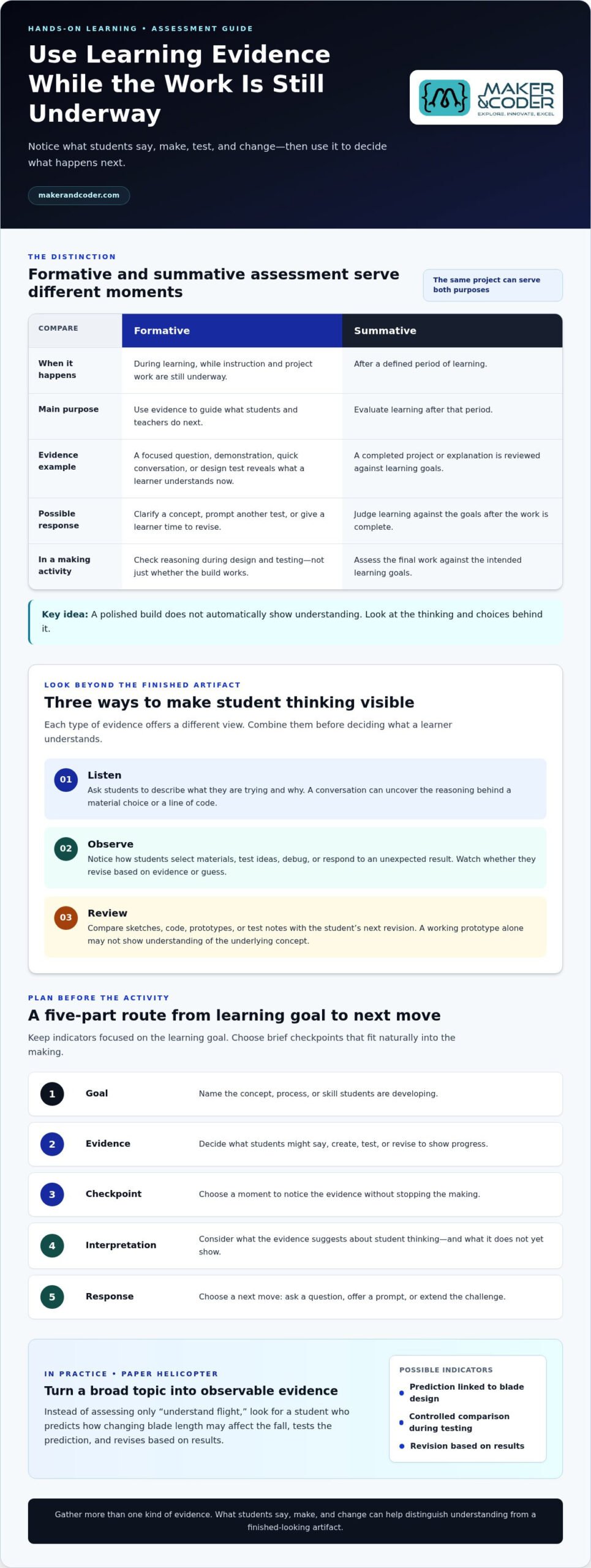
Formative assessment is the collection and use of evidence of learning to guide what happens next, while instruction is still underway. The Formative assessment overview explains its foundational principles and how it differs from summative assessment. In a making activity, the practical distinction is that evidence should shape learning, not simply confirm that a task is finished.
How is formative assessment different from summative assessment?
Formative assessment gives teachers and students information they can use during learning. A prompt, demonstration, or quick conversation might show that a design needs another test or a concept needs clarification. Summative assessment evaluates learning after a defined period, often by reviewing a completed project or explanation. The same project can serve both purposes: check reasoning during design, then assess the final work against learning goals.
What counts as evidence during hands-on learning?
Look beyond appearance and completion. Evidence might include a student explaining why a structure needs support, sketching a design, writing code, building a prototype, recording a test result, or choosing a revision after something fails. Each offers a different view of thinking. A working prototype alone doesn’t prove that a learner understands the underlying concept. An explanation, test, or follow-up question can add useful context.
- Listen: Ask students to describe what they’re trying and why.
- Observe: Notice how they select materials, test ideas, or respond to an unexpected result.
- Review: Compare sketches, code, or test notes with the student’s next revision.
Use more than one kind of evidence before drawing a conclusion. A learner may communicate an idea more clearly through a model or demonstration than through a written response. Combining what students say, make, and change helps distinguish understanding from a finished-looking artifact. It also gives you a stronger basis for deciding what to ask or teach next.
Plan a hands-on activity around observable learning goals
Start with what students should learn, not just what they’ll make. A broad aim such as “understand flight” is difficult to assess during an activity. Narrow it to a demonstrable idea: students can explain how changing a paper helicopter’s blade length may affect how it falls, then test their prediction. Now you have something specific to listen for and observe.
Assessment works best when you decide what evidence to look for before the activity begins. For formative assessment in a hands-on classroom, use this short planning sequence:
- Goal: Name the concept, process, or skill students are developing.
- Evidence: Decide what they might say, create, test, or revise to show progress.
- Checkpoint: Choose a moment to notice that evidence without stopping the making.
- Interpretation: Consider what the evidence suggests about student thinking, and what it doesn’t yet show.
- Response: Select a next move, such as asking a question, offering a prompt, or extending the challenge.
Keep the indicators focused. Tracking every action can bury useful insights in notes. A few signals tied directly to the goal are easier to notice and act on. STEM Teaching Tools’ guidance on three-dimensional formative assessments can help teachers design checks that draw on science and engineering practices, not factual recall alone.
Turn learning objectives into observable indicators
For the helicopter activity, indicators might include a prediction linked to blade design, a controlled comparison during testing, or a revision based on results. Students can demonstrate these ideas through a sketch, conversation, test, or written note. Avoid treating neatness, speed, or familiarity with a tool as proof of understanding. Those may reflect experience or access rather than the learning goal.
Choose assessment checkpoints that preserve making time
Plan brief moments after students sketch a design, try it for the first time, test it, and consider a revision. At each point, connect the check to a possible teaching decision: clarify the test conditions, prompt students to explain a result, or invite another trial. Check in with groups as you circulate rather than pausing everyone at once. The making continues, and your observations still shape what happens next.
Gather reliable evidence while students build, test, and revise
Choose evidence that fits the learning goal and the moment. A brief conference can uncover why a student chose a particular component or line of code. Watching a test or debugging attempt can show whether they’re using a systematic strategy, guessing, or revising based on results. A quick demonstration or reflection can make individual understanding visible without requiring every learner to respond in the same way.
No single method tells the whole story. A confident explanation may not match what a student can apply independently, and a successful group prototype may not reveal what each team member understands. Combine evidence across moments and record only what relates to the intended goal. A short note such as “tested one change at a time” is more useful than an exhaustive account of every action.
Which formative assessment methods work during making?
Use questions that invite reasoning: “What did you change after the first test?” or “How does this code make the sensor respond?” Observe students as they build, test, and debug. Then use sketches, quick demonstrations, or exit reflections to capture thinking that might not surface in conversation. Match the method to the evidence you need, and treat each response as one clue rather than proof of mastery.
| Evidence source | Teacher look-for | Possible next move |
|---|---|---|
| Brief student conference | Can the learner explain a design or coding choice? | Ask a follow-up question or prompt a clearer explanation. |
| Observation during testing or debugging | Does the learner use results to guide a change? | Model a way to compare attempts, or offer a new challenge. |
| Quick demonstration | Can the student show the target skill in action? | Invite another try with a focused hint. |
| Sketch or reflection prompt | Can the learner represent an idea or name a point of uncertainty? | Clarify a concept or plan a short check-in. |
| Student question | What part of the process is confusing or generating curiosity? | Respond with a scaffold, resource, or extension. |
How can teachers make assessment fair and manageable?
Gather evidence at different points instead of relying on one performance. Offer spoken, written, and practical ways to show understanding, so a single communication format doesn’t determine what you notice. Keep records tied to a learning goal: note what a student explained, tested, or revised, then decide what that evidence suggests. Separate individual contributions from group-product quality. A polished shared build can’t show who understands each decision, while a rough prototype doesn’t erase strong individual reasoning.
Use feedback and assessment evidence to move learning forward
Evidence becomes useful when it informs a next step. In formative assessment in a hands-on classroom, follow a simple cycle: Notice what a student does or says, interpret what it suggests, respond with a useful prompt or adjustment, then revisit the same indicator. This keeps assessment connected to learning rather than turning an observation into a label.
For example, a student may repeatedly adjust a design without testing one change at a time. Before stepping in, consider what might be behind the pattern. Is the learner unsure how to compare results, unclear on the concept, or unable to access a tool or instruction? The cause matters. A targeted response supports progress without taking the design process out of the student’s hands.
How do you give feedback students can use immediately?
Anchor feedback to the learning goal and a specific piece of evidence. Name a strength, offer one next step, then leave room for the learner to act. For instance: “You noticed that the output changed after your code adjustment. Now change one instruction at a time and see whether the result matches your prediction.” The feedback recognizes a useful decision and makes the next test clear.
Keep feedback focused. A string of corrections can leave students unsure where to begin, while one actionable suggestion gives them a path forward. Build in time for another attempt, and invite the student to explain what changed. That follow-up helps you see whether the feedback was understood and whether it moved learning forward.
What should teachers do when evidence reveals a misconception?
First identify the likely barrier. A conceptual misconception may call for a question that helps students reconsider an assumption. A procedural gap may need a brief demonstration of a testing or debugging step. If task access is the issue, adjust the materials, directions, or response format so the learner can engage with the intended idea. In each case, preserve student agency: offer a scaffold, then let the learner make and test the next decision.
Revisit the same indicator after responding. If students are learning to use test results to guide revisions, ask them to describe how new evidence shaped their next choice. Their explanation or demonstration gives you a fresh basis for deciding whether to continue, clarify, or extend the challenge.
Notice, interpret, respond, and revisit: that’s the formative cycle that turns classroom evidence into a next move. Maker & Coder provides teacher training programs to support educators implementing hands-on STEM activities and assessment. Learn more about teacher training for hands-on STEM learning.
Build formative assessment into a complete hands-on STEM learning pathway
Formative assessment in a hands-on classroom works best as part of a project’s design, not as an extra task added after students start building. Connect each stage to an intended learning goal, and decide what evidence could guide the next teaching move. A structured curriculum can help align activities with concepts and skills, while leaving room to adapt prompts and supports to learners’ needs.
What does a formative assessment cycle look like in a STEM project?
Imagine a design brief asking students to build a device that responds to a chosen input. The learning goal might be to explain how an input leads to an output. At each stage, gather a small piece of evidence:
- Plan: Review a sketch or ask, “What do you expect the input to make happen?”
- Prototype: Observe how learners connect their design choices to the goal.
- Test: Ask, “What happened, and how does it compare with your prediction?”
- Reflect: Invite students to describe what they would change and why.
- Revise: Watch whether they use test results to adjust the design, then ask what the revision was meant to improve.
Keep the cycle flexible. Younger learners might explain through a drawing or demonstration, while older students may compare test results or describe a more complex system. In either case, the teacher uses evidence to decide whether to clarify a concept, offer a prompt, or extend the challenge.
How can schools support consistent classroom implementation?
Shared learning goals, materials, and teacher preparation can make assessment more coherent across a learning pathway. Maker & Coder brings together the MC 4.0 Controller, MC Blocks, specialized MC4.0 kits, a K-12 MC Curriculum, and teacher training. The MC 4.0 Kit and MC Blocks support hands-on projects and modular experimentation, while the curriculum provides a structured educational pathway designed to integrate with the hardware. Teacher training helps educators implement STEM technology effectively in the classroom.
Consistency doesn’t mean every learner must build the same way or show understanding in the same format. It means teachers can return to clear goals, gather relevant evidence, and adjust instruction as students progress. When planning a classroom pathway, align the project goals and assessment checkpoints with the learning needs you want to address.
Make every build a chance to learn
The strongest projects reveal more than what students can finish. They give learners opportunities to explain choices, test ideas, and use feedback to improve. With formative assessment in a hands-on classroom, keep the focus on clear learning goals, gather evidence in different ways, and use what you notice to choose a useful next step.
Consistency grows when project materials, curriculum, and teaching approach work together. Maker & Coder’s K-12 MC Curriculum is designed to integrate with its hardware, and its teacher training programs support classroom implementation. These resources help educators connect hands-on activity to intended learning and meaningful assessment.
Every observation can open a path forward, from a clarifying question to a student’s next experiment. Explore Maker & Coder’s hands-on STEM learning resources and teacher training to plan a pathway that connects making with learning goals.
Frequently Asked Questions
What is formative assessment in a hands-on classroom?
Formative assessment in a hands-on classroom is the ongoing collection and use of evidence to guide teaching and learning while students are working. Rather than judging only a finished project, teachers notice how learners plan, explain decisions, test ideas, and respond to results. A quick question or observation can reveal where a student is progressing or needs support, helping the teacher choose a useful next step.
How do you assess students during project-based learning?
Start by identifying the learning goal, then decide what students might say, make, test, or revise to demonstrate progress. Build brief checkpoints into the project, such as reviewing a plan, asking a student to explain a design choice, or observing how they respond to test results. Record concise notes tied to the goal, give one actionable suggestion, and check later whether students used it.
What are examples of formative assessment in a STEM classroom?
Useful examples include asking learners to predict what a prototype will do, listening to a brief explanation of a coding choice, and observing how they troubleshoot after a test. Students can also sketch a design, demonstrate a process, write a quick reflection, or identify what they want to improve. Use more than one method when possible, since each offers a different view of understanding and may leave other parts unseen.
How can teachers assess individual learning in a group project?
Gather evidence from each learner, not only the team’s completed product. Ask individuals to explain a decision, sketch their own idea, demonstrate a relevant skill, or reflect on how test results shaped their contribution. Rotate brief check-ins so each student has a chance to share their reasoning. Interpret this individual evidence separately from group performance, since a strong shared build doesn’t show what every team member understands.
How do you assess the process as well as the final product?
Define process indicators alongside the criteria for the finished work. For example, look for students making a prediction, testing one change, using evidence to explain a result, or revising a design for a stated reason. Capture these observations in short notes or through student reflections. The final product can show what learners created, while process evidence helps reveal the decisions and understanding that developed as they worked.
Can hands-on activities be assessed without interrupting student learning?
Yes. Assess through brief, embedded interactions rather than stopping the whole class for a separate test. As students work, circulate, listen to explanations, notice how they test ideas, or ask a group one focused question. Short checkpoints can happen after planning or testing, while quick reflections let students share thinking without pausing the activity for long. Keep each check connected to a teaching decision so it serves learning, not paperwork.
How often should teachers use formative assessment during a project?
Use it at meaningful points in the project, not on a fixed schedule or after every action. Check when evidence can inform a next move, such as after planning, a first attempt, testing, or revision. The right cadence depends on the activity, learners, and goal. A few purposeful observations and check-ins can be more useful than constant monitoring. If new evidence reveals uncertainty, add a brief check or targeted prompt.