
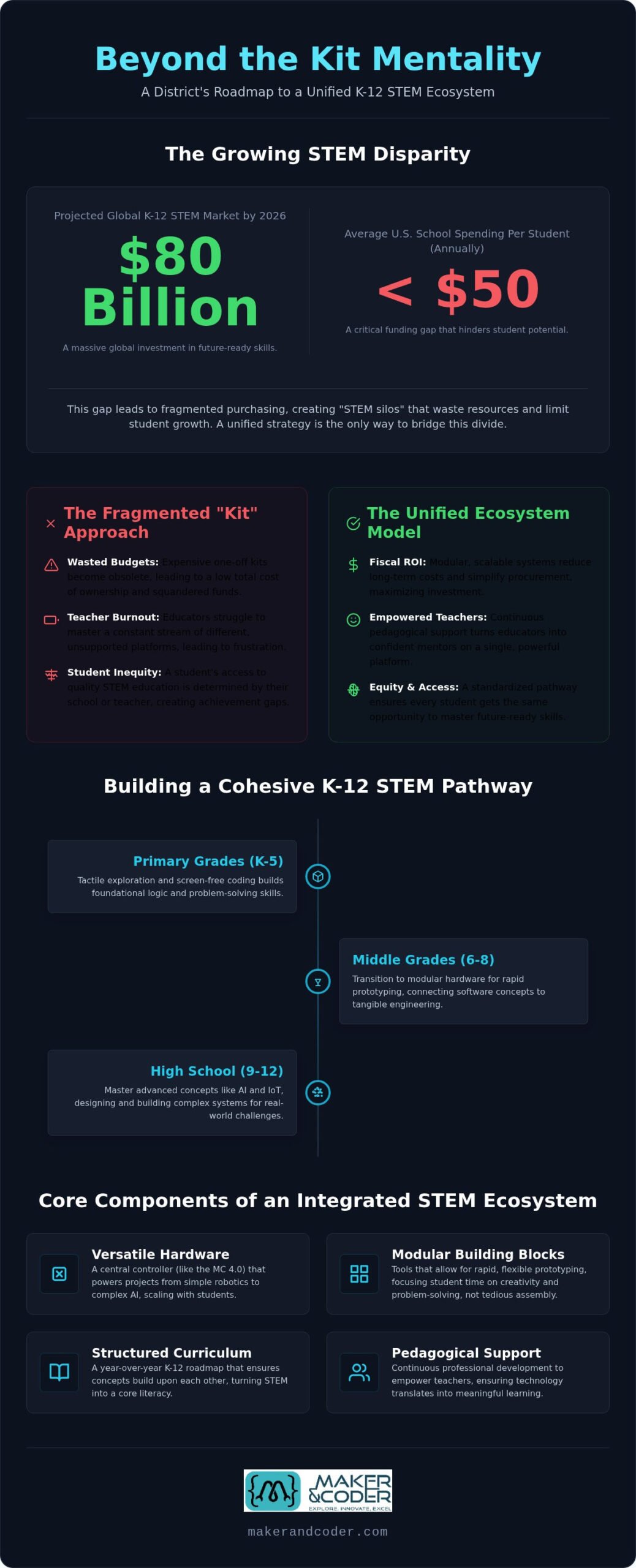
With the global K-12 STEM market projected to hit $80 billion in 2026, it’s startling that the average U.S. school still spends less than $50 per student on these vital programs. You’ve likely felt the strain of this gap firsthand. District leaders often face a “STEM silo” problem where schools use different tools, teachers struggle with burnout from constant platform shifts, and expensive technology becomes obsolete before it’s even fully implemented. True district-wide STEM curriculum adoption requires moving away from these fragmented, one-off purchases. Instead, it’s about building a unified, scalable ecosystem that ensures every student has an equal path to success.
We understand the pressure of balancing federal funding shifts with the urgent need for technical literacy. This article provides a clear roadmap to transition your schools from isolated labs to a cohesive K-12 framework. You’ll learn how to implement a turn-key solution that boosts student engagement and improves standardized testing outcomes. From tactile coding in primary grades to advanced AIoT kits in high school, we’ll show you how to create a future-ready environment that supports your teachers and inspires your learners to build something tangible.
Key Takeaways
- Stop the cycle of fragmented procurement by aligning your schools under a single, cohesive STEM strategy.
- Discover how modular hardware like MC Blocks allows for flexible, cost-effective scaling across different grade levels.
- Master the roadmap for successful district-wide STEM curriculum adoption through a proven pilot-to-scale implementation model.
- Empower your educators with continuous pedagogical support to ensure advanced equipment translates into real student learning.
- Prepare students for the 2026 technical landscape by embedding AI and IoT concepts into a structured K-12 technical pathway.
Table of Contents
The Strategic Necessity of District-Wide STEM Alignment
Many districts fall into the trap of “random acts of STEM.” This fragmented approach creates isolated silos where one school uses a specific robotics kit while another relies on screen-based coding. It’s a recipe for wasted budgets and profound teacher frustration. Successful district-wide STEM curriculum adoption requires a shift from these disconnected activities to a unified technical ecosystem. While a foundational overview of STEM defines the core disciplines, the 2026 standard demands more. We are moving beyond basic block coding into the sophisticated realms of Artificial Intelligence (AI), the Internet of Things (IoT), and modular engineering.
This alignment isn’t just about logistics; it’s about equity. When every school follows a standardized path, you bridge the achievement gap. You ensure that a student’s technical literacy isn’t determined by their zip code or a specific teacher’s personal hobby. In a post-AI job market, this consistency is the difference between a student who is a passive consumer and one who is a confident creator. It prepares them for a landscape where technical agility is a prerequisite for career readiness. By providing a clear, district-wide roadmap, you give every learner the same opportunity to master the tools of the future.
Moving Beyond Fragmented STEM Activities
One-off robotics kits often fail because they lack a vertical pathway. They offer a moment of excitement but fail to build long-term proficiency. Students need a journey of growth, moving from tactile exploration to complex system design. This requires transitioning from consumer-grade toys to professional-grade educational platforms like the MC Curriculum. By implementing a K-12 pathway where concepts build year-over-year, you transform STEM from an elective novelty into a core literacy. This structured progression ensures that the skills learned in elementary school provide the direct scaffolding needed for advanced high school engineering.
Economic and Academic Outcomes of Standardization
Standardization is the key to fiscal responsibility. By choosing modular systems like MC Blocks, districts significantly lower the “Total Cost of Ownership.” You reduce the need for specialized storage, simplify procurement, and ensure that hardware remains relevant across multiple grade levels. This uniformity also improves academic data collection. When every campus uses the same framework, administrators can accurately measure student performance and identify areas for intervention. Ultimately, STEM standardization is the foundation for measurable district-wide ROI, turning educational spending into a long-term investment in student outcomes and district reputation.
Evaluating the STEM Ecosystem: Beyond the ‘Kit’ Mentality
Successful district-wide STEM curriculum adoption requires a fundamental shift in perspective. Many administrators view STEM as a series of hardware purchases. They buy a set of robots for one grade and a 3D printer for another, hoping the pieces eventually fit together. This “kit” mentality often leads to expensive equipment gathering dust because it lacks a cohesive framework. A true STEM ecosystem is different. It’s a holistic environment where hardware, software, and pedagogical support work in perfect synergy to foster creative expression and technical mastery.
Think of the ecosystem as a living structure. At its base sits a versatile hardware foundation that adapts to different ages and skill levels. Above that, a structured curriculum provides the roadmap for discovery. Finally, professional development ensures teachers feel like empowered mentors rather than overwhelmed troubleshooters. This integrated approach solves the problem of technology becoming obsolete. When you invest in a modular system, you aren’t buying a toy; you’re building a scalable infrastructure that grows with your students.
The Core Components of an Integrated System
Every effective STEM ecosystem needs a central nervous system. The MC 4.0 Controller serves as this versatile brain, capable of powering everything from simple robotics to complex AI and IoT projects. This single piece of hardware transitions with the student from primary exploration to advanced engineering. To support this growth, modular MC Blocks allow for rapid prototyping. They reduce the time spent on tedious assembly, which increases the time available for experimentation and critical thinking. Because these tools are compatible across Chromebooks, tablets, and PCs, they fit seamlessly into your existing technical environment without requiring a hardware overhaul.
Aligning Curriculum with Modern Standards
A high-quality curriculum must do more than just provide instructions. It must align with NGSS and rigorous technical requirements. By utilizing state-level instructional resources, districts can ensure their programs meet the highest academic benchmarks. The goal is scaffolded learning. Students start with elementary basics and move toward sophisticated AIoT applications in high school. This ensures that technical literacy is built layer by layer, year after year. Check out the latest STEM hardware and kits to see how modular design supports this educational journey. If you’re ready to discuss how these tools can fit your specific goals, reach out to our team for a strategic consultation.
Scalability is the final piece of the puzzle. You don’t have to launch a full district-wide rollout on day one. Many successful leaders begin with a single grade level or a dedicated pilot program. This allows you to gather data, build teacher buy-in, and refine your approach before expanding. Whether you start small or go big, the focus remains the same: moving from fragmented activities to a unified, future-proof technical pathway.
The Implementation Roadmap: From Pilot to District-Wide Scale
Moving from a vision of technical literacy to a functional reality requires more than just a purchase order. It demands a structured, multi-phase strategy that addresses both infrastructure and human capital. District-wide STEM curriculum adoption is an evolution, not a single event. By following a methodical roadmap, you can minimize friction and ensure that your investment translates into measurable student success across every campus.
This journey typically follows five distinct phases. It begins with a deep needs assessment to identify current gaps. Next, you launch a controlled pilot program to test hardware and pedagogy in real classrooms. Once the pilot yields data, you move into curriculum mapping to ensure a seamless K-12 flow. The fourth phase involves the district-wide rollout where equipment and training are standardized. Finally, you establish a cycle of sustainable growth. This ensures your technical ecosystem remains vibrant and responsive to the 2026 landscape through regular feedback and technology refreshes.
Conducting a Comprehensive STEM Audit
Before adding anything new, you must understand what you already have. Start by inventorying existing equipment to identify what is obsolete, broken, or non-scalable. It’s common to find “technology graveyards” of disconnected kits that no longer serve a purpose. Simultaneously, survey your staff. Understanding teacher comfort levels with coding and robotics is essential for planning future training. Finally, identify your 2026 funding sources. Look beyond general funds to Title I, Title IV, or remaining ESSER funds to secure the necessary capital for a unified system.
Designing a Successful Pilot Program
The first 90 days of a pilot often determine the success of the entire district adoption. Rather than a massive launch, select a group of “Lead Teachers” who are eager to innovate. These educators will test hardware like the MC4.0 Base Kit in diverse classroom settings. Focus on clear metrics for success. Track student engagement, project completion rates, and qualitative teacher feedback. A pilot program with the MC4.0 STEAM Kit can serve as a blueprint for full adoption, allowing you to troubleshoot logistics before scaling. This small-scale start builds the internal evidence needed to win over skeptical stakeholders and ensures your full rollout is grounded in proven results.
Once your pilot proves successful, the focus shifts to curriculum mapping. This involves integrating the K-12 MC Curriculum into existing school schedules to ensure students don’t repeat the same basic concepts year after year. By standardizing equipment and training during the district-wide rollout, you eliminate the “STEM silos” discussed earlier. This methodical progression ensures that every teacher feels supported and every student has a clear, uninterrupted path toward technical mastery.
Overcoming the Implementation Gap: Teacher Empowerment
Even the most sophisticated technical ecosystem is powerless without a confident educator at the helm. While previous sections focused on the structural roadmap and hardware foundations, the human element is what truly sustains a district-wide STEM curriculum adoption. Many administrators are surprised to find that a significant portion of high-tech equipment sits unused in school closets. This isn’t due to a lack of interest; it’s a direct result of the “Teacher Confidence Gap.” When educators feel overwhelmed by complex tools or unsupported by their curriculum, they naturally revert to safer, more familiar teaching methods.
Empowerment begins by acknowledging that teachers are the primary architects of student discovery. Moving from hesitation to mastery requires more than a manual. It requires a partnership. By providing turn-key guides and ongoing pedagogical support, you remove the burden of individual lesson planning. This allows your staff to focus on what they do best: facilitating curiosity and guiding students through the fulfillment of building something tangible. If you want to ensure your investment translates into classroom action, schedule a teacher empowerment workshop with our team.
Effective Professional Development Models
Ditch the “one-and-done” workshop model. For STEM alignment to stick, professional development must be an ongoing journey rather than a single event. Teachers must have the opportunity to build what their students will build. Hands-on sessions where educators experiment with the MC 4.0 Controller create a sense of shared discovery. Beyond initial training, provide virtual coaching and on-demand support for real-time troubleshooting. Establishing a network of “STEM Champions” across different campuses also creates a culture of peer-to-peer mentoring. These local experts act as internal guides, helping their colleagues navigate technical challenges and sharing successful classroom strategies.
Simplifying Classroom Management
Hands-on learning can feel like controlled chaos without the right systems. Educators often cite classroom management as their number one objection to adopting new technology. They worry about lost parts, long setup times, and the mental load of learning a new platform. Modular storage and the intuitive design of MC Blocks directly address these concerns by simplifying the physical logistics of the lab. Digital dashboards within the MC Curriculum further reduce friction by allowing teachers to track student progress at a glance. This efficiency proves that technical literacy doesn’t have to come at the cost of teacher sanity. By reducing prep time and streamlining the “messy” parts of engineering, you create an environment where both teachers and students can thrive without burnout.
Building a true STEM culture also means encouraging cross-disciplinary collaboration. When math and science departments use a unified hardware-software framework, they can create integrated projects that reinforce concepts across different periods. This holistic approach doesn’t just benefit the students; it builds a stronger, more connected professional community within your district.
Future-Proofing with Maker & Coder: A Unified Vision
The technical landscape of 2026 doesn’t wait for slow transitions. While many programs focus on the basics of block-based logic, the modern workforce demands proficiency in Artificial Intelligence and the Internet of Things. Maker & Coder stands as the preferred partner for this transformation because we bridge the gap between classroom theory and industry reality. Choosing a partner for district-wide STEM curriculum adoption is about more than just procurement; it’s about securing a unified vision that remains relevant as global standards shift.
Our ecosystem is built on the principle of sustainable innovation. We don’t just sell kits that become obsolete in eighteen months. We provide a modular foundation where hardware like the MC 4.0 Controller adapts to new challenges. This approach ensures that your district isn’t constantly trapped in a cycle of expensive hardware refreshes. Instead, your schools gain a flexible infrastructure that evolves alongside the students it serves. This long-term perspective is essential for maintaining consistent student outcomes across every campus.
Advanced Technical Pathways with AIoT and STEAM
The transition from primary education to career readiness requires a sophisticated ladder of skills. We introduce the MC4.0 AIoT Kit specifically for middle and high school career pathways to meet this need. This isn’t just about building robots; it’s about connecting physical computing with real-world data science. Students learn how sensors interact with cloud environments, preparing them for the complexities of a hyper-connected world. By utilizing MC Blocks for rapid prototyping, learners enter the “Maker Economy” with the confidence to design, test, and iterate on their own inventions.
Partnering for Long-Term Success
Maker & Coder is committed to more than just delivery. We provide continuous teacher training and curriculum updates to ensure your district-wide STEM curriculum adoption stays ahead of the curve. Our experts work with you to align our K-12 MC Curriculum with your specific state standards and district goals. This partnership ensures that your educators always have access to the latest pedagogical strategies and technical support. It turns technology into an accessible tool for creative expression rather than a daunting challenge.
The journey toward a unified STEM ecosystem starts with a single conversation. Whether you’re looking to scale a successful pilot or overhaul your entire technical framework, we provide the expertise to make it happen. Contact our STEM specialists for a consultation to request a customized implementation plan for your district. Together, we can build a future where every student is prepared to lead in the technical landscape of tomorrow.
Leading the Next Generation of Technical Innovators
Transitioning from fragmented activities to a unified technical ecosystem is the most significant investment you can make for your students’ future. By moving beyond isolated kits and embracing a structured K-12 pathway, you ensure that technical literacy becomes a core competency across your entire district. We’ve explored how a methodical roadmap, paired with professional teacher training, turns daunting technology into an accessible tool for creative expression. Modular MC Blocks and turn-key curriculum guides don’t just simplify classroom management; they provide the peace of mind educators need to facilitate true discovery.
Your journey toward district-wide STEM curriculum adoption doesn’t have to be a solo venture. With the right partner, you can bridge the gap between complex modern systems and the classroom environment, preparing every learner for the 2026 landscape. It’s time to replace “STEM silos” with a scalable, future-proof framework that inspires curiosity and builds tangible skills. Ready to define your roadmap? Schedule a District STEM Strategy Session with our experts today. Let’s build something extraordinary together.
Common Questions Regarding District STEM Implementation
How do we choose the right STEM curriculum for a large school district?
Prioritize vertical alignment and modularity to ensure the system grows with your students year after year. A successful district-wide STEM curriculum adoption relies on a K-12 pathway that eliminates learning gaps between different grade levels. Look for platforms that integrate hardware and software into a single pedagogical framework. This consistency reduces procurement costs and ensures that every campus follows the same high academic standards, regardless of their starting point.
What is the difference between a STEM kit and a STEM ecosystem?
A STEM kit is a standalone tool designed for a specific project; a STEM ecosystem is a holistic infrastructure for long-term discovery. While kits often lead to fragmented silos and wasted budgets, an ecosystem combines modular hardware like MC Blocks with structured curriculum and professional development. This integrated approach ensures that technology doesn’t become obsolete within months. It provides a sustainable foundation for creative expression and engineering mastery across all schools.
How can we fund a district-wide STEM adoption in 2026?
Leverage a mix of federal and state resources such as Title I, Title IV, and Perkins V funding. Perkins V provides approximately $1.4 billion annually to support career and technical education, which directly applies to advanced technical pathways. For the 2026 landscape, many districts also utilize competitive state integration grants to expand instruction. Aligning your procurement with these specific funding cycles allows you to scale your technical infrastructure without straining general operating budgets.
What kind of teacher training is required for the MC 4.0 platform?
Effective implementation requires our structured Teacher Training Programs that move beyond one-time workshops. Educators participate in hands-on sessions where they build the same projects their students will tackle, fostering deep technical confidence. We also provide virtual coaching and on-demand support for the MC 4.0 Controller to ensure troubleshooting never interrupts classroom momentum. This continuous pedagogical support transforms teachers into expert-enablers who can guide complex student inquiries with ease.
Is the MC Curriculum aligned with NGSS and state standards?
The MC Curriculum is purposefully designed to meet Next Generation Science Standards (NGSS) and state-level technical requirements. It focuses on three-dimensional learning, which integrates core ideas with scientific practices and crosscutting concepts. This alignment ensures that your district-wide STEM curriculum adoption supports standardized testing outcomes while providing students with a rigorous academic foundation. Regular updates keep the material current with evolving 2026 standards and career readiness benchmarks.
How do we ensure STEM programs are inclusive for all student populations?
Inclusion is built into the framework through standardization and modular design. By implementing a unified district-wide strategy, you ensure that every student has equal access to high-level technology regardless of their specific school’s local funding. Modular MC Blocks allow for tactile, hands-on learning that supports diverse learning styles and neurodivergent populations. This approach removes barriers to entry, allowing all students to experience the fulfillment of building tangible technical solutions for real-world problems.
What is the typical timeline for a district-wide STEM rollout?
Expect a phased timeline that typically spans 12 to 18 months for full implementation. It begins with a 90-day pilot program where Lead Teachers test hardware like the MC4.0 Base Kit to establish a blueprint for success. Following the pilot, the rollout expands campus-by-campus to ensure hardware standardization and staff training are fully integrated. This methodical progression prevents the implementation gap and builds long-term momentum for your technical literacy goals across the entire district.
How does the MC 4.0 hardware handle the transition from block-based to text-based coding?
The MC 4.0 Controller acts as a versatile bridge that supports a student’s entire coding journey from primary school to graduation. Learners begin with intuitive, block-based coding to master logic and algorithmic thinking without the frustration of syntax errors. As their confidence grows, the platform allows for a seamless transition into professional text-based languages like Python. This scaffolded approach ensures that students are prepared for the 2026 technical landscape by mastering industry-standard programming tools on familiar hardware.