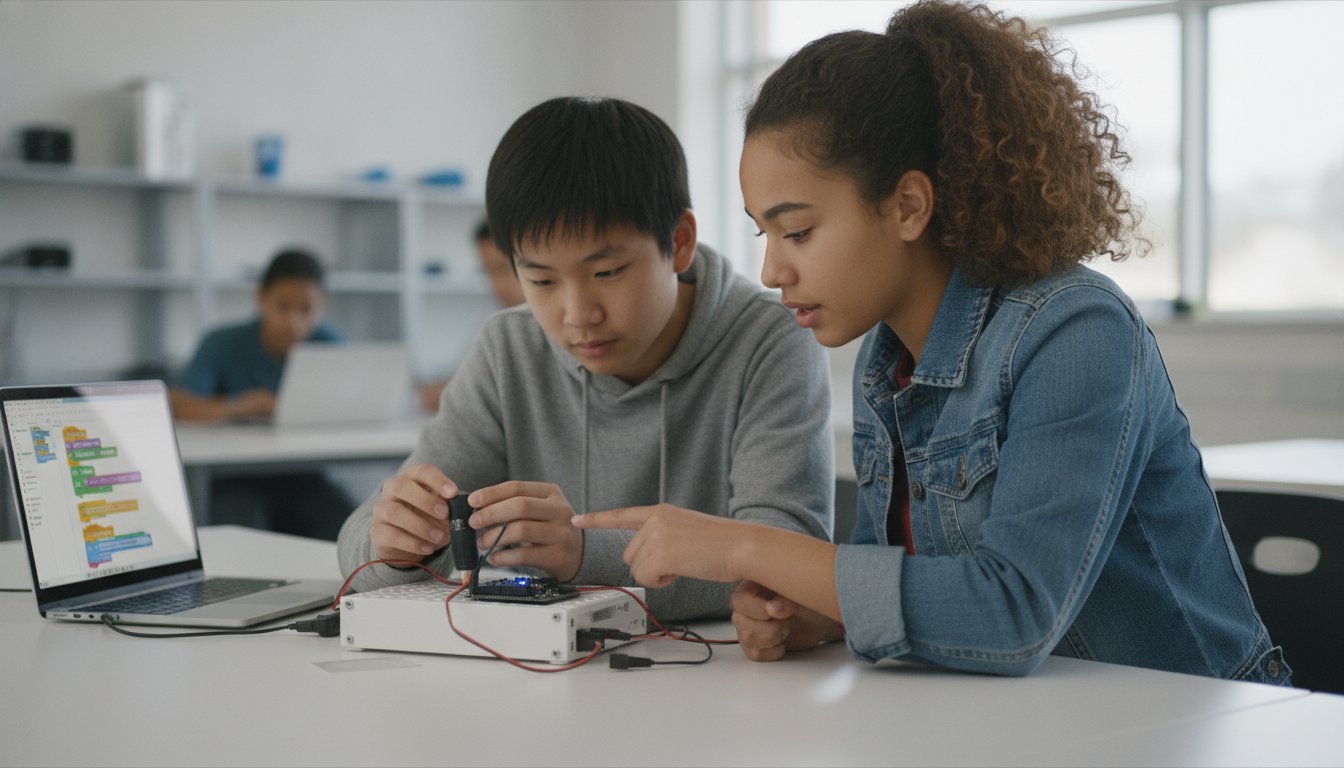
If your students can script a loop on a screen but can’t explain how a smart sensor reacts to the physical environment, they aren’t mastering computer science; they’re simply following a digital script. True innovation happens at the intersection of logic and reality. That’s why implementing a comprehensive coding curriculum with hardware kits is no longer an elective luxury but a foundational requirement for the 2026 classroom. You’ve likely felt the disconnect between software lessons and hardware functionality, or perhaps you’ve struggled with kits that feel like toys rather than tools for growth.
We understand that teacher anxiety regarding technical troubleshooting is a major barrier to STEM success. You need a system that works, from the first block-based project in primary school to sophisticated AIoT applications in the upper grades. This guide provides a clear roadmap to bridge the gap between abstract code and physical reality with a structured K-12 STEM ecosystem. We’ll show you how to transition from basic concepts to advanced applications using a turn-key solution that empowers both students and staff. Get ready to transform your lab into a hub of real-world creation and professional excellence.
Key Takeaways
- Move beyond screen-only lessons to physical computing that turns abstract logic into tangible, real-world results.
- Evaluate a coding curriculum with hardware kits based on pedagogical alignment with 2026 standards and hardware durability for long-term classroom reuse.
- Master the framework for scalability by choosing modular components that eliminate the “messy wiring” barrier and save valuable instructional time.
- Follow a structured two-step implementation process to audit your STEM infrastructure and select the right specialized kits for every grade level.
- Discover how the MC 4.0 ecosystem provides a comprehensive K-12 pathway, bridging the gap between simple block-based coding and professional-grade AIoT projects.
Table of Contents
Beyond the Screen: Why Coding Needs a Physical Dimension
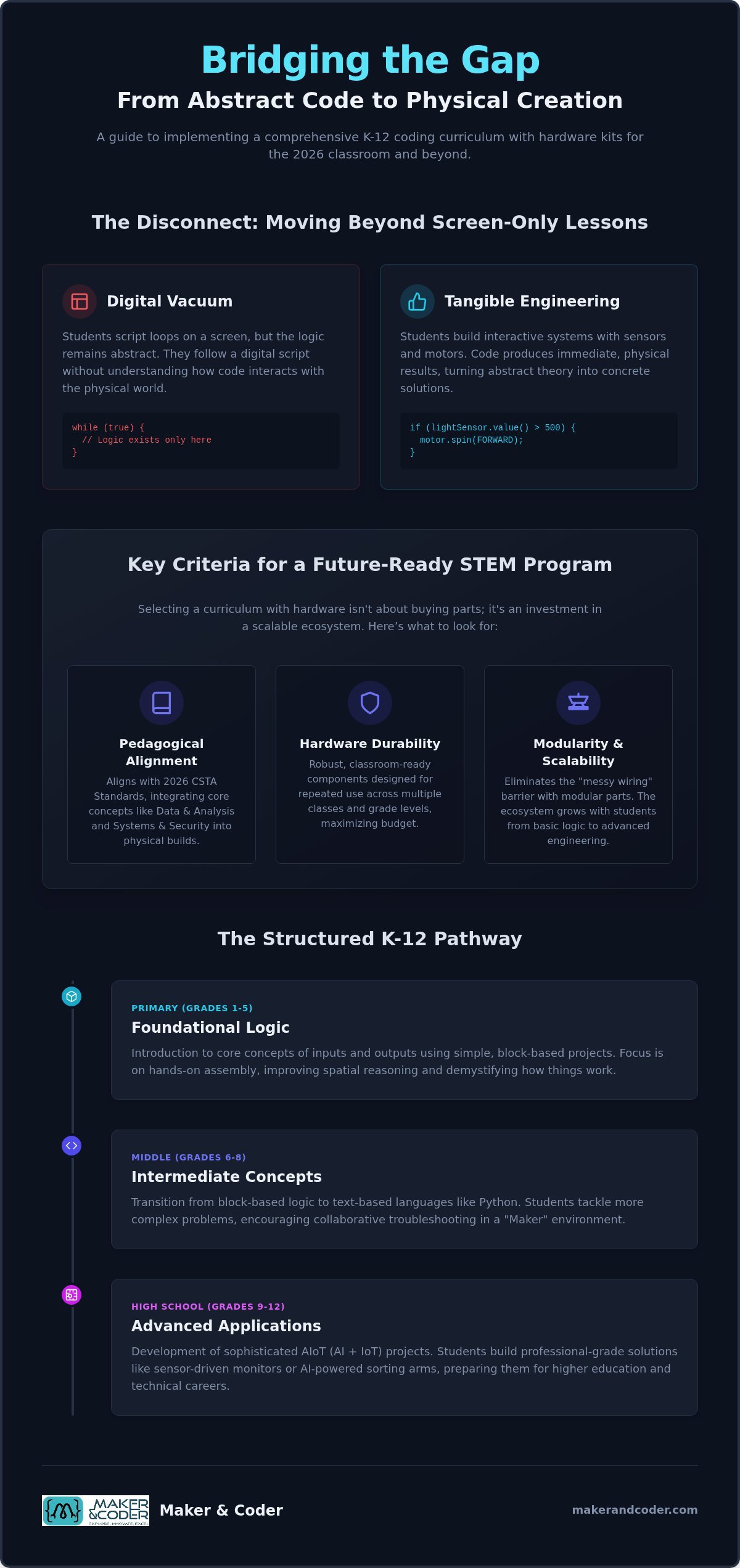
The 2026 update to the CSTA K-12 Computer Science Standards marks a pivotal shift in how we approach technology in schools. It’s no longer enough to move blocks on a screen in a digital vacuum. Modern education demands a bridge between the digital and the physical. By adopting a robust coding curriculum with hardware kits, schools move from abstract theory to tangible engineering. This integration ensures that students don’t just learn about algorithms; they see those algorithms interact with the real world through sensors, motors, and controllers. It’s the difference between reading about gravity and feeling a weight in your hand.
Defining Physical Computing in the Classroom
Physical computing is the design and construction of interactive systems that use software and hardware to sense and respond to the analog world. In a classroom setting, this creates a powerful, immediate feedback loop. A student writes a line of code, uploads it to a microcontroller, and observes a physical result, like a light sensor triggering a motor. This process demystifies how modern technology works, from smart thermostats to industrial robotics. It transforms a passive screen experience into an active engineering challenge.
As students progress, they often transition through various educational programming languages to manage these interactions. They move from simple block-based logic to sophisticated Python-powered control. This journey allows learners to master the core concepts of inputs and outputs without getting bogged down in complex circuitry early on. Utilizing a specialized coding curriculum with hardware kits, such as the MC 4.0 ecosystem, provides a professional-grade foundation that grows with the student. It shifts the focus from “how do I plug this in?” to “what can I create?”
The Impact on Student Engagement and Retention
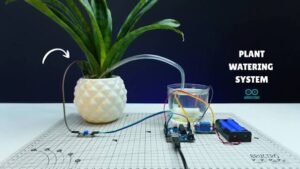
One of the greatest hurdles in STEM education is the “why” factor. Students often lose interest when code exists only as text on a monitor. Physical hardware solves this by providing visible, high-stakes outcomes. When a student builds a sensor-driven garden monitor or an AI-powered sorting arm, the logic becomes concrete. They aren’t just solving a puzzle; they’re building a solution.
- Cognitive Development: Hands-on assembly improves spatial reasoning and fine motor skills, which are essential for early learners.
- Collaborative Problem Solving: Hardware projects naturally encourage a “Maker” mindset. Students work in teams to troubleshoot physical and digital hurdles, mimicking real-world engineering environments.
- Real-World Context: Students see the direct application of their work, which significantly boosts long-term retention of complex concepts like variables and loops.
By grounding software lessons in physical reality, educators provide peace of mind that students are developing authentic, future-ready skills. Explore our range of tools in the Maker & Coder shop to see how these kits transform the learning experience. This approach doesn’t just teach kids how to code. It teaches them how to build the world of tomorrow.
Key Criteria for Selecting a Coding Curriculum with Hardware Kits
Selecting the right coding curriculum with hardware kits requires a shift in perspective. It’s not about buying a box of parts; it’s about investing in a scalable ecosystem. In light of the CSTA K-12 Computer Science Standards revision scheduled for summer 2026, your choice must align with core concepts like Data & Analysis and Systems & Security. A curriculum that fails to integrate these into physical builds leaves students unprepared for the technical rigors of higher education. You need a solution that balances professional-grade power with classroom simplicity.
Durability and modularity are the lifeblood of a sustainable STEM program. If a kit requires delicate wiring that breaks after two uses, it isn’t classroom-ready. Look for systems like MC Blocks that allow for infinite experimentation without the “messy wiring” barrier. This modularity ensures that the same kit can be reused across multiple classes and grade levels, maximizing your budget. Scalability is equally vital. The ecosystem should grow with the student, moving seamlessly from Grade 1 foundational logic to complex Grade 12 engineering projects.
Curriculum Breadth vs. Depth
A high-quality curriculum provides a structured pathway rather than a collection of “one-off” projects. While a single robot build might engage a student for an hour, it rarely builds long-term technical literacy. The most effective programs integrate cross-curricular STEAM topics, connecting coding to Math, Science, and even Art. This depth ensures students understand the “how” and the “why” behind every line of code. It transforms a simple lesson into a comprehensive engineering experience that sticks with them for years.
Advanced Features: AIoT and Machine Learning
Preparing students for the 2026 tech landscape means moving beyond basic loops. Modern hardware must support Artificial Intelligence and the Internet of Things (AIoT). By using sensors for light, sound, and motion, students can engage in data-driven coding that mirrors real-world industry applications. They learn to build systems that don’t just follow instructions but react intelligently to their environment. This level of sophistication is what separates a toy from a true educational tool.
Teacher support remains the final, most critical piece of the puzzle. Even the best hardware fails if the staff feels overwhelmed. Ensure your chosen provider offers comprehensive lesson plans, slide decks, and professional development. If you’re looking for guidance on how to integrate these advanced features into your specific school environment, you can reach out to our educational consultants for a tailored implementation plan. Success in the classroom starts with empowering the person at the front of it.
Modular vs. Fixed Hardware: A Framework for Scalability
Imagine a 45-minute classroom period where 30 minutes are spent untangling jumper wires and debugging loose connections. This is the “messy wiring” barrier that often stalls progress in technical education. When selecting a coding curriculum with hardware kits, the choice between fixed “all-in-one” boards and modular component systems determines whether your STEM program thrives or plateaus. Fixed boards offer a low entry barrier but frequently lack the technical depth required for middle and high school students. In contrast, a modular ecosystem allows students to build, break, and iterate with professional-grade flexibility.
Reusing a central controller across different project kits is the cornerstone of cost-efficiency. By utilizing the MC4.0 Controller as the brain for the MC4.0 Base Kit, the MC4.0 AIoT Kit, and the MC4.0 STEAM Kit, schools can maximize their investment. This approach ensures that the hardware remains relevant as students’ skills evolve from basic logic to complex data analysis. It future-proofs the lab by supporting multiple software languages, ensuring your equipment doesn’t become obsolete when the next coding trend emerges. Standardizing on a single, powerful platform provides the peace of mind that educators need to focus on teaching rather than troubleshooting.
The Power of the Modular Controller
The controller is the heart of the ecosystem. Unlike generic microcontrollers that require complex breadboarding, the MC4.0 Controller centralizes logic while maintaining classroom simplicity. It acts as a bridge between simple block-based coding and advanced Python applications. This consistency standardizes the learning curve for teachers across different grade levels. Once a staff member masters the core controller, they can confidently lead lessons in any grade, from primary to secondary, without relearning a new platform every semester.
MC Blocks and Rapid Prototyping
Iterative design is the soul of engineering. MC Blocks offer a “snap-and-code” advantage that empowers younger learners to see immediate results. They can experiment with sensors and actuators without the frustration of broken connections or incorrect pinouts. This encourages a bold, innovative spirit, allowing students to focus on the logic of their projects rather than the mechanics of a wire. As students mature, they naturally transition from these modular blocks to professional electronic components, preparing them for real-world technical challenges. Explore the possibilities in the Maker & Coder shop to see how these blocks simplify the path to innovation.
From Setup to Success: Implementing Hardware Kits in the Classroom
Audit your infrastructure before you buy. Successful implementation of a coding curriculum with hardware kits demands a methodical approach that respects both the teacher’s time and the student’s curiosity. Begin by assessing your current STEM readiness. Check your Wi-Fi stability, the number of available power outlets, and the comfort level of your instructional staff. A high-tech lab is only as effective as the network supporting it and the educators leading it. Once you’ve established a baseline, you can move from procurement to active learning.
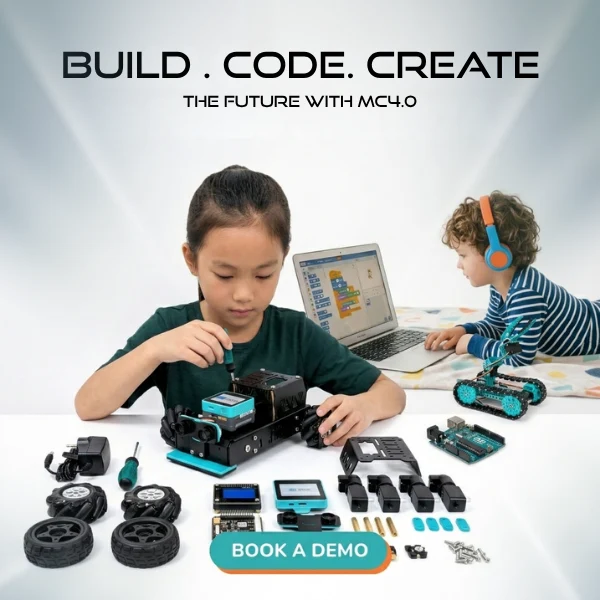
Selecting the right hardware is the next critical hurdle. For foundational years, the MC4.0 Base Kit offers an accessible entry point that builds confidence without overwhelming the learner. As students progress toward middle and high school, introduce specialized kits like the MC4.0 AIoT Kit or the MC4.0 STEAM Kit. This tiered approach prevents cognitive overload and maintains a steady trajectory toward technical mastery. Logistics also require a dedicated plan. Designate clear storage zones, use labeled bins for MC Blocks, and ensure charging stations are easily accessible. Inventory management should be a weekly routine to keep the lab running smoothly.
Empowering Educators through Training
Teacher training is the single biggest predictor of student success in any technical program. Many educators feel “tech phobia” when faced with microcontrollers and sensors. Our Teacher Training Programs bridge this gap by providing professional development that transforms anxiety into expertise. By utilizing pre-made slide decks and comprehensive teacher guides, staff can significantly reduce their prep time. This allows them to focus on facilitating discovery rather than troubleshooting basic connectivity issues. Building a community of practice among your STEM staff ensures that knowledge is shared and innovation is sustained across the district.
Classroom Management for Hardware Kits
Efficiency is everything in a 45-minute lab period. Organize your hardware for rapid distribution and cleanup to maximize instructional time. We recommend creating student-led “Tech Support” teams to handle minor troubleshooting. This doesn’t just free the teacher; it empowers students to take ownership of their learning environment. When it comes to assessment, move beyond the “Does it work?” grade. Evaluate the efficiency of the code, the creativity of the hardware assembly, and the student’s ability to iterate after a failure. Launching your coding curriculum with hardware kits with a “Capstone Project” mindset encourages students to view their work as a contribution to the real world.
Ready to transform your school’s technical pathway? Contact our implementation specialists today to design a custom roadmap for your district’s 2026 STEM goals.
The Maker & Coder Ecosystem: MC 4.0 and Beyond
The Maker & Coder ecosystem represents a paradigm shift in STEM education. Instead of treating hardware as an afterthought, we provide a unified platform where software and physical engineering evolve together. At the center of this transformation is the MC4.0 Controller. It delivers professional-grade power within a framework of classroom simplicity. This isn’t a toy; it’s a bridge to the future. By adopting our coding curriculum with hardware kits, you ensure that your students are prepared for the technical demands of 2026 and beyond. We don’t just provide tools. We provide a structured K-12 ecosystem that grows alongside your learners.
The MC Curriculum offers a comprehensive K-12 pathway designed to eliminate the gaps in traditional STEM programs. We’ve moved away from isolated projects toward a continuous journey of discovery. Every grade level builds upon the last, ensuring that technical literacy becomes a permanent asset for every learner. This structured approach provides educators with the peace of mind that their students are meeting the latest standards while exploring the limits of their creativity. It’s a visionary partnership that prioritizes long-term growth over short-term engagement.
Choosing Your Pathway: Base, AIoT, or STEAM?
Selecting the right entry point is crucial for classroom success. The MC4.0 Base Kit focuses on mastering the fundamentals of physical computing. It’s the perfect starting point for students to understand how code translates into movement and light. For those ready to explore connectivity, the MC4.0 AIoT Kit connects the classroom to the digital future. It introduces the Internet of Things, allowing students to build smart systems that interact across networks. This pathway transforms abstract data into tangible solutions.
The MC4.0 STEAM Kit integrates creativity with technical precision. It’s designed for students who want to push the boundaries of engineering by combining art, science, and advanced coding. Each kit is built around the same modular philosophy, ensuring that your investment remains relevant as your students’ ambitions grow. You can scale your lab one kit at a time, knowing each component works within a single, powerful coding curriculum with hardware kits.
Getting Started with Maker & Coder
Integration is seamless. You can easily incorporate MC Blocks into your existing computer science program to add a hands-on dimension to theoretical lessons. These modular components remove the frustration of complex wiring, allowing for rapid prototyping and iterative design. If you’re looking to expand your lab or scale your program, you can access the Maker & Coder Shop for kit upgrades and additional controllers. This ensures your lab stays current with the latest technical advancements.
Joining Maker & Coder means becoming part of a global network of educators redefining STEM literacy. We’re more than just a hardware provider; we’re a dedicated educational partner invested in the success of the next generation. Start your journey today. Empower your students to build the real-world projects that will shape tomorrow.
Empower the Next Generation of Innovators
Transitioning from abstract code to tangible creation is the defining challenge of modern STEM education. By implementing a structured coding curriculum with hardware kits, you provide students with the tools to solve real-world problems through logic and engineering. We’ve explored how modularity prevents classroom frustration and how a tiered pathway ensures every learner finds their creative voice. This journey from basic logic to advanced AIoT applications prepares students for a landscape that values both digital literacy and physical ingenuity. It’s about moving beyond the screen to build something that matters.
Success in the lab isn’t just about the hardware; it’s about the ecosystem supporting it. Our K-12 Aligned MC Curriculum and Professional Teacher Training Programs ensure your staff feels confident, while modular MC Blocks for rapid prototyping allow students to experiment without limits. You have the power to turn your classroom into a hub of visionary discovery. Explore the MC 4.0 Ecosystem and K-12 Curriculum to begin your district’s transformation today. The future of technology is physical, and it’s time to build it together.
Frequently Asked Questions
What is the best age to start a coding curriculum with hardware kits?
Students as young as seven, typically in Grade 2, can begin using a coding curriculum with hardware kits to explore physical computing. At this stage, learners possess the motor skills for modular assembly and the cognitive readiness for basic block-based logic. The MC 4.0 platform is specifically engineered for students aged 7 to 15, ensuring the complexity scales as they grow. Starting early builds a durable foundation for future AI and engineering mastery.
Do teachers need a computer science degree to use these hardware kits?
No, a specialized degree isn’t required to lead a successful STEM classroom. Our Teacher Training Programs provide the technical foundation and pedagogical strategies needed to guide students through complex projects. We provide pre-made slide decks and comprehensive lesson plans that reduce prep time and eliminate technical anxiety. This turn-key approach empowers educators from all backgrounds to become confident mentors in the high-tech lab environment.
How do modular MC Blocks differ from standard electronic components?
Modular MC Blocks eliminate the “messy wiring” barrier found in standard electronic components like breadboards and jumper wires. They utilize a secure, snap-together design that allows for rapid prototyping without the risk of broken connections or incorrect pinouts. This modularity ensures that students focus on the logic of their coding curriculum with hardware kits rather than the mechanics of circuitry. It’s a cleaner, faster, and more reliable way to build.
Can the MC 4.0 hardware be used with both Block-based and Python coding?
Yes, the MC 4.0 Controller is designed to support a multi-language learning pathway. Students typically begin with block-based Scratch logic to understand core concepts before transitioning to text-based Python as their skills mature. The platform also supports Arduino for advanced engineering applications. This versatility ensures that your hardware investment remains relevant from primary school through the end of secondary education without needing separate devices for each language.
What is included in a typical K-12 coding curriculum for schools?
A comprehensive K-12 curriculum includes structured lesson plans, student workbooks, and interactive slide decks aligned with the 2026 CSTA standards. It provides a clear project pathway from foundational logic to advanced AIoT and STEAM excellence. Teachers receive assessment rubrics and troubleshooting guides to manage the classroom effectively. This ecosystem ensures that every grade level has a specific, age-appropriate roadmap that builds toward professional-grade technical literacy.
How long does it take to implement a hardware-integrated coding program?
Implementation can happen in as little as four to six weeks with a dedicated strategy. This timeline includes auditing your current STEM infrastructure, selecting your initial MC4.0 Base Kits, and completing staff professional development. While full K-12 integration is a multi-year journey, the turn-key nature of our curriculum allows schools to launch pilot programs quickly. The goal is to build momentum through early success and scale as teacher confidence grows.
Are hardware kits compatible with Chromebooks and tablets?
Yes, the MC 4.0 platform is fully compatible with the hardware most common in modern schools, including Chromebooks and tablets. The web-based coding environment ensures that students can write and upload code without installing complex software or drivers. This accessibility is vital for schools with 1:1 device programs, as it allows for a seamless transition between digital lessons and physical hardware interaction regardless of the operating system.
How do I justify the cost of hardware kits to school administration?
Justify the investment by highlighting the long-term durability and K-12 scalability of the ecosystem. Unlike single-use toys, these kits are modular tools that serve multiple grade levels for years. Emphasize alignment with the updated 2026 educational standards and the potential for federal STEM funding or foundation grants. Demonstrating a clear pathway to real-world AIoT skills shows administrators that you aren’t just buying equipment; you’re investing in student future-readiness.