Most robotics kits are designed to be played with for an afternoon and then abandoned once the novelty of moving a plastic block wears off. If you’re looking for the best robotics kit for kids in 2026, you’ve likely realized that a simple toy isn’t enough to prepare a student for a future defined by AI and machine learning. You want tools that don’t just entertain; you want tools that empower. It’s about moving from passive consumption to active creation.
We agree that the jump from visual blocks to professional code shouldn’t feel like hitting a brick wall. You deserve a clear pathway that supports every step of the journey. This guide promises to show you how to transition from elementary play to high-school level Python 3.14 mastery with the right robotics ecosystem. We’ll explore hardware that integrates with modern AIoT tech, structured curriculum support, and how to align with the latest 2026 CSTA standards to ensure your learners are truly future-ready. Discover how to build a reliable bridge from the classroom to the cutting edge of modern technology.
Key Takeaways
- Understand the shift from simple toys to professional-grade tools by identifying why a 2026 robotics kit for kids must integrate mechanical engineering, coding, and AI literacy.
- Identify the core components of high-performance hardware, focusing on modular MC Blocks and powerful microcontrollers that grow alongside a student’s evolving skills.
- Bridge the gap between visual logic and text-based mastery by following a structured pathway from block-based coding to industry-standard Python.
- Align your educational goals with national STEAM standards using the structured K-12 MC Curriculum for scalable and measurable classroom success.
- Future-proof your learning environment with an integrated ecosystem like MC 4.0, moving from foundational mechanics to advanced AIoT and smart-system experimentation.
The Evolution of STEM: Why a Robotics Kit for Kids is Essential in 2026
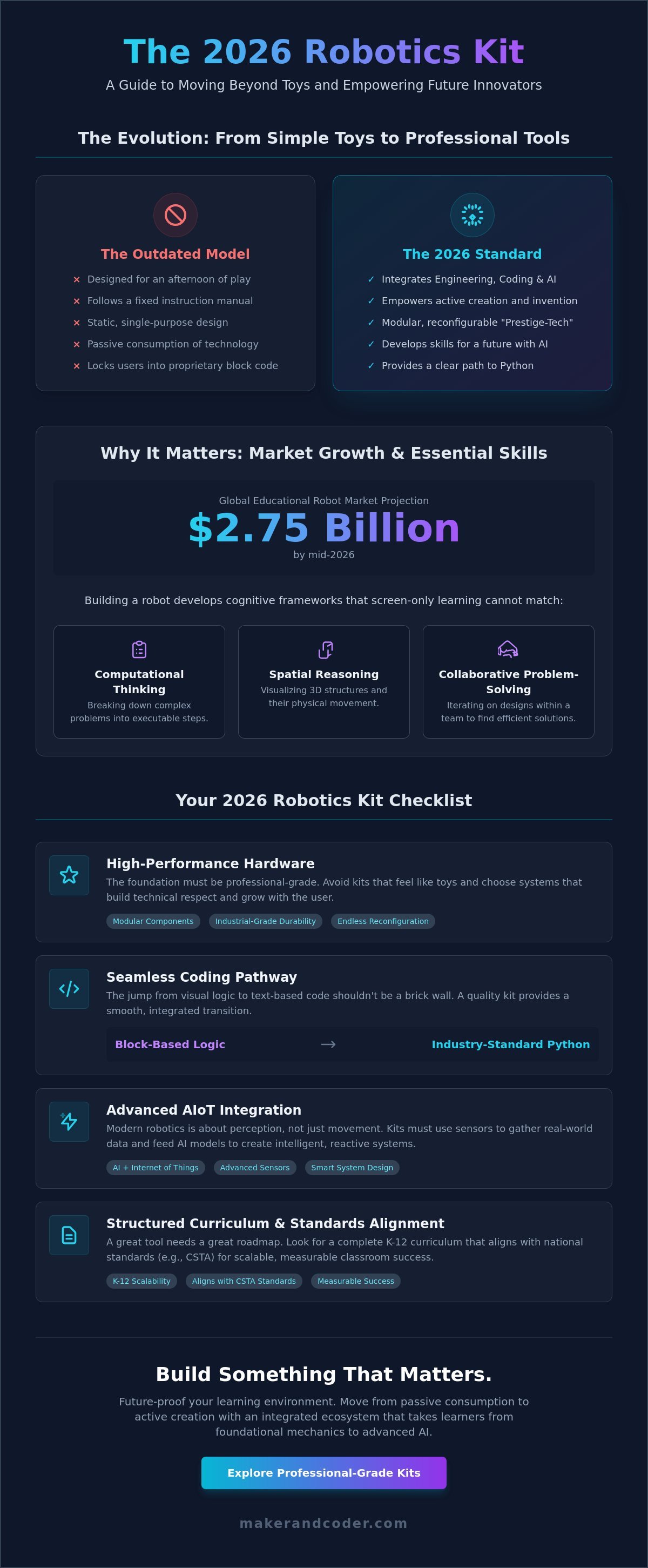
The definition of educational technology has fundamentally shifted. In 2026, a robotics kit for kids is no longer just a motorized toy with a remote control; it is a sophisticated, multidisciplinary vehicle for learning. It merges mechanical engineering, complex coding, and AI literacy into a single, cohesive experience. For a comprehensive overview of educational robotics, one can see how the field has grown from simple automation to these integrated systems. This evolution marks the “Prestige-Tech” era. Modern kits must mirror industrial standards to be effective. If students use hardware that feels like a toy, they won’t develop the technical respect required for professional-grade execution.
By mid-2026, the global educational robot market is projected to reach up to $2.75 billion. This growth reflects a clear reality: basic coding literacy is no longer a competitive advantage. It is the baseline. Students now need to understand how software interacts with physical environments. Building a robot develops essential cognitive frameworks that traditional screen-only learning cannot match. These include:
- Computational Thinking: Breaking down complex problems into executable steps.
- Spatial Reasoning: Visualizing three-dimensional structures and their movement.
- Collaborative Problem-Solving: Iterating on designs within a team to find the most efficient solution.
Transform your approach to STEM by choosing tools that challenge the mind. Move from passive observation to active engineering. When a student builds something tangible, they aren’t just learning a skill; they’re gaining the confidence to shape the future.
Beyond Basic Coding: The Rise of AIoT
The future is connected. AIoT, or the intersection of Artificial Intelligence and the Internet of Things, is the new standard for advanced learning. Modern robotics kits act as data collection points. They use advanced sensors to gather information from the real world, which is then fed into AI models for processing. This isn’t just about making a robot move. It’s about teaching it to perceive. Understanding how a sensor interprets light, distance, or sound allows students to build systems that react intelligently to their surroundings. It’s the first step toward mastering the systems that run our modern world.
The “Expert-as-Enabler” Philosophy
Technology should empower creative expression rather than just demanding that a user follow instructions. We believe in the “expert-as-enabler” approach. This philosophy treats the educator or parent as a mentor who provides the tools for discovery. Modular hardware, such as MC Blocks, allows for tangible building that builds immediate confidence. It moves the learner from a state of curiosity to a state of action. You aren’t just teaching them to code; you’re teaching them to invent. Explore our professional-grade tools in the Maker and Coder shop to see this philosophy in action. Build something real. Build something that matters.
Evaluating Quality: What to Look for in a Modern Robotics Kit
Selecting a high-caliber robotics kit for kids in 2026 requires looking past aesthetic appeal to the internal architecture of the system. You aren’t just buying a toy; you’re investing in an engineering platform. The quality of this platform determines whether a student merely follows a manual or learns to innovate. High-performance hardware is the new standard. Look for kits that prioritize modularity and industrial-grade durability. Static, single-purpose designs are quickly outgrown. Instead, choose systems that utilize interchangeable components like MC Blocks. This modular approach allows for endless reconfiguration, ensuring the kit remains relevant as projects grow in complexity. Explore the high-performance components available in our online shop to see how professional hardware makes a difference.
Software compatibility is equally vital. A professional-grade kit must bridge the gap between visual logic and text-based coding. If a system locks a user into a proprietary block language without a path to Python, it limits their growth. High-quality kits provide a seamless transition, allowing learners to see how their visual blocks translate into real code. This alignment is crucial when considering the broader context of automation and the future skills gap. By using tools that mirror industry standards, students gain the technical respect required for future success.
The Controller: The Heart of the Machine
The brain of any robot is its microcontroller. The MC4.0 Controller is specifically engineered for high-level technical education. It isn’t just a simple circuit board. It’s a robust hub featuring integrated Wi-Fi and Bluetooth for modern connectivity. These features allow robots to interact with other devices and the cloud, a staple of AIoT experimentation. Ensure your kit has multiple input and output ports. This capacity allows for the simultaneous use of various sensors and actuators, enabling the creation of truly complex systems.
Sensors and Actuators: Interacting with the World
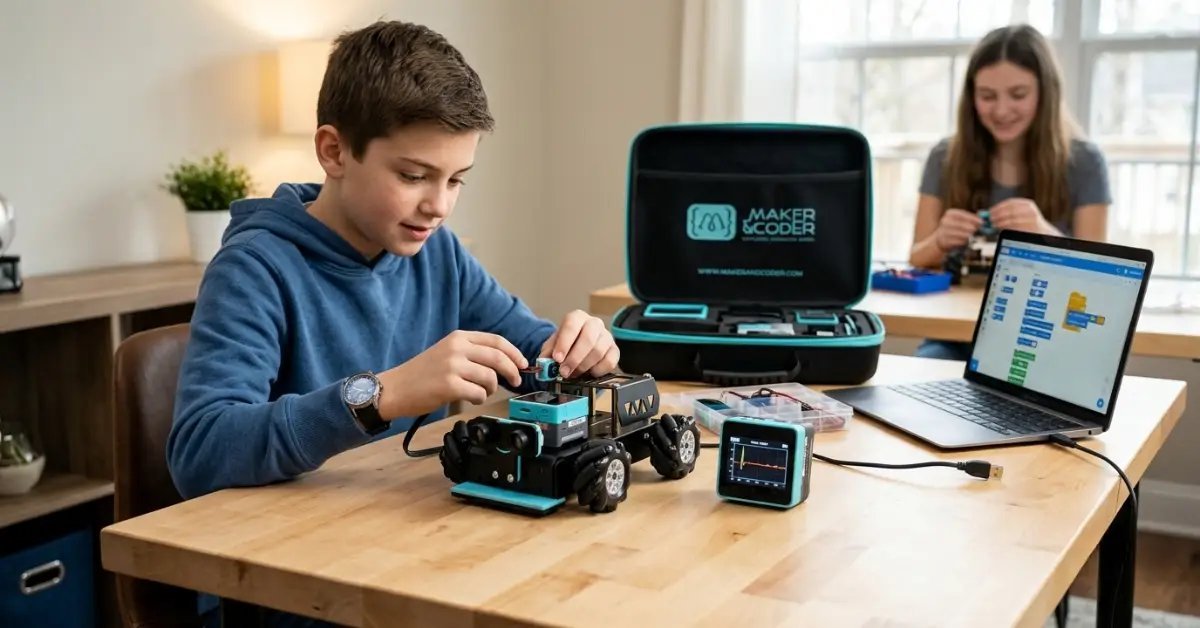
Precision is the hallmark of professional robotics. Move away from simple DC motors and toward precision servos that offer exact control over movement. A modern robotics kit for kids should include a diverse array of sensors, such as ultrasonic, infrared, and environmental data sensors. These components allow the robot to perceive its surroundings with accuracy. Modular blocks simplify the wiring process, which is especially helpful for younger students. This ease of assembly doesn’t sacrifice technical depth; it simply removes the barrier to entry for complex builds. If you need guidance on selecting the right configuration for your classroom, feel free to get in touch with our team.
From Blocks to Python: Bridging the Coding Learning Curve
The journey from a novice builder to a professional engineer is often stalled by a single hurdle: the transition from visual logic to text-based syntax. Many beginners feel comfortable with drag-and-drop interfaces but find the jump to a blank text editor intimidating. A high-quality robotics kit for kids must act as a functional bridge between these two worlds. It’s about moving from “what” the robot does to “how” the code executes. In 2026, this pathway is more critical than ever as industry standards demand more than just basic logic. You need a platform that allows for simultaneous viewing of blocks and code. This transparency helps learners visualize how a single logic block translates into specific lines of Python, demystifying the complexity of professional programming.
Python 3.14.6 stands as the global industry standard for AI and robotics development. It’s the language of choice for data scientists and automation engineers alike. By integrating this language into the learning process early, you ensure that a student’s skills remain relevant long after they leave the classroom. We often hear the objection that text-based coding is too difficult for younger learners. However, the difficulty usually lies in the lack of a structured transition, not the code itself. When the hardware and software are designed to grow together, the shift feels like a natural evolution rather than a daunting challenge. Empower your students to master the tools used by experts today.
Visual Logic: Building the Foundation
Block-based coding is the essential first step in the robotics journey. It allows students to master algorithmic thinking without the frustration of syntax errors or missing semicolons. By using visual blocks to control complex hardware movements, learners gain immediate feedback and “quick wins” that build essential confidence. This foundation isn’t just child’s play; it’s the architectural blueprint for all future programming. It teaches the core principles of loops, variables, and conditional logic in a tangible, accessible way. Start with logic, then move to language.
Professional Execution with Python
Once the foundation is secure, the MC 4.0 ecosystem facilitates a seamless transition to professional execution. This stage involves moving beyond simple movements to advanced AI data processing and autonomous decision-making. The hardware is designed to handle the sophisticated demands of Python, ensuring that the machine can keep up with the mind of the creator. It’s the difference between following a script and writing a new future. Python serves as the definitive technical bridge that connects classroom experimentation to high-level engineering careers in AI and autonomous systems. Invest in a robotics kit for kids that provides a clear trajectory toward professional mastery.
Implementing Robotics in the K-12 Classroom
Robotics education fails when it exists in a vacuum. A robotics kit for kids should be the centerpiece of a comprehensive learning strategy, not a Friday afternoon distraction. Scalable learning requires a structured MC Curriculum (K-12) that aligns with national STEAM standards. This approach ensures that every lesson builds on the last. It moves students from basic mechanical assembly to complex autonomous systems over several years. By adopting a multi-year pathway, schools can ensure students meet the rigorous 2026 CSTA K-12 Computer Science Standards while developing real-world engineering skills.
Managing a robotics lab requires more than just purchasing hardware. It demands a system for organized storage and consistent maintenance to protect your investment. Encourage student collaboration by assigning roles within teams, mirroring industrial engineering environments. This builds interpersonal soft skills alongside technical mastery. When students work together to solve a sensor calibration issue, they aren’t just fixing a robot. They’re learning the iterative process of modern innovation. Transition from a messy toy box to a professional laboratory environment.
Curriculum Alignment and Lesson Planning
Integrate robotics into existing math, science, and art classes to provide context for abstract concepts. Use a multi-year pathway to deepen understanding instead of relying on one-off projects. Assess student progress through hands-on demonstrations and functional prototypes rather than traditional tests. This allows learners to showcase their ability to troubleshoot and iterate in real-time. It turns the classroom into a dynamic incubator for future ready talent. Move from theory to practice with structured lesson plans that challenge every grade level.
Empowering Educators through Training
Teacher training is the secret to STEM success. Many educators feel tech-anxiety when faced with advanced microcontrollers and Python scripts. Our Teacher Training Programs are designed to bridge this gap. We empower teachers to act as mentors, ensuring they feel confident leading a classroom. Proper training also increases hardware longevity. It teaches staff how to care for the MC 4.0 Kit and its modular components. Create a sustainable STEM culture that inspires both students and staff. Move from tech-anxiety to classroom authority with professional development that sticks.
Ready to transform your school’s technology program? Speak with our educational consultants to build a customized implementation plan for your district.
The Maker & Coder Ecosystem: Future-Proofing with MC 4.0
Selecting a robotics kit for kids is an investment in a child’s long-term cognitive development. It shouldn’t be a dead-end purchase. The MC 4.0 ecosystem represents a fundamental shift in how we approach technical education by providing a scalable hardware lifecycle. Unlike isolated products that are quickly outgrown, this system evolves with the learner. It moves from foundational mechanics to the complexities of artificial intelligence. At the center of this world sits the MC4.0 Controller. This universal hub serves as the engine for all MC Blocks, ensuring that hardware purchased today remains compatible with the advanced sensors of tomorrow. It’s a prestige-tech solution for a generation that demands more than just plastic toys.
The ecosystem offers specialized pathways to match different learning objectives. The MC4.0 Base Kit focuses on establishing core mechanical and logical foundations. For those ready to push into the next frontier, the MC4.0 AIoT Kit provides the tools for advanced smart-system experimentation. It allows students to build autonomous devices that interact with cloud data and real-world environments. Meanwhile, the MC4.0 STEAM Kit encourages creative, multidisciplinary builds by blending engineering with artistic expression. This variety ensures that every student finds a point of entry that sparks their unique curiosity. You aren’t just buying a kit; you’re joining a dedicated educational partnership.
Choosing Your Starting Point
Identify the right entry point based on the learner’s current experience level. Beginners should start with the MC4.0 Base Kit to master the basics of assembly and block-based logic. Middle-school students or those with prior experience will find the MC4.0 AIoT Kit more rewarding as they begin their journey into Python 3.14 and internet-connected systems. The MC4.0 STEAM Kit is ideal for classrooms looking to integrate robotics into broader art and design projects. Remember that your setup is never static. You can expand a basic configuration over time by adding specialized MC Blocks. Explore the full range of options and customize your experience at the Maker & Coder Shop.
Joining the Maker & Coder Community
Future-proofing your STEM program requires a unified ecosystem that supports long-term technical growth. We act as a dedicated partner in this journey, providing the hardware, curriculum, and support needed to succeed. This isn’t about following a single set of instructions. It’s about gaining the tools to invent something entirely new. We empower you to move from a state of curiosity to a state of professional mastery. The transition from play to professional-grade engineering starts here. Build the future today. Start your journey with a robotics kit for kids that grows as fast as they do.
Build the Future of STEM Mastery
The shift from a simple toy to a professional-grade engineering platform is a defining moment for any young learner. By selecting a high-caliber robotics kit for kids, you aren’t just providing an afternoon activity; you’re opening a gateway to future-ready skills. This journey requires a seamless pathway from block-based logic to advanced Python execution. It’s about hardware that handles the demands of modern AIoT experimentation while growing with the student’s mind.
Real success in STEM education stems from a holistic approach. It combines the MC 4.0 ecosystem with a Comprehensive K-12 MC Curriculum and Professional Teacher Training Programs. This combination ensures that educators feel confident and students remain challenged through advanced STEAM integration. You have the power to turn a classroom into a laboratory of innovation where the next generation of bold pioneers is born.
Take the first step toward professional mastery today. Equip your classroom or home with the MC 4.0 Ecosystem and watch curiosity transform into tangible creation. The future isn’t just something to watch. It’s something you build.
Frequently Asked Questions
What age is a robotics kit for kids appropriate for?
Robotics kits for kids are designed for learners across the K-12 spectrum, typically starting from age 8 through high school graduation. Younger students focus on mechanical assembly and visual logic with the MC4.0 Base Kit. Older learners tackle complex AIoT projects that require the sophisticated processing power of our advanced controllers and sensors.
Do I need prior coding experience to use a Maker & Coder kit?
No prior coding experience is required to begin your journey with our ecosystem. We’ve designed our platform to act as a supportive mentor, guiding beginners through intuitive block-based logic before introducing text-based syntax. This “from-to” approach ensures that anyone can start building immediately while maintaining a clear path toward professional mastery.
What is the difference between a toy robot and a STEM robotics kit?
A toy robot is a self-contained entertainment device with fixed functions, while a robotics kit for kids is a professional engineering platform. Toy robots offer limited interaction and closed software. In contrast, a true STEM kit provides modular components like MC Blocks and supports industry-standard coding languages to build real-world technical literacy.
How does robotics help with K-12 curriculum standards?
Robotics activities bridge the gap between abstract theory and tangible application by integrating math, physics, and computer science. Our MC Curriculum (K-12) is specifically mapped to national standards, including the 2026 CSTA updates. This ensures that every project develops measurable skills in computational thinking, spatial reasoning, and collaborative problem-solving.
Can these kits be used for remote or hybrid learning?
Yes, our kits are highly effective for remote and hybrid learning environments due to their modular design and cloud-compatible software. Students can build and test their designs at home while accessing structured digital lessons. This flexibility ensures that technical education remains accessible and consistent, regardless of the physical classroom setting.
What programming languages are supported by the MC4.0 Controller?
The MC4.0 Controller supports a seamless transition from visual, block-based coding to text-based Python 3.14. This dual-language support allows students to see their logic reflected in real code in real-time. It’s the definitive technical bridge that prepares learners for high-level engineering careers in AI and autonomous systems.
Is teacher training included with classroom robotics sets?
We provide comprehensive Teacher Training Programs to ensure every educator feels confident as a mentor in the classroom. These programs focus on overcoming tech-anxiety and mastering the implementation of the MC Curriculum. We believe that empowering teachers is the most effective way to create a sustainable and inspiring STEM culture.
How durable are the MC Blocks for repeated classroom use?
MC Blocks are engineered with high-grade materials specifically designed to withstand the rigors of a high-frequency classroom environment. They feature robust connection points that allow for thousands of assembly and reconfiguration cycles without losing precision. This professional-grade durability ensures that your investment continues to deliver value over multiple school years.