What if the change that gets more students involved in STEM isn’t a bigger project, but a stronger connection to their lives? If you’re wondering how to increase student engagement in STEM, you may be balancing a familiar challenge: abstract concepts can feel distant, while hands-on activities take planning to work across different skill levels. Participation isn’t just about who speaks up. It also shows in students’ questions, persistence, and willingness to try again.
Engagement grows when learners have a reason to care, room to make choices, and a clear way to see their progress. You don’t need a major overhaul to create those conditions. Small, purposeful changes can help more students contribute while keeping lessons manageable within classroom time and resources.
This guide shares practical ways to connect STEM concepts to authentic questions and student interests, structure hands-on work for a range of learners, and build an inclusive classroom where curiosity can take different forms. You’ll also learn how to look for observable evidence of engagement and use it to shape your next lesson.
Key Takeaways
- Look beyond visible participation. Notice students’ thinking, persistence, and connection to the learning goal.
- Anchor investigations in authentic questions, then guide learners to predict, test, observe, improve, and communicate.
- Vary participation options so students can build, sketch, write, explain, test, or reflect.
- Use brief check-ins and student feedback to identify what’s working and make focused adjustments to upcoming lessons.
- Start with one engagement barrier, try a practical strategy, and refine it with curriculum and educator preparation in mind.
How to Increase Student Engagement in STEM Starts With Understanding What It Means
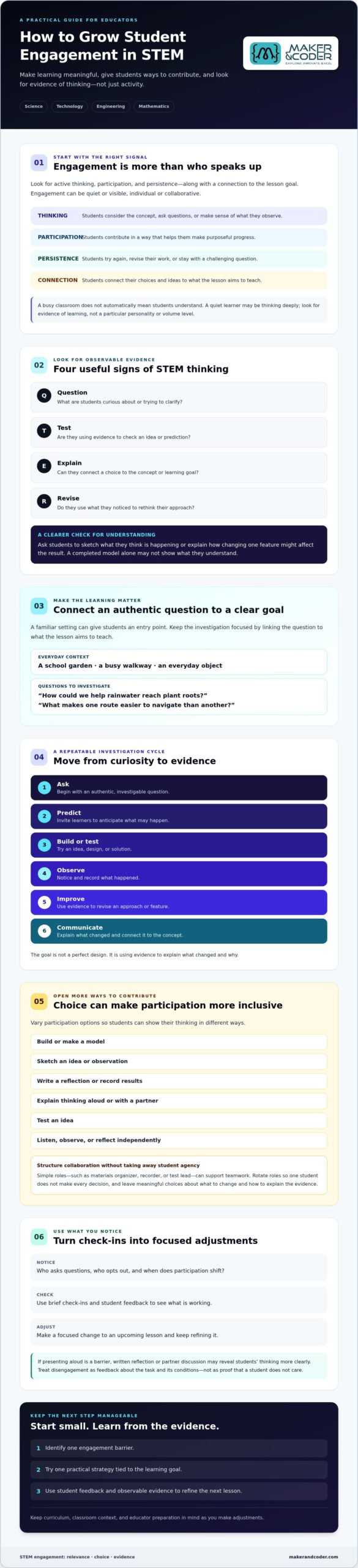
Before changing a lesson, clarify what you want students to engage with. STEM brings together science, technology, engineering, and mathematics, but students can encounter these fields in very different ways, from analyzing a pattern to designing a solution. To understand how to increase student engagement in STEM, look beyond whether learners are busy or following directions. Ask whether they’re thinking about the concept and making purposeful progress toward the learning goal.
Student engagement in STEM is the active thinking, participation, and persistence learners bring to a STEM task, along with their connection to what the lesson aims to teach. Engagement can be visible or quiet, individual or collaborative. A silent student may be considering a problem deeply, while an energetic group may be active without understanding the underlying idea.
What does student engagement in STEM look like?
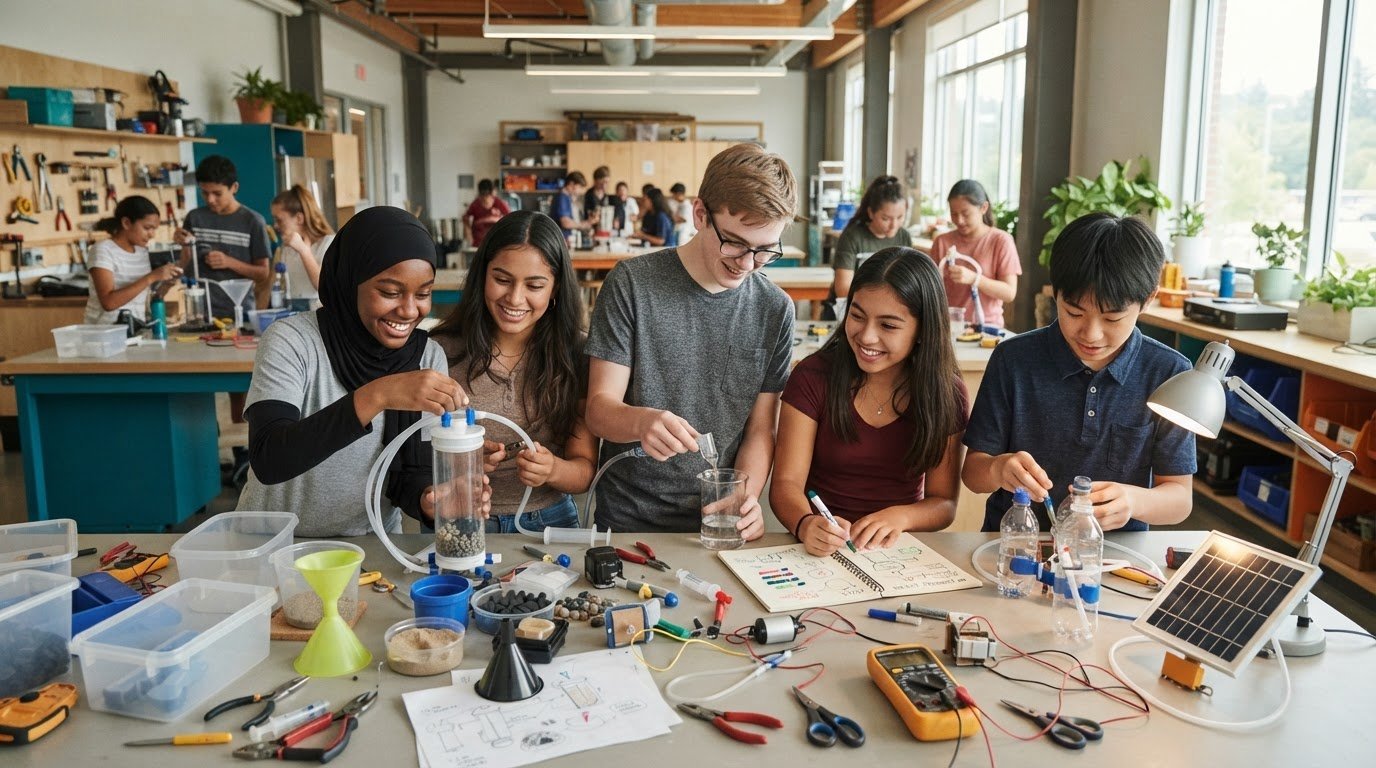
Look for evidence of thinking, not a particular personality or volume level. Students might ask a question, test a prediction, explain why they chose a design, or revise their work after an unexpected result. Listening closely, recording an observation, or reflecting independently can also show meaningful participation.
- Question: What are students curious about or trying to clarify?
- Test: Are they using evidence to check an idea?
- Explain: Can they connect a choice to the concept or goal?
- Revise: Do they use what they noticed to rethink their approach?
A completed model doesn’t automatically show that students understand the forces involved. Ask them to sketch what they think is happening or explain how changing one feature might affect the result. Their responses give you a clearer signal than activity alone.
Why can students disengage from STEM lessons?
A lesson may feel difficult to enter when its concepts seem abstract or disconnected from students’ experiences. Other possible barriers include fear of making a mistake, few opportunities to make choices, or a task with too few ways to contribute. These conditions can affect learners differently depending on age, subject, prior experience, and classroom context.
Notice patterns without labeling students as unmotivated. Who asks questions, who opts out, and when does participation shift? If learners hesitate when asked to present aloud, for instance, written reflection or partner discussion may reveal their thinking more clearly. Treat disengagement as feedback about the task and its conditions. That gives you a practical starting point for adjustment rather than a reason to assume a student doesn’t care.
Make STEM Learning Relevant, Hands-On, and Connected to Real Questions
Start with a question students can investigate, not a device or activity you want to use. A school garden, a busy walkway, or an everyday object can spark a STEM challenge. Ask, “How could we help rainwater reach plant roots?” or “What makes one route easier to navigate than another?” A relevant context gives students an entry point, while a clear learning goal keeps the investigation focused.
Then guide learners through a repeatable cycle: ask, predict, build or test, observe, improve, and communicate. Students might sketch a solution, test it with simple classroom materials, record what happened, and revise one feature. The aim isn’t to produce a perfect design. It’s to use evidence to explain what changed and connect that decision to the STEM concept.
Use project-based STEM to turn questions into investigations
Choose an open-ended challenge with more than one reasonable solution. Illustrative example: Ask teams to design a tabletop route that lets a small object travel from one point to another while crossing a gap. Students can predict which design will work, build and test a version, note where it succeeds or stalls, and revise it. Depending on the lesson goal, they might explore forces, measurement, or material properties.
Give teams simple roles, such as materials organizer, recorder, or test lead, and rotate them so one student doesn’t make every decision. Roles organize collaboration, but students should still have meaningful choices about how to shape the route, what to change, and how to explain their evidence. Ask them to document revisions and link results to the concept being taught. The activity creates a reason to think, but it doesn’t prove learning by itself.
Connect STEM concepts to students’ lives and interests
Offer a choice of contexts, such as accessibility, energy use, transportation, or familiar everyday objects. A shared learning goal can support different entry points: one learner might investigate a ramp, another compare ways to reduce wasted energy, and another study how people move through a space. Invite students to bring in their interests without assuming that a student’s background or identity determines what they’ll enjoy.
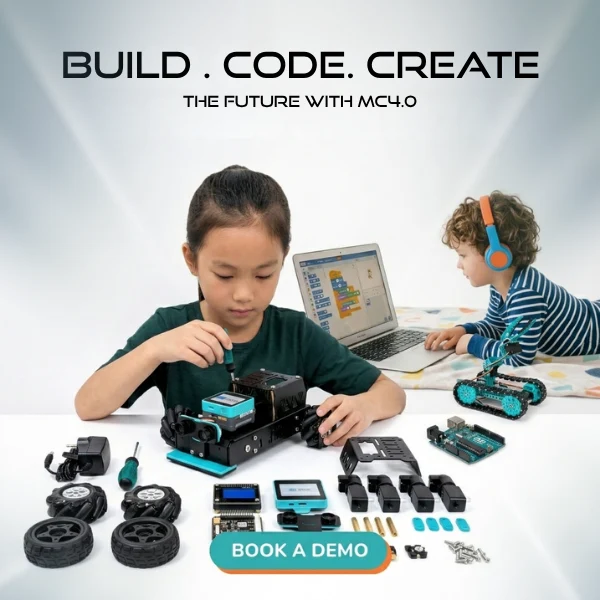
Materials should serve the investigation, not take it over. Paper prototypes, recycled items, or hands-on hardware can all make an abstract idea tangible when they fit the objective. For educators considering classroom equipment, Maker & Coder’s MC 4.0 hardware and kits are one option to explore. Its MC 4.0 platform and curriculum are designed to work together, so consider how equipment, lesson purpose, and teacher preparation fit your classroom.
For a broader framework, America’s Strategy for STEM Education outlines national goals that include building STEM literacy and broadening participation. Bring that ambition down to the classroom scale: select a meaningful question, identify the concept students should learn, and choose only the materials that help them investigate it.
Increase Participation With Choice, Collaboration, and Inclusive STEM Activities
One participation format won’t work equally well for every learner or every task. A student may think deeply during solo exploration, contribute more readily with a partner, or prefer to write an idea before discussing it with the class. To increase student engagement in STEM, design more than one way into the work. Then notice who contributes and whose thinking remains hard to see.
| Format | When it can support participation | What to monitor |
|---|---|---|
| Solo exploration | When students need time to think, sketch, or test an idea independently. | Are learners making progress, or do they need a clearer starting point? |
| Pairs | When talking through a prediction or comparing approaches feels easier with one peer. | Are both partners sharing ideas and handling materials? |
| Small teams | When a task benefits from combining different perspectives and contributions. | Are roles meaningful, or is one student directing the whole task? |
| Whole-class discussion | When learners can compare evidence, ask questions, or reflect on different solutions. | Are several voices represented, with ways to contribute beyond speaking aloud? |
Offer structured choice without losing the learning goal
Choice creates room for agency, but works best within clear boundaries. Let students select a project context, question, role, or way to present evidence while keeping the core concept and success criteria consistent. For example, learners studying measurement might choose what to measure or whether to report findings in a diagram or short explanation. All students still demonstrate how they measured and compared results.
Use Universal Design for Learning (UDL) as a planning lens. Consider whether students have varied ways to engage with a task and show what they understand. Choice isn’t about lowering expectations or creating a separate standard for each learner. It helps remove unnecessary barriers while keeping the intended learning in focus.
Build collaboration where every learner has a meaningful role
Rotate roles such as designer, builder, tester, recorder, and presenter so learners can contribute in different ways over time. Add brief checkpoints where each student records a prediction, identifies evidence, or explains one decision. This makes individual thinking visible alongside group progress.
Give students language to get started: “I predict…,” “Our evidence suggests…,” or “I’d change… because….” Learners can say a response, write it, sketch it, or share it with a partner before a larger discussion. Inclusive design isn’t one special activity format. It’s an ongoing practice of adapting participation options to the learning goal, students, and classroom context, then checking whether everyone has a meaningful way to contribute.
Use Feedback and Quick Checks to See Whether STEM Engagement Is Growing
Enthusiasm can be hard to measure, and it isn’t the same as learning. A student who speaks often may still be unsure of the concept; a quiet learner may be testing ideas carefully. To see whether an engagement strategy is helping, gather small, purposeful clues about participation and understanding. Then use what you notice to make one practical adjustment.
Choose indicators that show meaningful participation
Before a lesson, name the learning goal and decide what evidence might show students are engaging with it. Look for actions such as asking a relevant question, testing an idea, explaining a choice, listening and responding to a peer, or revising work. Don’t treat any one action as proof of understanding. Pair participation observations with a brief check of the concept itself.
Try prompts tied directly to the lesson, such as:
- “What evidence supports your explanation?”
- “What would you change next, and why?”
- “Which part of today’s task helped you understand the concept?”
An exit ticket or short reflection can reveal what felt relevant, challenging, or unclear. Keep responses focused on improving the learning experience, not ranking students by how visibly they participate. Protect student privacy, collect only information you need, and follow your school’s procedures for storing or sharing classroom data.
Refine the lesson using student responses
Use this repeatable routine to connect observations to action:
- 1. Set a goal. State the concept students should understand and the participation you hope to make possible.
- 2. Observe participation. Note who asks, tests, explains, listens, or revises, and where participation appears to stall.
- 3. Gather student feedback. Use a quick prompt or exit ticket to ask what supported involvement and what created friction.
- 4. Adjust one element. Change a direction, grouping, choice, or response format when practical.
- 5. Reflect. Compare the new evidence with the original goal, then decide whether to keep, revise, or set aside the change.
For example, if learners can identify a concept in writing but hesitate to explain it aloud, offer partner discussion before whole-class sharing. Check whether the change gives more students a way to express their reasoning and whether their explanations show the intended understanding. Avoid measuring success by a vague expectation of excitement. Look for evidence connected to the goal.
Start small. Test a strategy in one lesson or activity, gather feedback, and refine it before expanding it across a course or school. This keeps improvement manageable and helps you distinguish a useful adjustment from one that simply adds another step.
Build a Sustainable STEM Engagement Plan With Curriculum and Teacher Support
Lasting change doesn’t require redesigning every STEM lesson at once. To explore how to increase student engagement in STEM, begin with one barrier you’ve observed, test a focused response, and learn from what happens. A manageable pilot helps you build from a classroom need instead of adding technology or activities without a clear purpose.
Start with a focused classroom pilot
Choose one class, learning goal, or short project where participation is difficult to access. If students struggle to connect a concept to an investigation, for example, try adding a student-selected question while keeping the learning goal consistent. Before starting, check the available materials, lesson time, accessibility needs, and support the teacher may need to facilitate the activity.
Use a simple first-month sequence:
- Identify: Name the participation barrier and the goal for student learning.
- Test: Try one strategy in a lesson or short project.
- Gather: Review student work, participation observations, and brief feedback.
- Refine: Adjust the approach, then decide whether it’s ready to adapt or expand.
Review what students demonstrate and report before scaling the approach. A strategy that suits one class may need adjustment for another group, subject, or set of classroom conditions.
Match tools and professional learning to the teaching goal
Choose equipment only when it supports the investigation or helps make student thinking visible. A hands-on build can give learners something tangible to test and revise, but the materials shouldn’t overshadow the concept. Before introducing a tool, ask: What will students learn with it? What evidence will show their thinking? Can the activity fit the time and resources available?
Purposeful curriculum and educator preparation help connect equipment to instruction. Maker & Coder’s K-12 MC Curriculum is designed to integrate with its MC 4.0 hardware platform, which includes a controller and modular MC Blocks. Its teacher training programs offer additional support for implementation. These are resources to consider when they fit a school’s goals. No tool replaces the teacher’s understanding of learners and lesson context.
Build from one clear classroom question to a repeatable approach: plan with the learning goal in view, prepare teachers and materials, then refine using student evidence. For schools considering how these supports might fit their STEM plans, Discuss STEM learning options for your school.
Make Your Next STEM Lesson a Starting Point
Student engagement grows when lessons connect to meaningful questions, give learners more than one way to participate, and make room to test and refine ideas. To decide how to increase student engagement in STEM, start with one classroom barrier, try a focused change, and use student work and feedback to guide what comes next.
Keep the learning goal at the center. The right mix of curriculum, equipment, and teacher preparation can help turn that goal into a practical classroom experience. Maker & Coder offers a structured K-12 MC Curriculum, teacher training programs to support classroom implementation, and an MC 4.0 ecosystem that includes hardware and modular MC Blocks.
If your school is exploring ways to align STEM resources with its teaching goals, discuss STEM learning options for your school. Start with one thoughtful step, learn from your students, and build from there.
Frequently Asked Questions
How can teachers increase student engagement in STEM?
Teachers can increase student engagement in STEM by anchoring lessons in relevant questions and letting students investigate through building, testing, or data collection. Offer meaningful choices, assign collaborative roles, and use quick feedback to identify confusion. Tie each activity to a clear learning goal, then observe who participates and how. Start with one manageable change, and use student reflections and work samples to decide what to refine next.
Why are students disengaged in STEM classes?
Students may disengage when content feels abstract, has little connection to their lives, or seems difficult to approach. Fear of making mistakes, limited choice, and activities that don’t fit learners’ needs can also create barriers. The reasons vary by student and classroom, so avoid assuming there’s one cause. Listen to learners and examine the lesson context, including its instructions, materials, and opportunities to contribute.
What are some engaging STEM activities for the classroom?
Try open-ended design challenges, simple investigations, data collection, prototyping, or projects based on everyday questions. Students might compare how different materials affect a structure or gather and interpret data about a familiar classroom process. Choose activities that require learners to apply or explain a STEM concept, not just complete a task. Adapt materials and complexity to your learning goals, available time, students’ needs, and accessibility requirements.
How do you make STEM lessons more inclusive?
Offer different ways to participate, such as building, sketching, writing, testing, or explaining, and structure team roles so each learner has a meaningful contribution. Provide supports such as sentence starters or clear task steps, and allow choices in project context or presentation. Inclusive planning anticipates varied needs rather than expecting everyone to engage in the same way. Ask students what supports their participation, then review their feedback.
Can technology improve student engagement in STEM?
Technology can support exploration, building, testing, and iteration when it serves a clear learning goal. It doesn’t guarantee engagement by itself. Before choosing a tool, consider whether students can access it, whether teachers have the preparation needed to use it, and whether the lesson design makes room for meaningful thinking. Plan alternatives where appropriate. Evaluate students’ reasoning and participation, not technology use alone.
How can teachers measure student engagement in STEM?
Combine observations of questions, participation, persistence, collaboration, and revisions with brief reflections or formative checks tied to the lesson goal. Engagement and achievement are related but distinct, so neither participation alone nor an assessment score tells the whole story. Look for patterns across learners and activities, then use them to adjust instruction. Protect student privacy, collect only appropriate information, and follow school procedures for classroom data.
How do you engage students who say they are not good at STEM?
Respond without reinforcing a fixed label. Emphasize that STEM involves trying ideas, testing evidence, and improving approaches, then offer an accessible starting point connected to a relevant context. Structured collaboration and different ways to show thinking can help students enter the task. Give specific feedback on strategies and progress rather than perceived ability. Invite learners to reflect on what they discovered through a challenge or revision.