The most expensive piece of equipment in your classroom isn’t the high-end 3D printer; it’s the stack of “one-and-done” robotics kits currently gathering dust in the storage closet. Finding the best STEM kits for schools requires looking beyond the initial excitement of a single project. You likely feel the frustration of hardware that doesn’t align with curriculum standards or technology that feels obsolete by the second semester. It’s overwhelming for teachers to constantly master new interfaces that offer no clear growth path for their learners.
You deserve a vision that transforms these isolated moments of discovery into a continuous journey toward technical literacy. This guide reveals how to move from basic block-based coding to sophisticated AI and IoT applications using a scalable, modular ecosystem. We will explore the leading solutions for 2026, such as the MC 4.0 platform, to help you establish a structured K-12 pathway. Discover how to equip your staff with professional training while providing students with the tools to build a tangible, tech-driven future.
Key Takeaways
- Transition your classroom focus from simple edutainment to genuine technical literacy when selecting the best STEM kits for schools.
- Discover how modular hardware like the MC 4.0 platform outlasts fixed-form robots by adapting to evolving classroom needs.
- Build a cohesive K-12 pathway that moves students confidently from foundational logic to advanced AIoT and Python applications.
- Eliminate teacher burnout with professional training and a structured curriculum designed to align hardware with academic standards.
- Maximize your school’s budget through a scalable ecosystem that simplifies IT support and long-term maintenance.
Table of Contents
- Defining Excellence: What Makes a STEM Kit 'Best' for School Environments in 2026?
- The Power of Modularity: Why the MC 4.0 Platform is the New Industry Standard
- Grade-Specific STEM Pathways: From Block-Based Coding to Python and AIoT
- Solving the Implementation Gap: Teacher Training and Curriculum Integration
- Scaling Success with the Maker & Coder STEM Ecosystem
Defining Excellence: What Makes a STEM Kit ‘Best’ for School Environments in 2026?
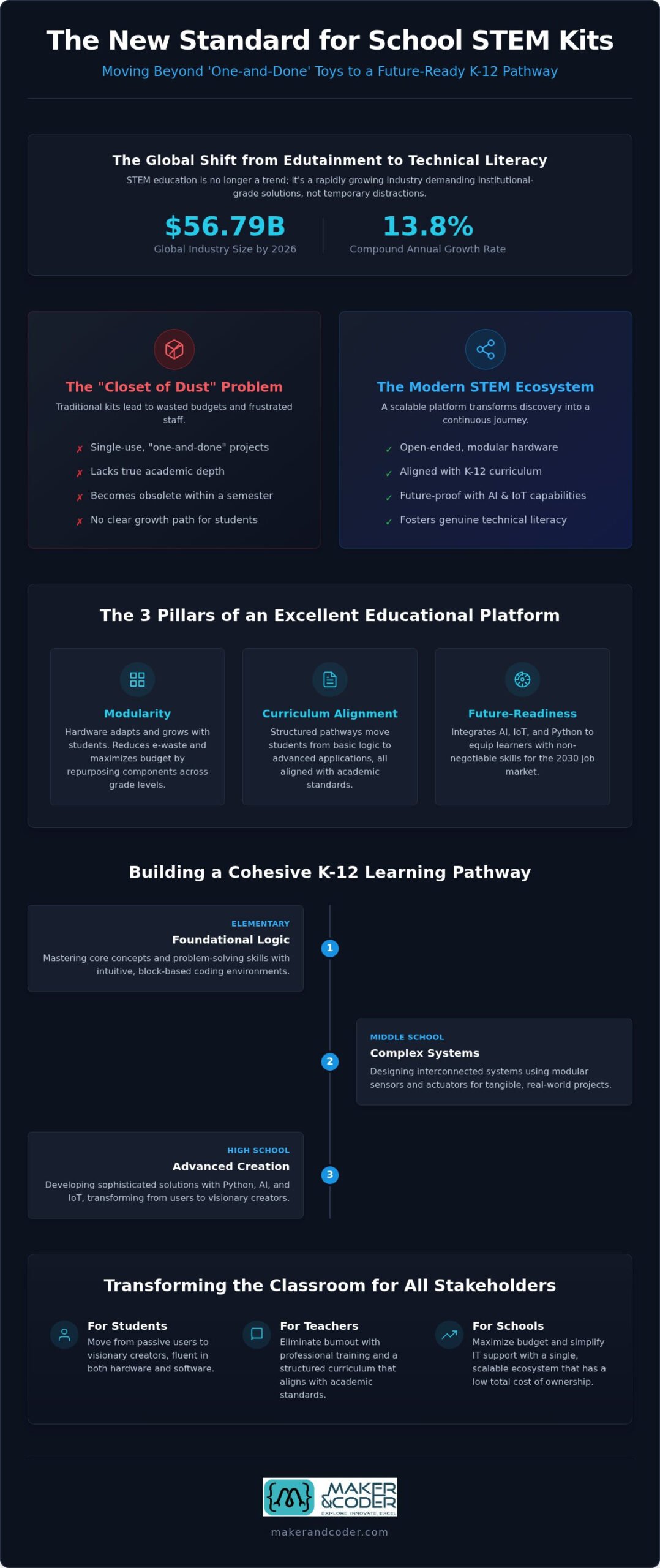
The standard for the best STEM kits for schools has radically evolved. In the past, “engagement” was the primary metric, often leading to a closet full of toys that lacked academic depth. By 2026, the global focus has shifted from simple “edutainment” toward a rigorous model of technical literacy. Schools now require tools that mirror the complexity of our modern world while remaining accessible to learners. Science, technology, engineering, and mathematics (STEM) education is no longer just a trend; it’s a $56.79 billion global industry that demands institutional-grade solutions. This growth reflects a 13.8% compound annual growth rate, signaling that schools are prioritizing long-term educational investments over temporary distractions.
Excellence in this environment is defined by three pillars: durability, modularity, and curriculum alignment. A kit that breaks after one semester or only teaches a single specific trick is a liability for any district. 2026 standards specifically require hardware to include AI and IoT capabilities to remain relevant. Evaluating the total cost of ownership is essential. Investing in a modular system like the MC 4.0 Kit that scales across grade levels provides far better long-term value than purchasing a series of one-off kits that lack a growth path. True excellence means the hardware doesn’t just survive the classroom; it thrives within it, year after year.
The Difference Between Consumer Toys and Educational Platforms
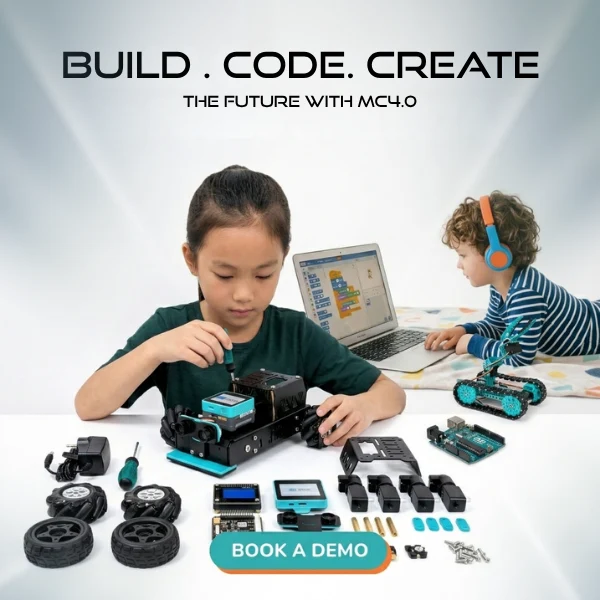
Consumer toys are often closed systems. They offer a “boxed-in” experience where students follow a manual to build one specific item. Once the project is finished, the learning stops. Educational platforms are different. They utilize open-ended modular hardware like MC Blocks that can be repurposed for infinite experiments. The MC4.0 Controller serves as a high-performance “brain” that supports everything from basic sensors to advanced machine learning modules. This ensures your investment doesn’t gather dust when the first project ends.
Future-Readiness: Preparing Students for the 2030 Job Market
The Power of Modularity: Why the MC 4.0 Platform is the New Industry Standard
Stop thinking about classroom robotics as a collection of single-purpose machines. It’s a system. The shift toward the best STEM kits for schools in 2026 is defined by a modular philosophy. Instead of buying a fleet of robots that students eventually outgrow, schools are adopting ecosystems like the MC 4.0 platform. This approach treats technology like building blocks rather than static toys. It moves the focus from what the machine can do to what the student can imagine.
Schools often struggle with “E-waste” from discontinued or broken hardware. Modularity solves this. When a student moves from primary to middle school, they don’t throw away their equipment. They simply add more complex MC Blocks or upgrade their software interface. This repurposing reduces classroom waste and ensures your budget stretches further. It’s a sustainable way to build a high-tech lab without constant reinvestment in “disposable” tech.
MC Blocks: Engineering Creativity Without Boundaries
In the MC4.0 Base Kit, students find a diverse array of sensors and actuators. These aren’t just for building vehicles. They’re for building smart homes, automated gardens, or wearable tech. This flexibility facilitates rapid prototyping, allowing learners to fail fast and iterate even faster. They move from simply snapping pieces together to designing complex, interconnected systems. If you’re ready to see how these systems fit into your specific lab environment, reach out to our educational consultants for a tailored demonstration.
Technical Specifications for Educators
The MC4.0 Controller is a powerhouse compared to standard classroom microcontrollers. It features integrated Wi-Fi and Bluetooth, making it ready for immediate IoT (Internet of Things) projects. Its “plug-and-play” design means teachers spend less time troubleshooting cables and more time facilitating discovery. It acts as the central brain, bridging the gap between physical hardware and cloud-based data.
| Feature | Modular (MC 4.0) | Fixed-Form (Ozobot) | DIY (Basic Kits) |
|---|---|---|---|
| Architecture | Adaptable/Modular | Static/Proprietary | Loose Components |
| Educational Span | Cohesive K-12 Pathway | Primary Focus | High Skill Barrier |
| Connectivity | Wi-Fi, Bluetooth, IoT | Limited/Closed | Requires Extra Shields |
| Setup Time | Instant Plug-and-Play | Quick Start | High Configuration |
Grade-Specific STEM Pathways: From Block-Based Coding to Python and AIoT
A fragmented curriculum is the silent killer of student engagement. When a fifth grader masters one system only to start over with an entirely different interface in sixth grade, you lose valuable cognitive momentum. The best STEM kits for schools solve this by providing a unified architecture that grows with the learner. This K-12 journey ensures that each grade level builds directly upon the previous one; moving from simple logic to professional-grade engineering without the friction of learning a new language every year. By 2026, the goal is clear: bridge the gap between classroom play and the technical demands of a workforce where STEM jobs are projected to grow by 8.1% through 2034.
Design your pathway to be a continuous ascent. In primary school, students focus on spatial awareness and fundamental logic using the MC4.0 STEAM kits. As they enter middle school, the focus shifts toward the MC4.0 AIoT Kit, where they begin the critical transition from block-based coding to Python. High schoolers then take these skills into the realm of data science and real-world IoT applications. They don’t just build robots; they solve systemic problems. This progression ensures that by graduation, students are not just consumers of technology but fluent architects of it.
Early Years: Developing the Maker Mindset
Empower your youngest learners with tactile, “low-floor” entry points into engineering. Using the MC4.0 Base Kit, students explore fundamental concepts like gear ratios and simple circuits. It’s about building a “maker mindset” where failure is just another step in the iteration process. Integrate art and design into these technical projects to ensure a holistic STEAM approach. This early exposure builds the confidence needed for more abstract challenges in later years.
Advanced Technical Literacy: AI and the Internet of Things
Secondary education in 2026 demands more than just basic coding. The MC4.0 AIoT Kit is essential for teaching students how to build smart systems that interact with their environment. They learn to collect data, utilize machine learning, and deploy IoT solutions. This isn’t about gadgets; it’s about understanding the interconnected systems that drive our global economy. Explore specialized tools for these advanced pathways at the Maker & Coder shop to find hardware that matches your academic rigor. Prepare your students to manipulate both hardware and software fluently before they even step onto a university campus.
Solving the Implementation Gap: Teacher Training and Curriculum Integration
Even the best STEM kits for schools are merely potential energy until they are activated by a skilled educator. Without a structured roadmap, high-tech hardware often becomes a source of stress rather than a catalyst for innovation. The “implementation gap” occurs when the excitement of new technology meets the reality of a crowded school timetable and a lack of clear lesson objectives. Closing this gap requires moving beyond project-specific guides to a comprehensive academic framework. By integrating the MC Curriculum, schools transform isolated activities into a cumulative learning experience that respects both the teacher’s time and the student’s cognitive limits.
Don’t let your investment gather dust. A successful lab requires a bridge between the physical blocks and the academic standards they are meant to teach. This means aligning every motor and sensor with specific learning outcomes. When hardware and curriculum move in lockstep, teachers spend less time wondering “what now?” and more time witnessing “aha!” moments. This synergy is what separates a world-class STEM program from a simple hobby club.
The K-12 MC Curriculum Framework
A successful STEM lab operates on a foundation of pedagogical rigor. The K-12 MC Curriculum provides lesson plans that evolve alongside a student’s cognitive development, ensuring the complexity of the task matches their growing skill set. These aren’t just instructions; they are blueprints for critical thinking. The framework includes robust assessment tools designed to measure STEM competency and problem-solving abilities, giving educators tangible data on student progress. Most importantly, it’s designed for reality. The curriculum provides flexible modules that fit into existing school schedules, whether you have a dedicated 60-minute block or a cross-curricular afternoon session.
Professional Development: Turning Teachers into Mentors
Technology should empower teachers, not intimidate them. Selecting the best STEM kits for schools is only the first step; the second is ensuring your team is ready to lead. Maker & Coder supports schools through dedicated Teacher Training Programs that prioritize hands-on experience over theoretical lectures. These workshops reduce “tech-anxiety” by allowing faculty to build, code, and troubleshoot in a supportive environment. From mastering the MC4.0 Controller to leading an AIoT lab, teachers gain the skills to act as expert facilitators.
Teacher confidence is the #1 predictor of STEM program success. When an educator feels capable, they shift from being a source of answers to a mentor who encourages exploration. Our ongoing support and community resources ensure that no teacher has to explore advanced robotics alone. If you’re ready to empower your faculty and bridge the implementation gap, book a professional development consultation today to explore our training pathways.
Scaling Success with the Maker & Coder STEM Ecosystem
Building a world-class laboratory doesn’t happen overnight. It requires a strategic vision that balances immediate classroom needs with long-term financial sustainability. Selecting the best STEM kits for schools is the foundation of this strategy. By adopting a single-platform approach, schools simplify their internal operations significantly. IT departments benefit from standardized firmware and connectivity protocols, while teachers enjoy a consistent interface across all grade levels. This unified ecosystem ensures that every dollar spent contributes to a cohesive, school-wide growth plan rather than a fragmented collection of gadgets.
Schools that have transitioned to the MC 4.0 platform report a marked increase in student engagement and a decrease in equipment downtime. Instead of managing dozens of different chargers, cables, and software licenses, they maintain a streamlined inventory of MC Blocks and controllers. This efficiency allows educators to focus on what matters most: mentoring the next generation of innovators. Audit your current STEM inventory today and prepare for a 2026 rollout that prioritizes scalability and academic rigor. The transition from isolated projects to an integrated ecosystem is the most effective way to ensure your students are ready for the technical demands of the future.
Selecting Your Starter Ecosystem
Begin your journey with a clear, manageable entry point. For many institutions, evaluating the MC4.0 Base Kit for initial lab setups provides the perfect balance of versatility and value. You don’t need to overhaul every classroom at once. Consider phased rollouts; start with a core set of hardware and add specialized AIoT or STEAM kits as your program matures and your faculty gains confidence. Visit the MC 4.0 Kit collection to explore procurement options that align with your district’s specific budgetary requirements.
Future-Proofing Your Investment
Technology moves fast, but your curriculum shouldn’t have to restart every year. The Maker & Coder ecosystem is designed for longevity. Regular firmware updates and an ever-evolving library of MC Blocks ensure your hardware remains at the cutting edge of educational technology. This commitment to advancement helps you build a sustainable “Maker Culture” within your school community. It’s about creating an environment where students feel empowered to experiment, fail, and succeed. Ready to transform your classroom into a hub of innovation? Explore the full Maker & Coder K-12 Ecosystem and lead your students into a future of infinite possibility.
Empowering the Next Generation of Visionary Creators
The journey toward technical literacy isn’t a single project; it’s a lifelong pursuit. You’ve seen how the best STEM kits for schools move beyond the novelty of a “move-the-robot” task to build a scalable ecosystem. By integrating modular hardware with a structured academic pathway, you bridge the gap between classroom play and professional-grade engineering. This transformation ensures your students graduate with the fluency to manipulate both hardware and software in a world driven by AI and data; for those who want to see how these skills apply to the business world, you can discover MONEYMAKER – Expertos y Tecnología para vender en internet to learn about scaling sales in the digital economy.
Success requires more than just components; it demands a partner in implementation. With the Modular MC 4.0 Hardware platform, your school gains a foundation that evolves alongside your learners. Our K-12 MC Curriculum and Professional Teacher Training programs provide the peace of mind that your investment will thrive in the hands of confident educators. It’s time to stop managing isolated kits and start leading a future-ready laboratory.
Build Your Future-Ready Classroom with Maker & Coder
The future is tangible. Let’s build it together.
Frequently Asked Questions
What are the most important features to look for in a school STEM kit?
Prioritize modularity, institutional durability, and curriculum alignment when evaluating hardware. The best STEM kits for schools must provide a clear transition from basic logic to advanced engineering. Look for hardware that supports both simple block coding and professional languages like Python. This ensures the technology remains relevant as students progress through different grade levels.
How do STEM kits align with K-12 educational standards like NGSS?
STEM kits align with K-12 standards by focusing on three-dimensional learning, which combines disciplinary core ideas with science and engineering practices. The MC Curriculum is specifically mapped to standards like the Next Generation Science Standards (NGSS). This mapping ensures that every hands-on activity directly supports the academic requirements teachers must meet in their daily instruction.
Can the MC 4.0 platform be used by teachers with no coding experience?
Yes, the MC 4.0 platform is designed for educators of all technical backgrounds. Our Teacher Training Programs provide the foundational skills needed to lead a classroom without any prior coding knowledge. The plug-and-play nature of the MC4.0 Controller and intuitive software allow teachers to learn alongside their students, transforming them into confident facilitators.
What is the difference between block-based and Python coding in STEM kits?
Block-based coding uses visual drag-and-drop elements to teach logic, while Python is a text-based language used in professional industries. High-quality kits allow students to start with blocks to understand logic and then toggle to Python to see the actual code. This bridge is essential for moving from foundational computer science concepts to real-world software application.
How many students can typically share one MC 4.0 Kit?
We recommend a ratio of two to three students per MC 4.0 Kit to maximize engagement and collaboration. This setup encourages peer-to-peer problem solving and ensures every student has hands-on time with the hardware. Maintaining a small group ratio with the best STEM kits for schools ensures every student remains active in the building process.
Do these kits require a constant internet connection to function?
Constant internet connectivity is not required for the core functions of the kits. Most coding and hardware manipulation happens locally on the device. However, a connection is necessary for initial software updates, accessing cloud-based curriculum resources, or engaging in advanced AIoT projects that require data exchange with external servers or cloud platforms.
How does the MC Curriculum support cross-curricular learning?
The MC Curriculum integrates math and science by applying abstract concepts to physical engineering challenges. Students don’t just calculate angles in a textbook; they program a robotic arm to move with geometric precision. This application of physics and mathematics makes complex subjects tangible. It reinforces core academic concepts through the lens of creative, real-world problem solving.
What kind of ongoing support does Maker & Coder provide after purchase?
Maker & Coder provides comprehensive post-purchase support, including technical troubleshooting, firmware updates, and access to a dedicated educator community. We offer ongoing professional development to ensure your program stays current with technological shifts. Our team acts as a dedicated partner, helping you scale your lab as your school’s STEM strategy matures over the years.