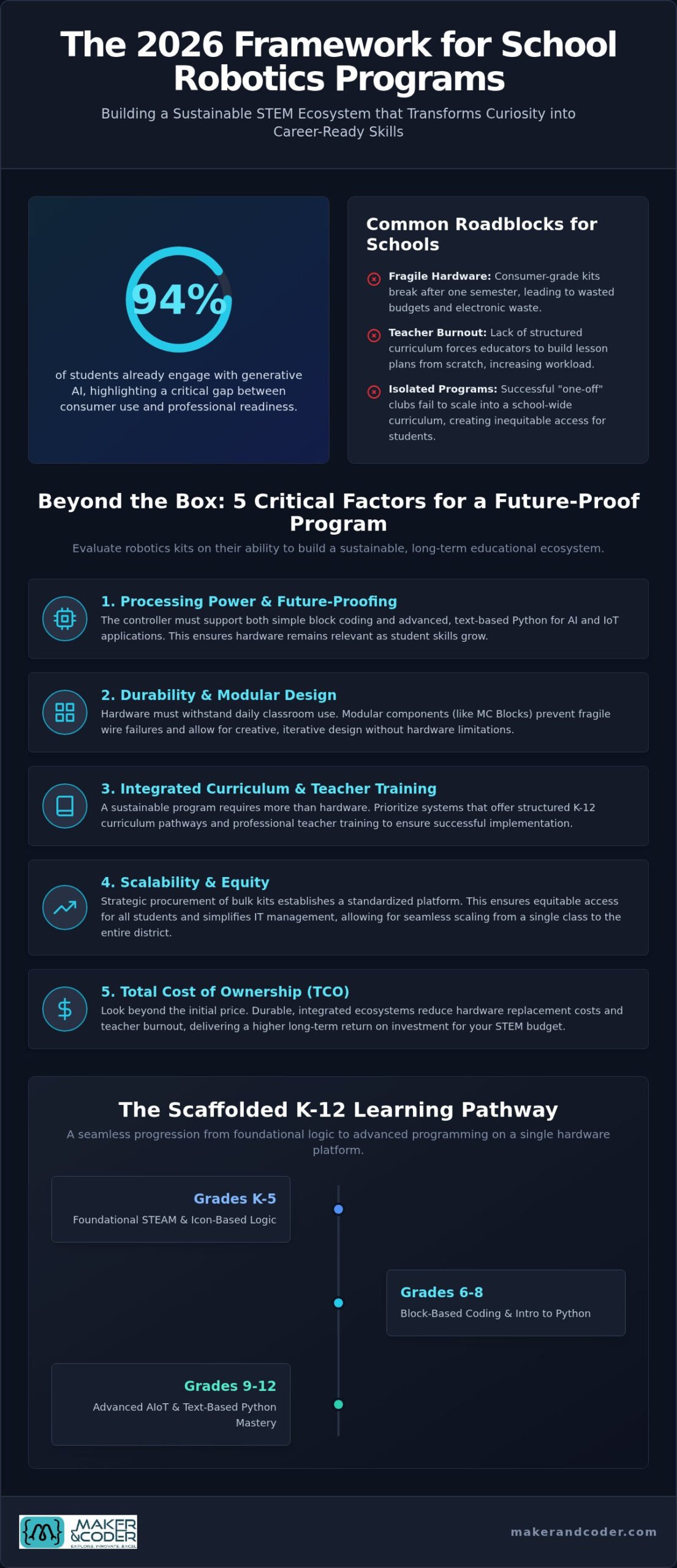
With 94% of students already engaging with generative AI in their daily schoolwork, the gap between consumer-level play and professional-grade readiness has never been more apparent. Most educators realize that simply purchasing bulk robotics kits for schools isn’t enough to bridge this divide. You’ve likely felt the frustration of hardware that breaks after one semester or the exhaustion of trying to build a lesson plan from scratch while managing a busy classroom. It’s a common struggle to move beyond a single successful club toward a sustainable, school-wide program that actually delivers measurable results.
This guide provides the 2026 framework for evaluating, implementing, and scaling a robotics ecosystem that grows alongside your learners. We’ll show you how to leverage modular hardware like the MC 4.0 platform and integrated K-12 curricula to eliminate teacher burnout and hardware obsolescence. From foundational STEAM kits to advanced AIoT applications, you’ll learn how to build a durable STEM program that transforms curiosity into career-ready skills in coding and automation.
Key Takeaways
- Transition from isolated elective clubs to a unified core curriculum to ensure every student gains critical technological literacy and future-ready skills.
- Evaluate hardware based on modularity and processor capability, focusing on tools like the MC 4.0 Controller that support both simple block coding and advanced AIoT projects.
- Strategic procurement of bulk robotics kits for schools reduces long-term costs while providing a standardized hardware foundation that prevents technical fragmentation.
- Build a sustainable program by prioritizing professional teacher training and structured K-12 curriculum pathways over “one-and-done” hardware purchases.
- Ensure measurable learning outcomes by mapping robotics activities to educational standards, moving students seamlessly from icon-based logic to text-based Python programming.
Scaling STEM: Why Bulk Robotics Kits Are the Foundation of Modern Classrooms
Robotics has graduated from the after-school club to the center of the core curriculum. As school districts align with updated 2026 technical standards, the focus has shifted from mere novelty to technical mastery. Investing in bulk robotics kits for schools is no longer just about securing a volume discount; it’s about establishing a universal baseline for student achievement. When every student has access to the same high-performance hardware, the learning environment becomes equitable, predictable, and scalable.
Standardizing on a single platform across multiple grade levels drastically reduces IT overhead. Instead of managing a fragmented collection of “toy-grade” gadgets, administrators can deploy a unified ecosystem. This consistency allows teachers to share resources, troubleshoot effectively, and focus on pedagogy rather than technical glitches. It transforms the classroom from a space of trial and error into a laboratory of purposeful innovation.
The Institutional Shift Toward Robotics Literacy
The field of educational robotics has evolved into a “third literacy” that sits alongside reading and mathematics. This institutional shift is driven by the 2026 CSTA standards, which demand that students understand the “why” behind AI and automation. Modular kits allow schools to meet these rigorous benchmarks while fostering essential soft skills like persistence and iterative design. Students move from being passive users of technology to becoming the architects of future systems.
Total Cost of Ownership (TCO) in School Robotics
Smart procurement looks past the initial sticker price to evaluate the long-term value of the investment. While consumer-level kits might seem attractive, they often lack the durability required for daily classroom use. Durability is a design choice. Systems built with modular MC Blocks are engineered to survive years of assembly and disassembly, outlasting cheaper alternatives that quickly become electronic waste.
Scaling to 100+ units requires a methodical approach to logistics, including charging stations and inventory management. Schools that prioritize integrated ecosystems over “free” standalone software see a much higher return on investment. They experience reduced teacher burnout and a significant decrease in hardware replacement costs. You can explore these professional-grade solutions at the Maker & Coder shop to see how integrated hardware simplifies high-volume rollouts and ensures your STEM budget works harder for your students.
Beyond the Box: 5 Critical Factors for Evaluating School Robotics Hardware
Selecting bulk robotics kits for schools requires looking past the colorful plastic and focusing on the underlying architecture. It’s about finding hardware that doesn’t just entertain but educates across a decade of learning. A robust evaluation ensures that your investment remains relevant as students progress from simple logic to complex systems. You need a platform that scales with the learner, moving from basic motor movements to sophisticated data processing.
The ‘Brain’ of the Classroom: Controllers and Processing
The controller serves as the central nervous system of any robot. While basic microcontrollers suffice for elementary logic, the 2026 tech landscape demands more. The MC 4.0 Controller provides the processing power needed for AI and IoT applications, ensuring students aren’t limited by their hardware as their skills grow. This is crucial because Python compatibility is now a non-negotiable requirement for middle and high school students. It allows them to transition from block-based coding to industry-standard text-based programming without switching hardware platforms. Academic research supports this scaffolded approach; A Systematic Review of Studies on Educational Robotics highlights how hardware versatility directly impacts long-term student engagement and learning outcomes.
Durability and Modular Design
Classrooms are high-impact environments. Fragile wires and proprietary connectors often lead to high failure rates and frustrated teachers. The MC Blocks system utilizes modular connections built to withstand daily student use. This modularity isn’t just about durability; it’s about sustainability. Instead of discarding an entire unit when one part fails, you can replace individual components. This approach ensures your hardware grows with your program rather than ending up in a storage closet. If you’re curious about how these components fit into your specific classroom environment, you can reach out to our educational consultants for a tailored implementation plan.
Modern collaborative coding thrives on seamless connectivity. Integrated Wi-Fi and Bluetooth allow students to share code and control robots wirelessly, mirroring real-world engineering workflows. The best kits balance the “build-it-yourself” experience with “ready-to-run” reliability. This ensures students understand the mechanics of assembly without getting bogged down in repetitive tasks that don’t add educational value. By prioritizing modularity and processing power, you create a foundation for a STEM program that is both ambitious and reliable.
Curriculum Integration: Mapping Robotics Kits to K-12 Educational Standards
Many schools fall into the trap of “Isolated Tech”—purchasing high-end hardware without a structured pedagogical strategy. Without a clear roadmap, even the most advanced tools eventually gather dust in a storage closet. To avoid this, successful programs integrate bulk robotics kits for schools with a comprehensive K-12 curriculum. This ensures that every lesson builds on the last, moving students from basic curiosity to technical competence through a unified learning ecosystem.
The K-12 Educational Pathway
Start early and build deep. In primary school, the curriculum focuses on foundational logic, sequencing, and cause-and-effect. Students use icon-based blocks to bring their creations to life, sparking an early joy in discovery. As they transition to middle school, the complexity increases. Here, they introduce sensors, variables, and data gathering via the Internet of Things (IoT). By high school, the scaffolding is removed. Students leverage the power of Python to solve advanced engineering problems and develop AI literacy. This from-to journey ensures that technology remains a tool for creative expression rather than a source of frustration.
Alignment with Global Standards
Meeting the updated 2026 CSTA standards requires more than just teaching code; it demands algorithmic thinking and real-world application. The MC Curriculum is designed to align with ISTE and CSTA benchmarks, providing project-based learning (PBL) modules that mirror modern industry challenges. Whether it’s designing an autonomous delivery bot or a smart agricultural sensor, these modules make learning tangible. They also ensure inclusivity by offering multiple entry points for diverse learning styles, allowing every student to find their voice in STEM. You can explore these curriculum-aligned solutions at the Maker & Coder shop to see how we bridge the gap between hardware and high-level learning.
Robotics shouldn’t live in a silo. Link these kits to physics to demonstrate force and motion, or to art for creative STEAM projects. You can even use them in social studies to model urban planning or environmental impact. Teachers need clear assessment frameworks to measure this progress effectively. Instead of traditional tests, evaluate students on their iterative design process, their ability to troubleshoot complex systems, and the functionality of their final projects. This holistic approach ensures that your STEM investment delivers measurable educational outcomes across the entire district.
Implementation Strategy: Moving from ‘Unboxing’ to Sustainable STEM Programs
Successful deployment of bulk robotics kits for schools requires a shift in focus from the delivery truck to the classroom floor. Buying the hardware is only the first step. To ensure these tools don’t end up as expensive paperweights, you need a phased rollout that prioritizes infrastructure and human capital. This methodical approach transforms a one-time purchase into a permanent pillar of your school’s technical identity.
A sustainable implementation typically follows four distinct phases:
- Phase 1: Inventory and Infrastructure. Audit your Wi-Fi bandwidth to handle 30 plus simultaneous Bluetooth or cloud connections. Establish dedicated charging stations and mobile storage carts to keep hardware organized and ready for use.
- Phase 2: Professional Development. Transition your staff from “tech phobia” to technical confidence. Empowering the non-technical teacher is the most critical factor in program longevity.
- Phase 3: Pilot Programs. Start with a small group of early adopters. Use their feedback to refine lesson delivery before scaling across the entire grade level or district.
- Phase 4: Full Integration and Showcasing. Host STEM fairs or inter-school competitions. These events build community momentum and provide students with a platform to demonstrate their mastery of AI and coding.
Professional Teacher Training: The Key to ROI
Static PDFs and manual-only guides aren’t enough to support modern educators. True success comes from hands-on Teacher Training Programs that provide a clear path to certification. We recommend a “Lead Teacher” model where a few faculty members receive intensive training to act as peer-to-peer mentors. This creates a self-sustaining support network within your building. Whether through on-demand digital modules or in-person workshops, training should focus on pedagogy first and technical troubleshooting second. When teachers feel supported, student engagement naturally follows.
Managing Bulk Assets in a School Environment
Scaling to a fleet of 500 plus controllers requires a tactical approach to asset management. Best practices include color-coding bulk robotics kits for schools by classroom and maintaining a centralized inventory of modular MC Blocks. This makes part replacement simple and prevents the “cannibalization” of kits. Crucially, managing firmware updates across a large fleet shouldn’t be a manual chore. Integrated systems allow for streamlined software management, ensuring every student works on the same version of the platform. You can find organized classroom packs and storage solutions at the Maker & Coder shop to simplify this logistical challenge.
Creating a sustainable budget for annual maintenance is equally vital. Plan for a 5% to 10% annual replacement rate for small components like sensors or cables that see heavy use. By treating robotics as a long-term infrastructure project rather than a one-off enrichment activity, you ensure your program remains vibrant for years to come. If you’re ready to design a custom rollout for your district, contact our implementation specialists for a comprehensive consultation.
The Maker & Coder MC 4.0 Ecosystem: A Turnkey Solution for Global Schools
Modernizing a school’s technical infrastructure requires a partner that understands the delicate balance between high-level engineering and classroom reality. The Maker & Coder MC 4.0 ecosystem provides this stability, offering a unified platform where hardware and pedagogy coexist. At the heart of this system sits the MC 4.0 Controller, a high-performance hub designed to handle everything from basic motor logic to complex AI data processing. By standardizing on this “brain,” schools can deploy bulk robotics kits for schools that remain relevant from the first day of primary school through the final year of secondary education.
The ecosystem is built around specialized tools tailored to specific educational milestones. The MC4.0 Base Kit establishes foundational skills, while the MC4.0 STEAM Kit integrates creative design and physical computing. For advanced students, the MC4.0 AIoT Kit introduces the world of artificial intelligence and the Internet of Things. While these kits provide the physical tools, the K-12 MC Curriculum serves as the “operating system” of the lab. It provides the structured pathway teachers need to turn high-performance hardware into measurable student growth.
Unlocking Creativity with MC Blocks
Innovation thrives when barriers to entry are removed. Our modular philosophy ensures that students spend less time struggling with fragile components and more time exploring infinite configurations. This seamless integration between the modular MC Blocks and the MC 4.0 software environment creates a “from-to” journey where students move from tactile assembly to sophisticated digital control. MC Blocks provide a tactile, magnetic connection system that eliminates the complexity of traditional wiring, allowing young learners to focus on mechanical logic and engineering principles. This approach empowers even the youngest creators to build functional, complex machines with confidence.
Securing Your School’s Future with Maker & Coder
Scaling a robotics program is a journey that requires visionary leadership and reliable support. Leading global schools have already transitioned from fragmented pilot programs to district-wide rollouts by leveraging the MC 4.0 platform. These institutions have seen firsthand how a unified ecosystem reduces IT friction and accelerates student mastery. Whether you’re managing a single classroom or a network of schools, our global support team provides the training and resources necessary to maintain institutional momentum.
Ready to transform your STEM environment? You can access the Maker & Coder Shop to request customized bulk quotes and explore institutional pricing options designed for large-scale deployments. Partner with an innovator dedicated to the next generation of creators and ensure your students are ready for the 2026 technical landscape. We don’t just sell kits; we build the foundations for future innovators.
Empowering the Next Generation of Innovators
Scaling a robotics program is a journey of transformation that moves beyond simple hardware acquisition. It’s about creating a sustainable environment where students grow from curious builders into sophisticated engineers. By prioritizing modular MC 4.0 hardware and a comprehensive K-12 Curriculum, you ensure your investment remains relevant as technical standards evolve. Success depends on empowering your faculty through Professional Teacher Training, turning technical challenges into a shared passion for discovery.
Investing in bulk robotics kits for schools is the first step toward a district-wide culture of innovation. This methodical approach reduces administrative friction and maximizes student engagement across every grade level. Don’t let your STEM goals be limited by fragmented tools or static guides. It’s time to build a program that is as ambitious as your students’ potential. Explore the MC 4.0 Ecosystem and request a bulk quote to start your implementation today. The future is waiting for your students to build it.
Frequently Asked Questions
What is the ideal student-to-robot ratio for a classroom setting?
We recommend a 2:1 student-to-robot ratio to maximize hands-on engagement while fostering essential collaboration skills. This balance ensures every learner has significant physical interaction with the hardware. In larger classrooms, a 3:1 ratio remains effective for project-based learning. This setup encourages students to rotate roles between driver, navigator, and coder, mirroring real-world engineering workflows found in professional laboratories and high-tech environments.
How do I choose between different bulk robotics kits for middle school vs. elementary?
Selecting the right bulk robotics kits for schools depends on your students’ cognitive development and technical readiness. For elementary grades, focus on the MC4.0 Base Kit to teach foundational logic and sequencing. Middle school programs benefit from the MC4.0 STEAM or AIoT Kits, which introduce complex sensors and data variables. These advanced kits allow older students to explore the Internet of Things and move toward text-based programming as their skills mature.
Can these robotics kits be used to teach Python coding?
Yes, the MC 4.0 ecosystem is specifically designed to support the transition from block-based logic to text-based Python coding. The MC 4.0 Controller provides the necessary processing power to run sophisticated Python scripts directly. This capability is vital for middle and high school students who need industry-standard skills. By using Python, learners can control complex AI functions and IoT data streams, preparing them for the professional technical landscape of 2026.
What kind of teacher training is required to implement Maker & Coder kits?
We offer comprehensive Teacher Training Programs designed to empower educators regardless of their technical background. These sessions focus on both hardware operation and pedagogical strategies for the classroom. Training is available in various formats, including on-demand digital modules and intensive in-person workshops. Our goal is to move teachers from tech phobia to technical confidence, ensuring they feel supported as they guide students through the structured K-12 MC Curriculum.
Are the MC 4.0 kits compatible with existing school tablets and laptops?
The MC 4.0 kits offer seamless compatibility with modern school infrastructure, including Chromebooks, iPads, and Windows laptops. Connectivity is handled via integrated Bluetooth and Wi-Fi, allowing for a clutter-free wireless coding environment. This ensures that students can upload code and monitor sensor data in real-time from their existing devices. The software environment is designed to be accessible through standard web browsers, reducing the need for complex local software installations.
How long do the batteries last in a typical classroom robotics kit?
Batteries in our typical robotics kits are engineered to last through a full day of standard classroom instruction. Under continuous active use, the high-capacity cells generally provide four to six hours of run time. We recommend establishing a centralized charging station as part of your implementation strategy to ensure kits are ready for the next period. This methodical approach to power management prevents downtime and keeps student engagement high during project builds.
Do you offer discounts for district-wide bulk purchases?
We provide specialized institutional pricing and volume incentives for district-wide implementations of bulk robotics kits for schools. These options are designed to help schools scale their STEM programs sustainably while managing tight budgets. Because every district has unique requirements, we provide customized quotes based on your specific kit count and training needs. Our team works closely with administrators to ensure that bulk procurement delivers the highest possible return on investment.
Is the curriculum included with the purchase of bulk robotics kits?
A structured K-12 MC Curriculum is a core component of our turnkey solution and is designed to integrate directly with the hardware. It provides a clear pedagogical roadmap across all grade levels, from primary logic to advanced high school engineering. The curriculum includes project-based learning modules, assessment frameworks, and alignment with global standards like CSTA and ISTE. By including these resources, we ensure that your teachers have a proven path for successful STEM integration.