Why do we allow students to “reset” their knowledge every summer, forcing teachers to spend the first two months of every grade level retreading old ground? It’s a frustrating cycle where learners “do” coding projects without ever truly “understanding” the logic behind them. Adopting a spiral curriculum for technology education breaks this pattern. By revisiting core concepts with increasing complexity, we transform technology from a series of isolated tasks into a continuous, lifelong skill set. This approach ensures that the leap from basic blocks to advanced AIoT feels like a natural evolution rather than a daunting hurdle.
You likely recognize the fragmented learning trap where a fifth grader masters a simple robot only to feel completely lost when faced with text-based sensors in middle school. This article promises to show you how to bridge that gap. Discover a framework that scales effortlessly from fundamental logic to sophisticated physical computing. We’ll examine how successive mastery builds student confidence and provides teachers with a clear, manageable roadmap for K-12 progression. It’s time to move your classroom from simple participation to professional innovation.
Key Takeaways
- Move beyond fragmented “one-and-done” projects by adopting an iterative approach that reinforces core concepts every single year.
- Discover how a spiral curriculum for technology education creates a seamless transition from visual block-based logic to advanced Python coding.
- See how modular hardware like MC Blocks acts as a physical anchor for abstract software logic, allowing students to experiment with confidence.
- Learn to audit your current STEM program for knowledge gaps and map a unified progression across logic, electronics, and AI.
- Explore how the MC4.0 Controller serves as the central brain for a scalable K-12 pathway that grows with your students’ ambitions.
What is a Spiral Curriculum for Technology Education?
A spiral curriculum for technology education isn’t a repetitive loop; it’s an upward trajectory. Based on the educational theories of Jerome Bruner, this model suggests that any subject can be taught to any child in an intellectually honest form. In a high-tech lab, this means a first grader isn’t “too young” for logic; they simply need the right entry point. What is a Spiral Curriculum? At its core, this approach moves away from “one-and-done” units toward a continuous journey of discovery. It ensures that students don’t just “do” technology, but actually master the underlying principles that drive it.
Linear learning models often treat coding like a checklist. Students learn HTML in March, finish the project, and never touch it again. By the time they reach the next grade, the syntax is forgotten. This creates massive knowledge gaps and a sense of “starting over” every September. The spiral model replaces this checklist with three essential pillars: cyclical reinforcement, increasing complexity, and the integration of prior knowledge. It’s a method that transforms abstract commands into intuitive skills, allowing students to build a deep, permanent understanding of how the digital world functions.
The Shift from Linear to Spiral Tech Learning
Traditional “one-off” coding projects often fail to build long-term computational thinking because they lack a bridge to the next level. When students constantly start from scratch with new tools, their cognitive load skyrockets. They spend more time fighting the interface than understanding the logic. A spiral approach uses intentional scaffolding to lower these barriers. By building on familiar foundations, students move from “how do I make this move?” to “how do I optimize this algorithm?” with significantly less friction. This progression ensures that the student remains in a state of flow, where the challenge always matches their growing capability.
Why Technology Needs a Spiral Approach
The technical world moves fast. In 2026, students must grapple with AI, IoT, and rapidly shifting software environments. A robust spiral curriculum for technology education is the only way to combat the “forgetting curve” that plagues seasonal STEM programs. When a student revisits a concept like a “loop” in the context of a simple LED blink, then later in a complex robotics sensor array, and finally within an AI data set, the logic becomes cemented. They aren’t just memorizing code; they’re mastering universal principles. This prepares them for the “unknown” technologies of the future by giving them a reliable mental toolkit. It turns learners into innovators who can adapt to any system they encounter.
Core Principles of a Successful Tech Spiral
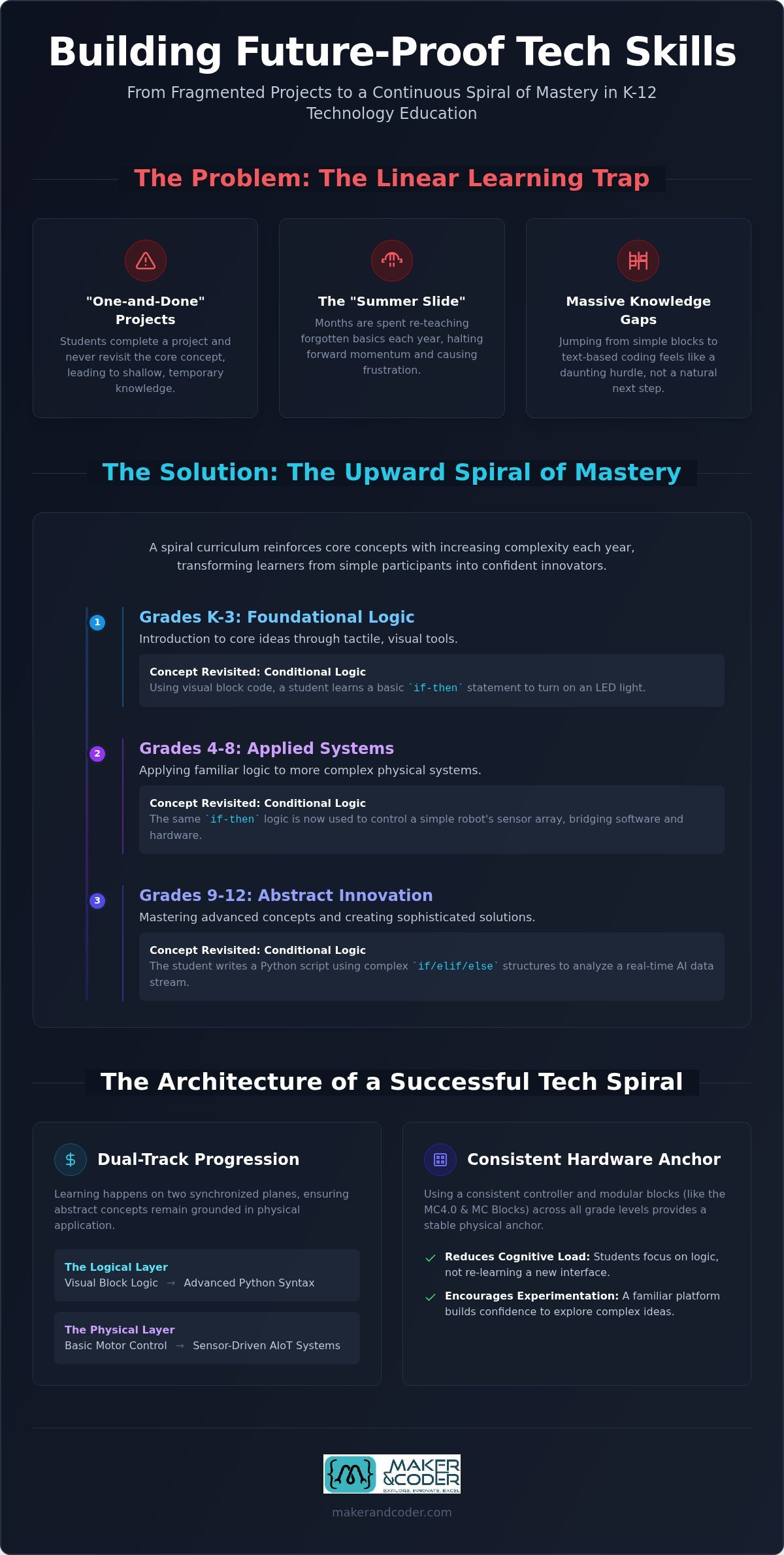
Building a robust tech pathway requires more than just buying kits; it demands a structured architecture. A successful spiral curriculum for technology education operates on two synchronized planes: the Logical Layer and the Physical Layer. The Logical Layer guides students from the tactile visual logic of block-based coding toward the sophisticated syntax of Python. Simultaneously, the Physical Layer moves from basic motor control to advanced, sensor-driven AIoT systems. This dual-track approach ensures that as concepts become more abstract, the physical application remains grounded and understandable.
Understanding the Core Principles of a Spiral Curriculum involves mastering what educators call the Complexity Ladder. Imagine a Grade 3 student learning about a simple “if-then” statement to turn on an LED. By Grade 9, that same student revisits the conditional logic to manage a complex array of environmental sensors. They aren’t repeating a lesson; they’re expanding a mental model. Prerequisite mastery is non-negotiable here. A student must fully grasp the “loop” in a controlled environment before they can be expected to apply it to real-time data streams or cloud-based triggers.
Cyclical Reinforcement in Coding
Consistency is the secret to long-term retention. By revisiting the relationship between inputs and outputs across every grade level, teachers can eliminate the “summer slide” where students forget technical basics. Using a consistent interface, like the MC4.0 Controller, allows students to focus on the logic rather than relearning hardware every year. Learners move from simply understanding what a loop does to optimizing that loop for speed and efficiency. This repetition transforms fragile knowledge into durable expertise that survives beyond the classroom environment.
Increasing Complexity and Abstract Thinking
As the spiral ascends, the projects must challenge students to think beyond the physical desk. They transition from pressing physical buttons to managing virtual triggers in the cloud, bridging the gap between local hardware and global networks. This process develops Computational Persistence, a vital trait in an era where debugging and iteration are more important than getting it right the first time. Integrating STEAM elements like data visualization or environmental science into each loop makes the technology feel relevant and purposeful. If you’re ready to see how these principles can transform your school’s tech program, reach out to our educational consultants for a tailored roadmap.
Anchoring the Spiral: The Role of Modular Hardware
Software is invisible, making it difficult for young minds to grasp without a tangible reference point. Hardware provides the physical memory necessary to ground these abstract software concepts. In a robust spiral curriculum for technology education, modular hardware acts as the anchor that prevents knowledge from drifting away. Students shouldn’t just read about variables; they should see those variables change the speed of a motor or the color of an LED. This immediate feedback loop creates a lasting cognitive connection that software alone cannot replicate.
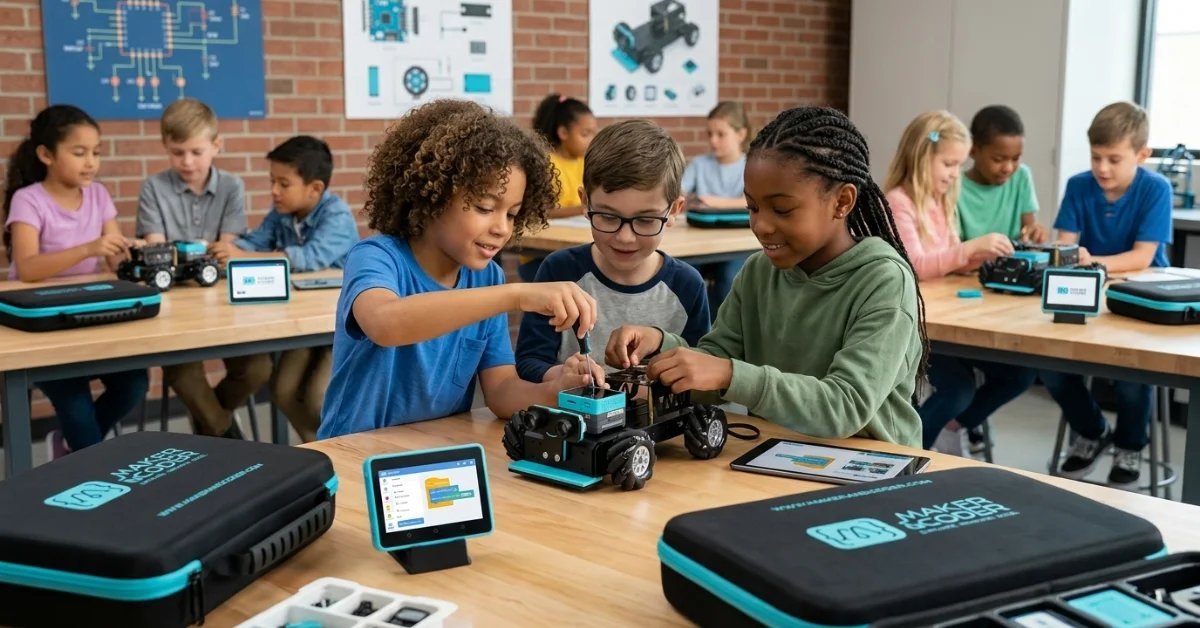
Using modular systems like MC Blocks allows for a safe, exploratory environment. Students can experiment without the fear of breaking delicate components. This psychological safety is crucial for fostering innovation. When a learner knows they can plug, play, and iterate without permanent consequences, they are more likely to push the boundaries of their projects. This hands-on approach moves the classroom from passive consumption to active creation, turning every lesson into a tangible achievement.
One of the greatest pitfalls in STEM education is changing platforms every year. Switching from one microcontroller to another creates unnecessary cognitive friction. By maintaining a fixed platform like the MC4.0 Controller, schools provide a consistent “brain” for the entire educational journey. Students spend less time learning new pinouts and more time mastering complex logic. The transition from the MC4.0 Base Kit to the MC4.0 AIoT Kit becomes a natural progression of the spiral. It moves from local control to global connectivity without the need to start over from scratch.
MC Blocks as Conceptual Building Units
Physical blocks mirror the logic of code blocks, providing a seamless transition for early learners. This tactile feedback reduces the barrier to entry, allowing younger students to engage with complex ideas like loops and branches before they can even type. By standardizing the hardware interface, we allow students to bypass the frustration of wiring errors and focus on higher-level problem solving. It turns the classroom into a laboratory of ideas rather than a struggle with hardware compatibility. This standardization is the bedrock of a scalable tech pathway.
Bridging Software and Physicality
The action-reaction loop is a powerful pedagogical tool. Seeing a physical motor turn in response to a line of code beats seeing a pixel move on a screen every time. This physicality is essential for teaching advanced concepts like Edge Computing and IoT in the middle school spiral. Using hardware to solve real-world problems encourages a vibrant Maker culture. It invites students to revisit engineering principles through a digital lens, ensuring that every loop of the spiral adds a new layer of practical expertise. Explore our full range of modular systems at the Maker & Coder shop to find the right anchor for your classroom.
Implementing a K-12 Technology Pathway in 2026
Transform your educational vision into a measurable roadmap. Implementing a spiral curriculum for technology education requires a shift from sporadic, isolated activities to a unified K-12 strategy. Start by auditing your current STEM offerings for knowledge silos. Identify where students are repeating the same entry-level tasks and where they face “cliffs” in difficulty. In 2026, with the release of updated CSTA K-12 Computer Science Standards, schools must ensure their pathways aren’t just collections of cool gadgets but are instead rigorous journeys toward technical literacy.
Follow these five strategic steps to build your pathway:
- Audit Knowledge Silos: Pinpoint where learning stops and identify gaps in student retention between grade levels.
- Map Core Concepts: Distribute Logic, Electronics, and AI across all grades, ensuring each year adds a layer of depth.
- Standardize Hardware: Use a versatile platform like the MC 4.0 Kit to provide a consistent “anchor” for students as they progress.
- Align Teacher Training: Invest in Teacher Training Programs to ensure educators at every level understand the “before and after” of their specific curriculum.
- Use Data-Driven Assessment: Monitor student progress to decide when to loop back for reinforcement or accelerate into new territory.
Standardization is the engine of this growth. When a school district commits to a single hardware ecosystem, they eliminate the “relearning phase” that wastes precious instructional time every autumn. This allows teachers to focus on higher-level pedagogy rather than troubleshooting new interfaces. If you’re ready to modernize your school’s approach, contact our team to begin your K-12 audit and build a future-ready framework.
Primary Years: The Foundation of Discovery
Focus on logic and simple mechanics during the early years. By using the MC4.0 Base Kit, primary students develop the “language of technology” through play-based experimentation. They learn that code isn’t just text; it’s a series of instructions that produces a physical result. These pre-coding concepts set the stage for future complexity, ensuring that when they reach middle school, the logic of a loop or a conditional statement is already second nature. It’s about building intuition before introducing syntax.
Secondary Years: Innovation and AIoT
Secondary education is where the spiral ascends into professional territory. Students transition from block-based interfaces to Python and real-world data processing with the MC4.0 AIoT Kit. They move from following step-by-step instructions to independent system design, tackling industry-standard challenges in automation and environmental monitoring. This stage prepares them for the workforce by teaching them how to integrate hardware, software, and cloud connectivity into a single, functional solution. They aren’t just learning tech; they’re becoming architects of it—and for those interested in how these technical foundations apply to creative tools like professional music plugins, click here.
Scaling Your STEM Vision with Maker & Coder
Theory alone won’t build the next generation of engineers. You need a practical, proven engine to drive your school’s progress. The MC Curriculum offers a ready-made spiral curriculum for technology education designed specifically for the rigorous demands of the 2026 classroom. It eliminates the guesswork for administrators by providing a structured, K-12 framework that grows alongside your students. Instead of disjointed units, you gain a cohesive narrative of discovery that spans every grade level, ensuring no student is left behind as technology evolves.
Central to this journey is the MC4.0 Controller. Think of it as the consistent “brain” that follows a student from their first block-based project to their final AIoT senior thesis. By maintaining this single hardware anchor, you remove the barrier of relearning interfaces every year. This stability allows learners to dive deeper into complex logic and creative problem-solving. It transforms the classroom from a place of technical frustration into a laboratory of pure innovation.
The MC 4.0 Ecosystem: Hardware Built for Spirals
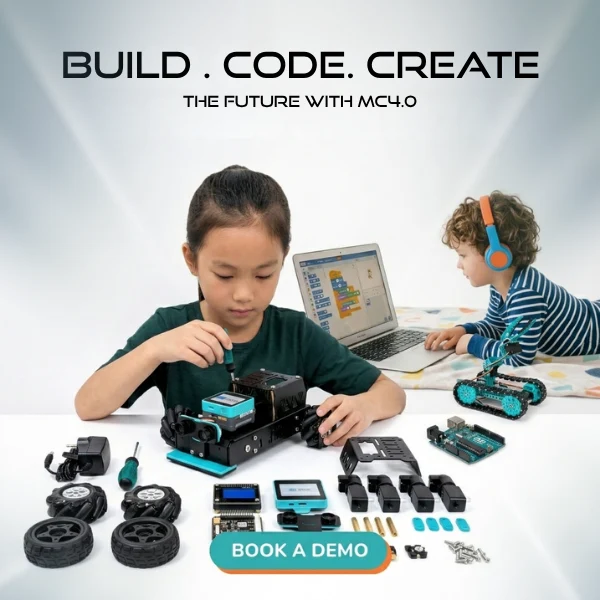
Success in a spiral model depends on tools that can scale. Our modular MC Blocks provide the tactile foundation younger students need to understand the physical world. These units are durable, intuitive, and designed for thousands of iterations. As students progress, the MC4.0 STEAM Kit serves as the ultimate tool for cross-curricular integration, blending art, science, and high-level engineering into a single project. This ecosystem ensures that your hardware investment stays relevant as students move from simple motor control to sophisticated data analysis. Explore our range of MC 4.0 Kits and hardware to see how these tools support long-term mastery.
Empowering Educators through Training
A curriculum is only as strong as the teachers who deliver it. We recognize that many educators feel overwhelmed by the rapid pace of AI and IoT development. Our Teacher Training Programs are designed to bridge this gap, turning non-technical teachers into confident mentors. We focus on building a community of practice within your school, ensuring that every educator understands their role in the K-12 pathway. By providing the right pedagogical support, we ensure that every teacher becomes an enabler of the spiral curriculum for technology education. This continuity is what prevents knowledge gaps and keeps student engagement high across all grade levels.
Planning for the 2026 academic year requires a partner who understands both the classroom and the cutting edge. We invite principals and STEM coordinators to explore the full Maker & Coder ecosystem. Let’s work together to build a technology pathway that is ambitious, reliable, and truly transformative. Your vision for a future-ready school starts with a single, well-placed loop.
Architecting a Future of Continuous Discovery
Building a future-ready school requires more than just the latest gadgets; it demands a strategic vision that bridges the gap between grade levels. We’ve seen how a spiral curriculum for technology education replaces fragmented units with a continuous journey of mastery. By grounding abstract software logic in modular hardware, you ensure that students don’t just “do” projects, but truly understand the systems they create. This progression from simple motor control to cloud-connected AIoT prepares learners for the professional challenges of 2026 and beyond.
Success rests on the strength of your ecosystem. With the K-12 Aligned MC Curriculum and modular MC Blocks, you provide students with the “physical memory” they need to scale their ambitions. Our Professional Teacher Training Programs ensure your staff feels empowered to lead this transformation at every stage of the spiral. It’s time to move beyond the summer reset and start building lasting technical literacy. Build your school’s future-ready STEM pathway with the MC 4.0 Ecosystem and give your students the tools to build something extraordinary. The future is waiting for their first line of code.
Frequently Asked Questions
What are the benefits of a spiral curriculum in STEM?
The primary benefits include durable knowledge retention and the complete elimination of the frustrating “reset” phase at the start of each school year. By adopting a spiral curriculum for technology education, students build immense confidence through successive mastery. This approach significantly reduces cognitive load because learners always begin from a familiar foundation before tackling more difficult challenges. It transforms tech education from a series of forgotten units into a permanent, lifelong skill set.
How does a spiral curriculum differ from a traditional linear model?
A traditional linear model treats subjects as a checklist where a topic is taught once and then dismissed forever. In contrast, the spiral model is iterative, purposefully revisiting core principles like logic and circuitry with increasing depth and complexity. This prevents the knowledge gaps that occur when students move to advanced topics without a solid grasp of the basics. It ensures that complex ideas remain accessible to every student through constant reinforcement.
Is the spiral curriculum suitable for early primary school students?
Yes, it’s highly effective for early primary students when paired with tactile, hands-on learning tools. Introducing “pre-coding” logic through physical play builds an intuitive understanding of cause and effect without the need for complex syntax. By the time these students reach middle school, they’ve already mastered the foundational patterns needed for advanced text-based coding. It’s about teaching the “why” behind technology long before they ever touch a keyboard.
How do I choose the right hardware to support a spiral tech curriculum?
Select hardware that is modular and remains consistent across multiple grade levels to ensure long-term stability. Changing ecosystems every year forces students to waste time learning new interfaces rather than deepening their logical skills. Prioritize versatile platforms that can scale from basic motor control to advanced AI applications. This consistency acts as an anchor, allowing the curriculum to move toward abstract concepts while the physical tools remain familiar and reliable.
Can I implement a spiral curriculum if my teachers aren’t coding experts?
Absolutely, provided you have a structured framework and professional support to guide the process. You don’t need a degree in computer science to lead a successful classroom when you implement a spiral curriculum for technology education. Comprehensive Teacher Training Programs bridge the gap for non-technical staff, turning educators into facilitators of discovery. The focus shifts from the teacher as the source of all code to a trusted guide who enables student-led innovation.
How does the MC 4.0 Kit specifically support spiral learning?
The MC 4.0 Kit provides a unified hardware ecosystem that grows with the student’s ability from K through 12. By using the MC4.0 Controller as the central “brain” across all grade levels, students avoid the friction of switching platforms. Modular MC Blocks allow for safe, fear-free experimentation at any age. This standardization ensures that instructional time is spent on higher-level problem solving rather than troubleshooting unfamiliar wires or confusing hardware pinouts.
What happens if a student joins the spiral mid-way through the curriculum?
Students joining mid-way can quickly find their footing through the curriculum’s built-in reinforcement loops and re-entry points. Because the spiral frequently revisits core concepts, late arrivals have natural opportunities to catch up on foundational logic without feeling overwhelmed. The modular nature of the MC Blocks also allows for individualized “bridge projects” that fill specific knowledge gaps. This flexibility ensures that no student is permanently left behind by a rigid, one-way timeline.
How do I measure student progress in a cyclical learning model?
Measure progress through competency-based assessments that track how students apply familiar logic to increasingly complex scenarios. Instead of testing for simple memorization, look at their ability to debug an original system or optimize an existing algorithm. This cyclical model rewards “Computational Persistence” and creative problem-solving over rote learning. Progress is visible when a student can take a concept they learned in Grade 4 and use it to solve a Grade 8 engineering challenge.