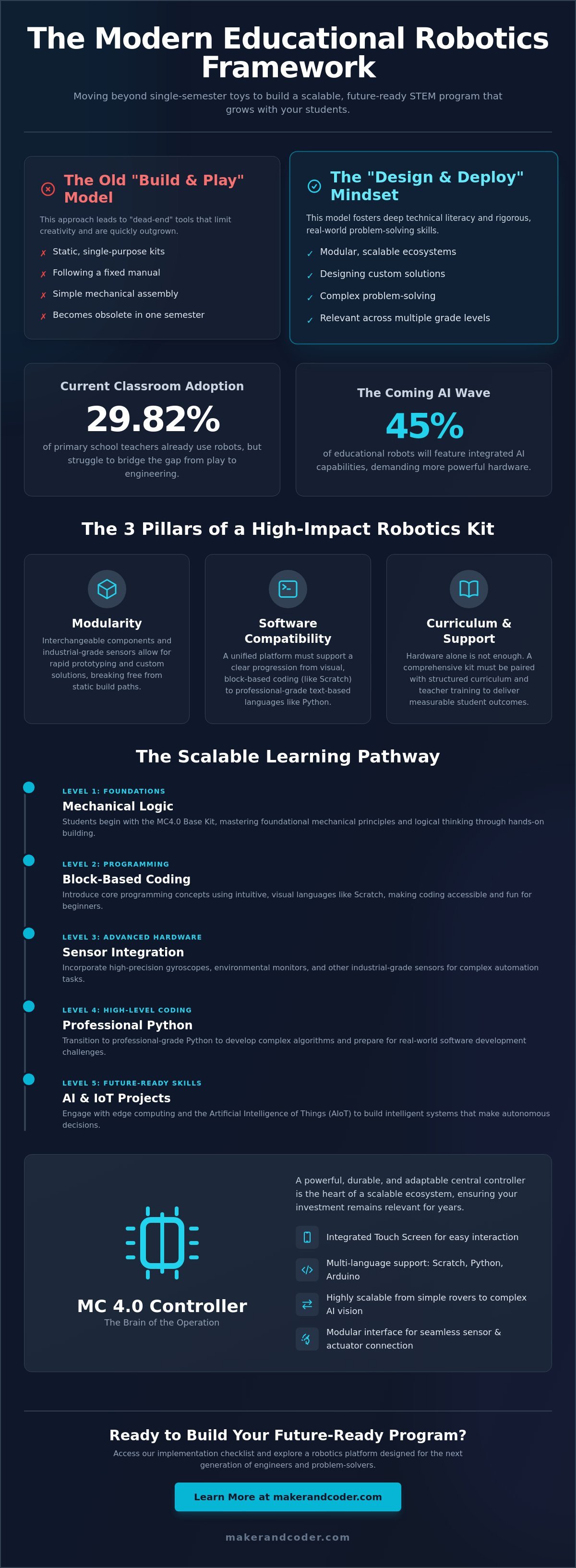
The most expensive mistake a school can make isn’t buying technology; it’s buying a “dead-end” tool that students outgrow in a single semester. While 29.82% of primary school teachers are already using robots in their classrooms, many struggle to bridge the gap between basic play and real-world engineering. Finding the right educational robotics kit requires looking past the flashy lights to find a system that scales from simple blocks to sophisticated Python coding. You need a platform that doesn’t just entertain, but actually prepares students for a future where 45% of educational robots will soon feature integrated AI capabilities.
It’s common to feel overwhelmed by hardware that lacks the power to handle modern AIoT concepts or by a lack of confidence when implementing new tech. We believe that technology should be an accessible tool for creative expression, not a daunting challenge. This article provides a clear framework to evaluate robotics hardware, curriculum alignment, and teacher support to build a future-ready STEM program. You’ll learn how to move from basic concepts to advanced applications using a unified platform that ensures measurable student engagement through every grade level.
Key Takeaways
- Shift your focus from simple assembly to complex problem-solving by choosing systems designed for a design-and-deploy mindset.
- Explore the technical versatility of modular components like the MC 4.0 Controller and MC Blocks to ensure your hardware remains relevant across multiple grade levels.
- Evaluate how a comprehensive educational robotics kit must be paired with structured curriculum and teacher training to deliver measurable student outcomes.
- Identify the specific pathways for progression, moving from foundational mechanical logic in the MC4.0 Base Kit to advanced Python-based AIoT projects.
- Access a practical implementation checklist designed to help administrators and educators pilot a successful, scalable robotics program with professional confidence.
Table of Contents
- What Defines a High-Impact Educational Robotics Kit in 2026?
- Evaluating Hardware: The MC 4.0 Controller and Modular Versatility
- Beyond the Box: Why Curriculum and Teacher Training Matter
- From Base to AIoT: Choosing the Right Kit for Your Learning Pathway
- Implementing Maker & Coder: The Future of Classroom Innovation
What Defines a High-Impact Educational Robotics Kit in 2026?
Stop viewing robots as static toys. A high-impact educational robotics kit in 2026 is a modular ecosystem designed to cultivate deep technical literacy and rigorous problem-solving skills. Educational robotics has evolved far beyond simple mechanical assembly. Today, it represents a bridge between classroom theory and industrial application. It’s about giving students the tools to build, break, and rebuild until they find a functional solution.
We’ve moved past the “build-and-play” era where students follow a manual to create a single-purpose machine. Modern STEM education demands a “design-and-deploy” approach. In this model, students identify a real-world problem, design a custom solution using modular components, and deploy code that interacts intelligently with the environment. This shift is supported by three critical pillars: modularity, software compatibility, and curriculum depth. Without all three, a kit is just an expensive plastic distraction.
The Evolution of STEM Hardware
Static kits limit creativity. When students are confined to a single build path, they miss the iterative nature of true engineering. Modular systems using interchangeable components like MC Blocks allow for rapid prototyping. These kits integrate industrial-grade sensors, such as high-precision gyroscopes and environmental monitors, which provide the accuracy required for professional-level automation. The MC 4.0 platform serves as a scalable brain that empowers students to bring diverse, high-level projects to life.
Why 2026 Demands AI and IoT Literacy
By 2026, robotics is no longer just about movement; it’s the primary gateway to understanding the Artificial Intelligence of Things (AIoT). Students now engage with edge computing, where data is processed locally on the robot to make immediate, autonomous decisions. This level of complexity requires a transition from simple block-based coding to professional-grade Python. Integrating AI and Python is now non-negotiable for middle and high school levels. It ensures students aren’t just consumers of technology but creators who understand the logic behind modern smart systems.
Success in the modern classroom requires hardware that grows with the learner. A kit that’s too simple for a 14-year-old is a wasted investment. Conversely, a system that’s too complex for a beginner creates a barrier to entry. The goal is a unified platform that starts with mechanical logic and ends with sophisticated AI applications.
Evaluating Hardware: The MC 4.0 Controller and Modular Versatility
Hardware selection dictates the ceiling of student achievement. Many schools fall into the trap of purchasing project-specific kits that offer no room for growth, eventually cluttering storage closets with “one-off” robots. A truly versatile educational robotics kit centers on a powerful, adaptable brain. This ensures that your investment lasts through years of curriculum evolution and changing technology standards. By focusing on a controller-first ecosystem, you provide students with a consistent interface that grows in complexity as they do.
Durability is equally vital. Educational tools must survive the rigors of daily classroom use, from accidental drops to repeated assembly and disassembly. High-quality hardware doesn’t just feel professional; it functions with the precision required for advanced automation. When students trust their tools, they feel empowered to take bigger creative risks. A systematic review of educational robotics suggests that hardware quality directly impacts student engagement and the depth of their technical exploration.
The MC4.0 Controller: The Brain of the Operation
The MC4.0 Controller serves as the sophisticated central processing unit for the entire Maker & Coder ecosystem. It features an integrated touch screen and supports a wide array of programming languages including Scratch, Python, and Arduino. This single controller can power a diverse range of projects. You might start with a simple primary school rover and eventually transition to a complex AI vision system without ever changing the core hardware. Its modular interface allows for the seamless connection of sensors and actuators, making it a truly scalable solution for K-12 progression.
MC Blocks: Engineering Without Barriers
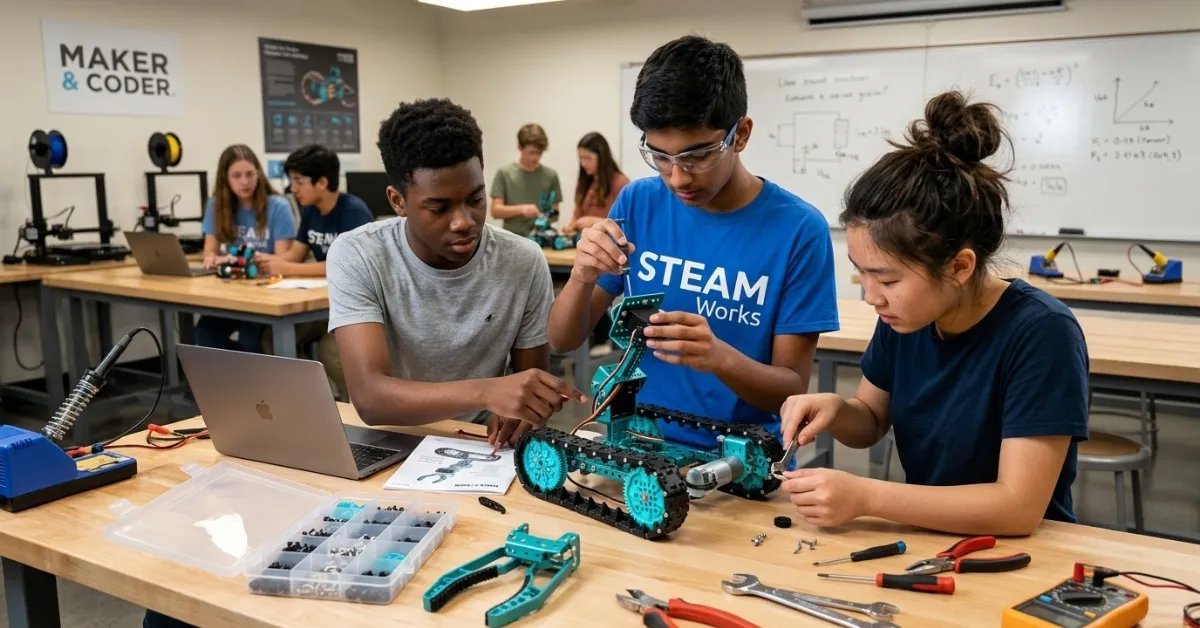
MC Blocks provide the mechanical versatility required for rapid prototyping and modular experimentation. These components allow students to focus on logic and engineering principles rather than getting bogged down in tedious assembly. The system is designed for quick iteration. If a design fails, students can rebuild it in minutes. This mechanical flexibility is enhanced by the synergy between MC hardware and 3D printing. Students can design custom modifications in CAD software and print them to fit perfectly onto the existing block structure, bridging the gap between digital design and physical reality.
Future-proofing your STEM lab means choosing hardware with expandable ports and high-speed processing. As AI and IoT concepts become more integrated into standard curricula, your hardware must have the overhead to handle these data-heavy applications. If you are unsure which hardware configuration best fits your specific classroom needs, reach out to our educational consultants for a personalized walkthrough of the MC4.0 product line.
Beyond the Box: Why Curriculum and Teacher Training Matter
Hardware is often the easiest part of the equation to solve. The real challenge lies in what happens after the boxes are opened. A high-quality educational robotics kit is only as effective as the pedagogical framework supporting it. Without a structured plan, even the most advanced sensors become mere distractions. We view hardware as the vehicle, but curriculum is the roadmap that ensures students reach their destination of technical mastery.
Teacher confidence is the silent engine of a successful STEM program. It’s common for educators to feel “tech anxiety” when faced with AI, IoT, or Python coding. Professional training programs bridge this gap. They transform a hesitant implementer into a bold innovator. By aligning every lesson with Next Generation Science Standards (NGSS) and CSTA guidelines, we ensure that robotics isn’t an “extra” activity but a core component of academic success. This alignment provides administrators with the measurable engagement data they need to justify program expansion.
Structured Learning Pathways (K-12)
The journey begins with foundational mechanical logic and evolves into complex Artificial Intelligence of Things (AIoT) applications. The MC Curriculum provides a scaffolded approach that respects the cognitive development of the learner. In primary years, students focus on spatial reasoning and basic sequences. By high school, they are engaging in project-based learning (PBL) that mirrors industrial challenges. This curriculum doesn’t exist in a vacuum; it integrates seamlessly with existing math and science standards, reinforcing classroom concepts through tangible, robotic applications.
Empowering Educators Through Specialized Training
Effective implementation requires more than a manual. Specialized Teacher Training Programs focus on three essential areas: technical setup, rapid troubleshooting, and advanced pedagogy. When teachers understand the “why” behind the code, they can better guide student discovery. Developing “certified” STEM leads within a school creates a sustainable culture of innovation. The best systems are designed to “teach the teacher” alongside the student, providing real-time support and peace of mind. This collaborative approach ensures that the educational robotics kit remains a vibrant, active tool in the classroom for years to come. It’s about building a legacy of learning that survives long after the initial excitement of new hardware fades.
From Base to AIoT: Choosing the Right Kit for Your Learning Pathway
The most effective educational robotics kit isn’t a static purchase; it’s a strategic investment in a student’s cognitive trajectory. Selecting the right entry point requires a clear understanding of where your students are today and where they need to be tomorrow. We’ve designed a tiered framework that scales with the learner, ensuring that the technology remains a catalyst for growth rather than a source of frustration. Choosing a kit based on student age, prior experience, and specific learning goals allows for a seamless transition from elementary play to secondary engineering. You can browse the full collection to compare technical specifications across our entire ecosystem.
A unified platform eliminates the friction of learning new hardware every year. When students stay within a consistent ecosystem, they spend less time figuring out “how it works” and more time solving “what’s next.” This continuity builds the confidence required to tackle increasingly complex challenges in automation and data science.
The MC4.0 Base Kit: Foundations of Robotics
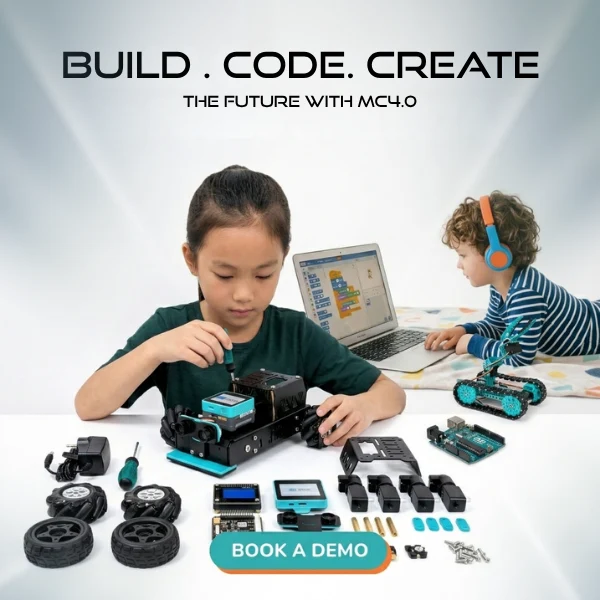
The MC4.0 Base Kit serves as the essential starting point for mechanical logic. It focuses on the core components of robotics, including basic motor control and fundamental sensor input. This is the ideal entry point for primary and early middle school students who are just beginning to explore the physical manifestation of digital logic. Students learn to build sturdy, functional structures before introducing the logic that brings them to life. This kit transforms abstract ideas into physical realities as students move from their first mechanical assembly to writing their first line of functional code.
Advanced Frontiers: AIoT and STEAM Kits
The MC4.0 AIoT Kit serves as the capstone for advanced secondary education. It introduces the concept of the Artificial Intelligence of Things (AIoT), which combines localized artificial intelligence with internet-connected devices. This allows students to build autonomous systems that communicate across networks and make data-driven decisions in real time. For those looking to bridge the gap between technical skill and creative design, the MC4.0 STEAM Kit provides the tools for interdisciplinary projects that combine art and engineering. Students can engage in high-level projects such as smart city models that respond to environmental data or AI-driven sorting machines that use computer vision to categorize objects. These projects move beyond simple robotics into the sophisticated territory of system architecture and edge computing.
Empower your students to become the architects of the future by selecting a pathway that matches their ambition. If you’re ready to design a custom implementation plan for your school or district, contact our STEM specialists today to discuss your specific program needs.
Implementing Maker & Coder: The Future of Classroom Innovation
Implementing a new educational robotics kit is more than a procurement decision; it is a commitment to a school’s technological legacy. The MC 4.0 platform stands as the logical choice for institutions prioritizing longevity and real-world skill acquisition. By standardizing on a single, modular brain, schools eliminate the waste associated with proprietary, single-use hardware. This ecosystem ensures that your investment today continues to deliver value as students progress from basic mechanical builds to complex, AI-driven systems. We don’t just provide parts; we provide a pathway for cognitive development.
Success begins with a strategic pilot program. Administrators should follow this essential checklist to ensure a smooth transition:
- Define measurable student outcomes aligned with NGSS or CSTA standards.
- Identify “STEM Leads” to participate in comprehensive Teacher Training Programs.
- Evaluate classroom infrastructure to support both block-based and Python coding environments.
- Secure a scalable hardware rotation that includes the MC4.0 Base Kit for early learners and AIoT kits for advanced students.
- Establish a central repository for modular MC Blocks to encourage cross-classroom collaboration.
Our community provides a robust support network where educators share project ideas, custom 3D-printed modifications, and troubleshooting tips. You are never implementing in isolation. We act as a dedicated partner, providing the technical reliability and pedagogical depth needed to sustain a high-performing STEM lab. This collaborative environment ensures that as technology evolves, your classroom stays at the absolute forefront of innovation.
Scaling Your STEM Program
Moving from a single classroom pilot to a district-wide implementation requires a focus on durability and cost-efficiency. The MC 4.0 hardware is engineered for the long haul, featuring a low total cost of ownership due to its modular, repairable nature. Rather than replacing entire kits every few years, schools can simply add new sensors or specialized blocks as their curriculum expands. This modularity allows budgets to go further while keeping technology current. Visit the Maker & Coder Shop to explore bulk school pricing and specialized bundles designed for large-scale deployments.
The Next Step for Your Students
Envision the transformation of your learners. They move from simple curiosity to professional proficiency, gaining fluency in Python, deep AI literacy, and the systems thinking required for modern engineering. This journey prepares them for a future where technology is a tool for creation rather than a mystery to be solved. Start this journey with a proven educational partner committed to your long-term success. Contact us for a tailored curriculum consultation to begin building your future-ready STEM program today.
Empower the Next Generation of Innovators
Building a future-ready STEM lab is a journey from basic mechanical logic to advanced autonomous systems. You’ve discovered how the right educational robotics kit acts as a catalyst for this growth when it’s supported by a comprehensive K-12 MC Curriculum. Success isn’t just about the parts in the box. It’s about the professional confidence instilled through our Teacher Training Programs and the limitless versatility of the modular MC 4.0 Hardware Platform.
By standardizing on a platform that evolves alongside your students, you provide them with the Python proficiency and systems thinking required for the modern world. It’s time to move past temporary toys and invest in a pathway that leads to true technical mastery. We are ready to help you design a program that inspires curiosity and delivers measurable results.
Explore the MC 4.0 Ecosystem and Kits and start your school’s transformation today. The future of innovation is waiting for your students to build it.
Frequently Asked Questions
What is the best age to start using an educational robotics kit?
Students can begin their journey as early as primary school, typically around ages six or seven. Early exposure focuses on tactile mechanical logic and spatial reasoning before transitioning to digital interfaces. A well-designed educational robotics kit allows younger learners to build foundational skills that scale into complex engineering as they mature, ensuring they remain engaged through every grade level.
Do Maker & Coder kits require prior coding experience from teachers?
Prior coding experience isn’t required to successfully implement our systems in your classroom. We provide comprehensive Teacher Training Programs that guide educators through setup, troubleshooting, and pedagogical strategies. These resources empower teachers to learn alongside their students, transforming them from tech-hesitant observers into confident STEM facilitators who can lead advanced projects with ease.
Can these robotics kits be used to teach Python?
Yes, our platform is specifically engineered to bridge the gap between block-based logic and professional Python programming. The MC4.0 Controller provides a native environment for text-based coding, allowing older students to apply industry-standard syntax to their robotic builds. This transition ensures learners develop the high-level technical skills demanded by the modern workforce and higher education.
What is the difference between the MC4.0 Base Kit and the AIoT Kit?
The MC4.0 Base Kit focuses on foundational mechanical logic and basic sensor integration for early learners. In contrast, the MC4.0 AIoT Kit is a capstone system that incorporates advanced artificial intelligence and internet connectivity features. While the Base Kit establishes core principles, the AIoT Kit enables students to build smart, connected systems capable of complex data processing and autonomous decision-making.
Are the hardware components in the MC 4.0 platform compatible with 3D printing?
The MC 4.0 platform is fully compatible with 3D printing to encourage custom engineering and rapid prototyping. Students can design original components in CAD software and integrate them directly with standard MC Blocks. This synergy allows for the creation of unique, specialized robots that go beyond the standard builds, fostering a deeper understanding of the design-and-deploy mindset.
How does the MC Curriculum align with international STEM standards?
The MC Curriculum is meticulously mapped to international standards, including the Next Generation Science Standards (NGSS) and CSTA guidelines. This alignment ensures that every project delivers measurable educational value and supports core academic objectives. Educators can confidently integrate these lessons into their existing science and math frameworks, providing a structured pathway for long-term technical growth.
What kind of support is available if a kit component breaks during class?
We act as a dedicated partner to ensure your STEM lab remains fully operational throughout the school year. If a component fails, our support network provides rapid assistance and guidance on replacements or repairs. Our modular hardware design also makes it easy to swap individual parts, minimizing classroom downtime and ensuring students can continue their projects without interruption.